
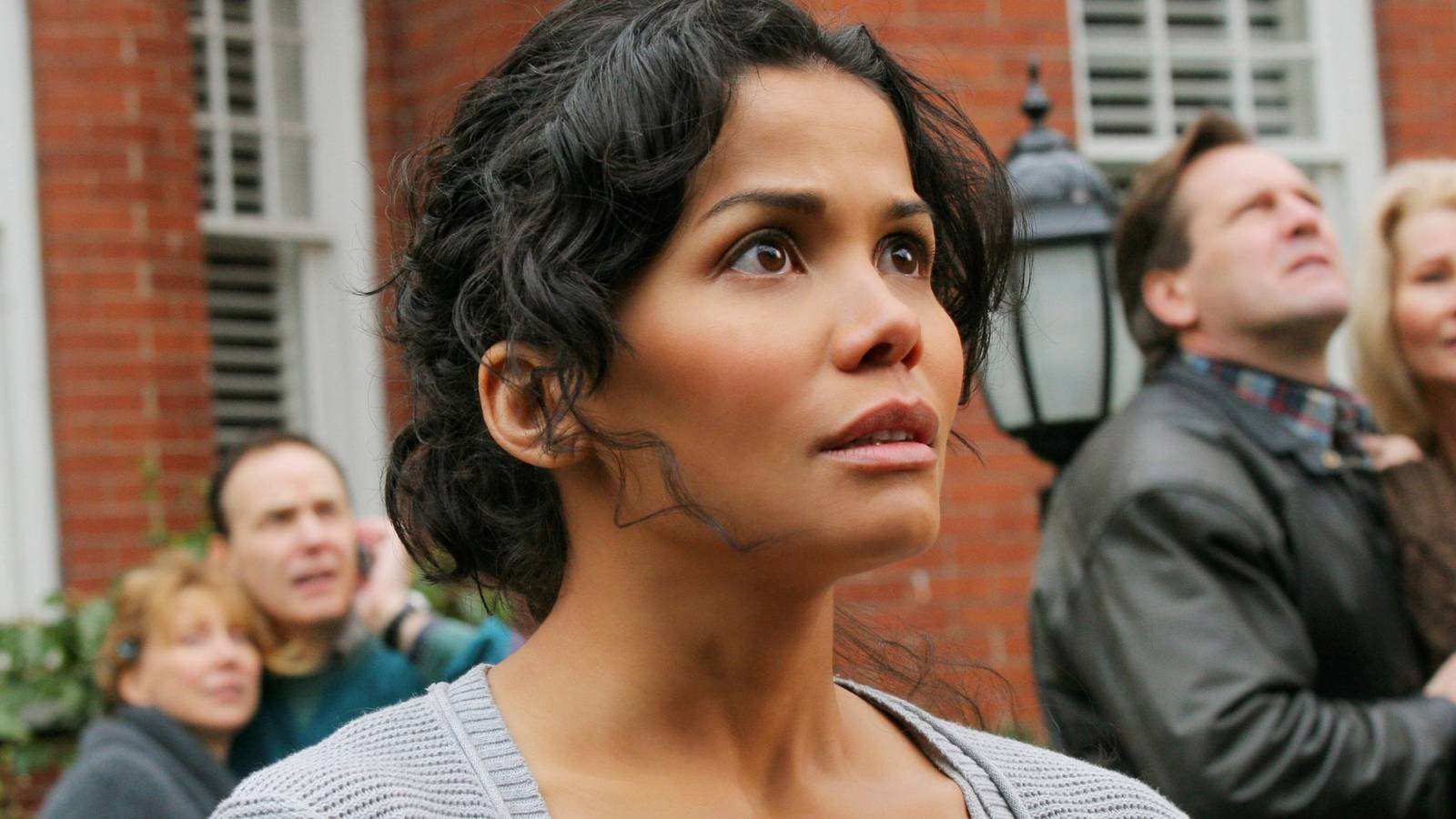
Image via David Gray/Everett Collection Published Sep 23, 2026, 12:37 PM EDT Michael John Petty is a Senior Author for Collider who spends his days writing, in fellowship with his local church, and enjoying each new day with his wife and daughters. At Collider, he writes features, reviews, recaps, and conducts interviews. In addition to writing about stories, Michael has told a few of his own. His novella, The Beast of Bear-tooth Mountain, was released in 2023. His Western short story, The Devil's Left Hand, received the Spur Award for "Best Western Short Fiction" from the Western Writers of America in 2025. Michael currently resides in North Idaho with his growing family. Sign in to your Collider account If you're looking for a quick sci-fi series to binge this fall, the 2009 V reboot is available to stream for free on Tubi in the U.S. Following the reveal that we are not alone in the universe after all, V begins with the mysterious Visitors arriving on Earth with the outward intent of helping humanity achieve its full potential — but inwardly they intend to literally devour us whole. Starring Elizabeth Mitchell, Morena Baccarin, Morris Chestnut, and Laura Vandervoort, this two-season ABC series is full of alien conspiracies, thrilling sci-fi action, and family drama that will break your heart. 'V' Rebooted the Original '80s Classic for the 21st Century If V sounds familiar, but you're not sure if that's because you saw it a decade ago or sometime in the '80s, it's probably because the 2009 series is a reboot of the original. What started as two separate miniseries in the early 1980s grew into a short-lived, full-length series that aired on NBC. But after 25 years off the air, ABC decided it was time to give V another shot, albeit with a new cast (mostly) and a modernized take that brought the property firmly into the 21st century. Developed by Scott Peters based on Kenneth Johnson's original premise, the 2009 V kicked off with a bang, introducing the Visitors to the world via and pitting two mothers against one another for the survival of their respective races. Collider Exclusive · Sci-Fi Survival Quiz Which Sci-Fi World Would You Survive? The Matrix · Mad Max · Blade Runner · Dune · Star Wars Five universes. Five completely different ways the future went wrong — or sideways, or up in flames. Only one of them is the world your instincts were built for. Eight questions will figure out which dystopia, galaxy, or desert wasteland you'd actually make it out of alive. 💊The Matrix 🔥Mad Max 🌧️Blade Runner 🏜️Dune 🚀Star Wars TEST YOUR SURVIVAL → 01 You sense something is deeply wrong with the world around you. What do you do? The first instinct is often the truest one. APull on every thread until I understand the system — then figure out how to break it. BStop asking questions and start stockpiling — food, fuel, weapons. Questions don't keep you alive. CKeep my head down, observe carefully, and trust no one until I know who's pulling the strings. DStudy the patterns. Every system has a rhythm — learn it, and you learn how to survive it. EFind the people fighting back and join them. You can't fix a broken galaxy alone. NEXT QUESTION → 02 In a world of scarcity, what resource do you guard most fiercely? What we protect reveals what we believe survival actually requires. AKnowledge. If you understand the system, you don't need resources — you can generate them. BFuel. Everything else — movement, power, escape — runs on it. CTrust. In a world of fakes and informants, a truly reliable ally is rarer than any commodity. DWater. And after water, information — the two things empires are truly built on. EShips and credits. The galaxy is big — you survive it by being able to move through it freely. NEXT QUESTION → 03 What kind of threat keeps you up at night? Fear is useful data — if you're honest about what you're actually afraid of. AThat reality itself is a lie — that everything I experience has been constructed to keep me compliant. BA raid. No warning, no mercy — just the roar of engines and then nothing left. CBeing identified. Once someone with power decides you're a problem, you're already out of time. DBeing outmanoeuvred — losing a political game I didn't even know I was playing. EThe Empire tightening its grip until there's nowhere left to run. NEXT QUESTION → 04 How do you deal with authority you don't trust? Every dystopia has a power structure. Your approach to it determines everything. ASubvert it from the inside — learn its rules well enough to weaponise them against it. BIgnore it and stay out of its reach. The further from any power structure, the better. CAppear to comply while doing exactly what I need to do. Visibility is the enemy. DManoeuvre within it carefully. You can't beat a system you refuse to understand. EResist openly when I have to. Some things are worth the risk of being seen. NEXT QUESTION → 05 Which environment could you actually endure long-term? Survival isn't just tactical — it's physical, psychological, and very much about where you are. AUnderground bunkers and server rooms — cramped, artificial, but with access to everything that matters. BOpen wasteland — brutal sun, no shelter, constant movement. At least the threat is honest. CA dense, rain-soaked city where you can disappear into the crowd and nobody asks questions. DMerciless desert — extreme heat, no water, and something enormous living beneath the sand. EThe fringe — backwater planets and busy spaceports where the Empire's attention rarely reaches. NEXT QUESTION → 06 Who do you want in your corner when things fall apart? The company you keep is the clearest signal of who you actually are. AA tight crew of believers who've seen behind the curtain and have nothing left to lose. BOne or two people I'd trust with my life. Any more than that and someone talks. CNobody, ideally. Alliances are liabilities. I work alone unless I have no choice. DA community bound by shared hardship and mutual survival — people who need each other to last. EA ragtag team with wildly different skills and total commitment when it counts. NEXT QUESTION → 07 Where do you draw the line — if you draw one at all? Every survivor eventually faces a moment that tests what they're actually made of. AI won't harm the innocent — even the ones who'd report me without hesitation. BI do what I have to to protect the people I've chosen. Everything else is negotiable. CThe line shifts depending on who's asking and what's at stake. DI draw a long-term line — nothing that compromises my people's future, even if it'd help now. ESome lines, once crossed, can't be uncrossed. I know which ones they are. NEXT QUESTION → 08 What would actually make survival worth it? Staying alive is one thing. Having a reason to is another. AWaking others up — dismantling the illusion so no one else has to live inside it. BFinding somewhere — or someone — worth protecting. A reason to keep moving. CAnswers. Understanding what I am, what any of this means, before time runs out. DLegacy — shaping the future in a way that outlasts me by generations. EFreedom — for myself, for others, for every world still living under someone else's boot. REVEAL MY WORLD → Your Fate Has Been Calculated You'd Survive In…Your answers point to the world your instincts were built for. This is the universe your temperament, your survival instincts, and your particular brand of stubbornness were made for. The MatrixYou took the red pill a long time ago — probably before anyone offered it to you. You're a systems thinker who can't help but notice the seams in things. You're drawn to understanding how the system works before figuring out how to break it. You'd find the Resistance, or it would find you — your instinct for spotting constructed realities is the machines' worst nightmare. You function best when you have access to information and the freedom to act on it. The Matrix built an airtight prison. You'd be the one probing the walls for the door. Mad MaxThe wasteland doesn't reward the clever or the well-connected — it rewards those who are hard to kill and harder to break. That's you. You don't need comfort, community, or a cause larger than the next horizon. You need a vehicle, a clear threat, and enough fuel to outrun it — and you're good at all three. You are unsentimental enough to survive that world, and decent enough — just barely — to be something more than another raider. In the wasteland, that distinction is everything. Blade RunnerYou'd survive here because you know how to exist in moral grey areas without losing yourself completely. You read people accurately, keep your circle small, and ask the questions others prefer not to answer. In a city where humanity is a legal designation rather than a feeling, you hold onto something that keeps you functional. You're not a hero. But you're not lost, either. In Blade Runner's world, that distinction is everything. DuneArrakis is the most hostile environment in the known universe — and you are precisely the kind of person it rewards. Patience, discipline, and political awareness are your core strengths — and on Arrakis, they're survival tools. You understand that the long game matters more than any single victory. Others come to Dune and are consumed by it. You'd learn its logic and earn its respect. In time, you wouldn't just survive Arrakis — you'd begin to reshape it. Star WarsThe galaxy far, far away is vast, loud, and in a constant state of violent political upheaval — and you wouldn't have it any other way. You find meaning in being part of something larger than yourself — a cause, a crew, a rebellion. You'd gravitate toward the Rebellion, or the fringes, or whatever pocket of the galaxy still believes the Empire's grip can be broken. You fight — not because you have to, but because standing aside isn't something you're capable of. In Star Wars, that willingness is what makes all the difference. ↻ RETAKE THE QUIZ After the lizard-like Visitors spent decades infiltrating human society (wearing human flesh to conceal their true visage), the world now knows there is more out there beyond the stars. Morena Baccarin plays the Visitor leader Anna, whose daughter Lisa (played by the stunning Vandervoort) has fallen in love with a human, Tyler Evans (Logan Huffman), the son of FBI counterterrorism agent Erica Evans (Mitchell), who isn't quite buying the story the Visitors are selling. In many respects, the heart of the V reboot concerns the warring tensions between two mothers as they navigate their children's romance that represents the potential coupling of their respective peoples. But this is more than just your typical family drama with a sci-fi tinge, as V also meditates on the resistance fighters who believe that the Visitors aren't there to help humanity, but rather to consume and enslave it. In the first episode, Erica meets a local priest by the name of Father Jack Landry (Joel Gretsch) after they both begin to suspect there's more to these "alien saviors" than meets the eye. After an anti-Visitor meeting is attacked by the alien overlords, the pair quickly fall in with Ryan Nichols (Chestnut), a Visitor posing as a human who works with a resistance group called the Fifth Column. As the series progresses, Erica and the Fifth Column do their best to take down Anna and her operation from the inside, while characters like TV news anchor Chad Decker (Scott Wolf) wax poetic about the good the Visitors are doing, thus doing the reptilians' work for them. For two seasons, this 22-episode series pushed the boundaries of what network television could achieve as far as weekly science fiction was concerned, but V was perhaps most notable because of the controversy it drew from critics... Image via ABC Despite being a straightforward "humans vs. aliens" sci-fi drama with roots that stemmed back to the original 1983 miniseries, V was thought to be "too political" by many critics. The series premiered on November 3, 2009, and while that date may not seem significant, some have pointed out that V hit TV screens a year to the day after the election of Barack Obama into office as the 44th President of the United States. Coupled with the Visitor's language of "hope" and "change," as well as their desire to bring "universal health care" to the human masses, we can see how some may have read into V a bit too deeply. In a post-9/11 world, it became harder not to read politics into something as simple as an alien invasion drama, and so many considered V to be an allegorical take on Obama's presidency. To that point, Glenn Garvin of the Chicago Tribune wrote that, "Nominally a rousing sci-fi space opera about alien invaders bent on the conquest (and digestion) of all humanity, [V is] also a barbed commentary on Obamamania that will infuriate the president's supporters and delight his detractors." But whether you believe these parallels were a stretch or right on the money, it didn't affect the result. After all, the show was in development during George W. Bush's presidency, and the original V itself was a product of the tail end of the Cold War. One can always read modern politics into modern art (indeed, we all read into stories what we wish to see or believe to be seeing in them), but that does not necessarily mean that was the intent of those crafting the narrative. In the end, no one was truly furious one way or another about V, unless you count those disappointed that one of their most beloved sci-fi shows had been rebooted at all. The critical upheaval aside, series developer Scott Peters made it clear that there was no political angle at all when creating the 2009 reboot. "Shows are open to interpretation," he explained at the Summer TV Press Tour 2009, as reported by The Washington Post. "People bring subjective thoughts to it... but there is no particular agenda." To Peters, it didn't terribly matter how people interpreted what they saw on V, as folks on both sides of the political aisle would likely relate on some level. It's no wonder that there are also strong parallels to John Carpenter's They Live (which was also controversially interpreted by critics) early on in the series. "People will bring to it what they bring to it," he added. "If one group wants to claim it as their show and another group wants to claim it as their show, that's their prerogative." In the end, V was a show about the collective rebellion of humanity against alien forces that wanted to annihilate them. Science fiction is hardly more unifying than that. 'V' Was Tragically Cancelled Before It Could Receive a Proper Conclusion Politics aside, the real tragedy of the 2009 V series was that it ended so abruptly. Like many shows of this era that ended on cliffhangers after only two seasons — such as Terminator: The Sarah Connor Chronicles, Alphas, and Jericho, to name only a few — V was axed by ABC two months after its impromptu series finale due to steadily declining ratings. While the second season brought in familiar V faces from the original series to take on new roles — with Marc Singer playing Project Aries head Lars Tremont and Jane Badler reprising her role as the Visitor leader Diana, albeit a reinterpreted take — it wasn't enough to pull audiences in and garner continued support. It's a shame too, because V maintained a consistent level of quality throughout, proving once again that network television ought to give sci-fi more of a chance. Still, the good news is that all 22 episodes of V are available to stream for free on Tubi in the U.S. If you haven't had the chance to give this one a go, now is the perfect time. For those searching for a quick sci-fi series to binge this fall that will have you furious it was canceled on a cliffhanger, give ABC's V reboot a shot. With engaging characters, a real-world feel, and plenty of extraterrestrial conspiracies to go around, you won't be able to get enough. Who knows, maybe watching the reboot will send you back further in time to the original miniseries and its offshoots. This is one underrated sci-fi franchise that deserves more love. Release Date 2009 - 2011-00-00 Network NBC Showrunner Kenneth Johnson Directors Kenneth Johnson Writers Scott Peters, Kenneth Johnson
The 2000s’ Most Divisive Sci-Fi Show Is Officially Free To Stream This Weekend
Full Article
Original Source
Read the full article at Collider →KhanList aggregates and links to publicly available news content. We do not host full articles from third-party sources. Always verify important information with original sources.