
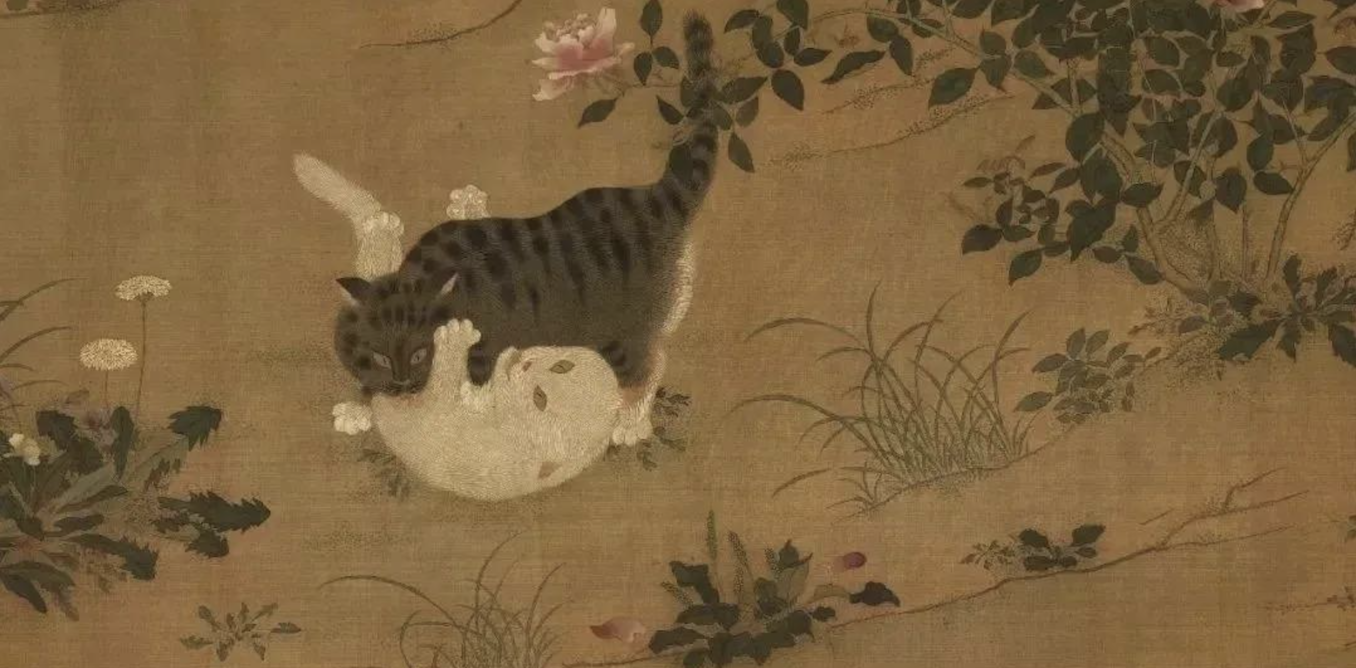
If you’re reading this, then your media feed, like mine, is probably full of cats. That’s hardly surprising. The internet has always belonged to cats, which suits me just fine: I love cats and live with four of them. But in one of the classes I’ve taught, “Cats: Why We Love Them,” I explain how our affection for the house cat, Felis silvestris catus, is a relatively recent phenomenon in the scope of human history. In many parts of the world, cats were viewed with suspicion and subjected to terrible mistreatment. Of course, the ancient Egyptians loved cats – this can be seen in sculptures, paintings and even mummified cat remains. Meanwhile, premodern poets, writers and artists were among the first to wonder about the inner lives of cats – and to explore how caring for them might expand our capacity for empathy. One of the earliest literary accounts of a cat is the ninth-century poem “Pangur Bán,” written by an unnamed Irish monk. In the poem, he describes the parallels between his devotion to hunting for meaning in the texts he is studying and the cat’s devotion to hunting mice. What’s interesting about the poem is how the anonymous poet sees the cat as possessing qualities that resemble human qualities – and, in doing so, implicitly suggests that cats have dignity much like human dignity. The monk does not set himself above the cat in some great hierarchy of life, but instead places himself alongside the cat as peers in their dedicated practices. Lu You’s cat The Chinese poet and historian Lu You. Wikimedia Commons In the 12th century, the Chinese poet Lu You composed over 9,000 poems. A handful were about his cats, and of these, three are entitled “Zeng mao,” or “Presented to My Cat.” It’s not clear if the poems are all about the same cat, as Lu had more than one cat over his lifetime. In Chinese literature, poems that include the term “zeng” – “to present” – are often sent to acquaintances as a form of literary exchange. Prior to Lu, there’s no literary evidence that anyone had addressed a poem to a cat. In the first poem, Lu begins by explaining that he acquired a cat to protect his library from vermin. Looking around his home, he feels embarrassed by his lack of success in life: I’m ashamed that I’m poor and my achievements few, When you’re cold there’s no rug, when I feed you there’s no fish. In the second of these poems, a longer eight-line poem, the poet accuses his cat of poor feline behavior familiar even today: You frequently get drunk from catnip, You commandeer the blanket every night. But he follows with praise for the cat’s achievements: Deeds of the mousehole – just now recounted, Rewards of fish morsels – how could these be omitted? He ends by naming the cat: Still, I should give you a name, I’ll call you “Little Tiger.” Lu chooses a name that probably was given to countless cats in premodern China. But by ending the poem with the act of naming, he is emphasizing how this cat is an individual to him, known to him by this name and none other. Poet and cat, late in life The relationship that Lu depicts between cat and human will be familiar to anyone who has fought with their cat over who gets the blanket or wondered what their cat might be thinking. The third poem, translated here in full, finds the cat late in its life, with its days chasing mice long behind it. Its poignancy is amplified by the fact that Lu composed it in the last year of his own life: As for catching mice you lack merit, but I never complain, A ladle of fish and rice will come at the usual time. Throughout the day I see you sleeping peacefully, So why am I always coming and going? Lu sees himself through the bemused eyes of the cat, who’s perhaps wondering why this foolish old man is rushing to and fro, fulfilling goals and seeking praise, when he might just be satisfied with what he already has. And despite his cat’s indolence, Lu continues to cherish his feline, making sure to regularly serve its dinner. This is significant, given that other premodern Chinese writers viewed cats primarily as vermin-catchers that should be replaced once they outlive their usefulness. ‘Monkey and Cats,’ an 11th-century silk painting by the Chinese painter Yi Yuanji. National Palace Museum/Wikimedia Commons Personhood and care Imagining oneself as a pampered cat will be familiar to those of us who live with cats – a thought-experiment that is tinged with more than a little envy for the capacity to live in the moment, without anxiety over the future. Lu’s care for his cat affords him the possibility of imagining a nonhuman animal mind. The poet learns something from his cat in the end, as he imagines the world through the cat’s eyes and, in doing so, perhaps finds a measure of solace. Lu does not speak in the language of what philosophers call moral personhood. He is not reflecting on the broader ethical question of which creatures deserve to be treated with care and respect. But I argue that his actions nonetheless demonstrate how he treats his cat as somewhat of an equal. This can be seen, not least of all, by how he addresses poems to his cat, an act of social exchange that was heretofore reserved for literary interactions with other human beings. Personhood – the recognition of an individual as deserving of dignity – is often assumed the sole province of human beings. But philosopher María Puig de la Bellacasa has promoted a worldview that she calls “more than human thinking,” which urges people to broaden their scope of moral concern, and in this way, enlarge human capacities for care and love. The philosopher Lori Gruen similarly conceives of an “entangled empathy,” calling attention to the complex relational intimacies that bind human and nonhuman animals together. They insist that human lives are better when the sphere of care and concern is extended to those creatures with whom human lives are entangled. Born in the 12th century, Lu You could not be expected to argue for animal rights. But he clearly understands that his cat has claims to happiness, pleasure, comfort and companionship, and that while the cat might see the world differently than he does, that doesn’t diminish its claim to empathy and love.
The 12th-century Chinese poet who was among the first to explore the inner lives of cats
Full Article
Original Source
Read the full article at Theconversation →KhanList aggregates and links to publicly available news content. We do not host full articles from third-party sources. Always verify important information with original sources.