
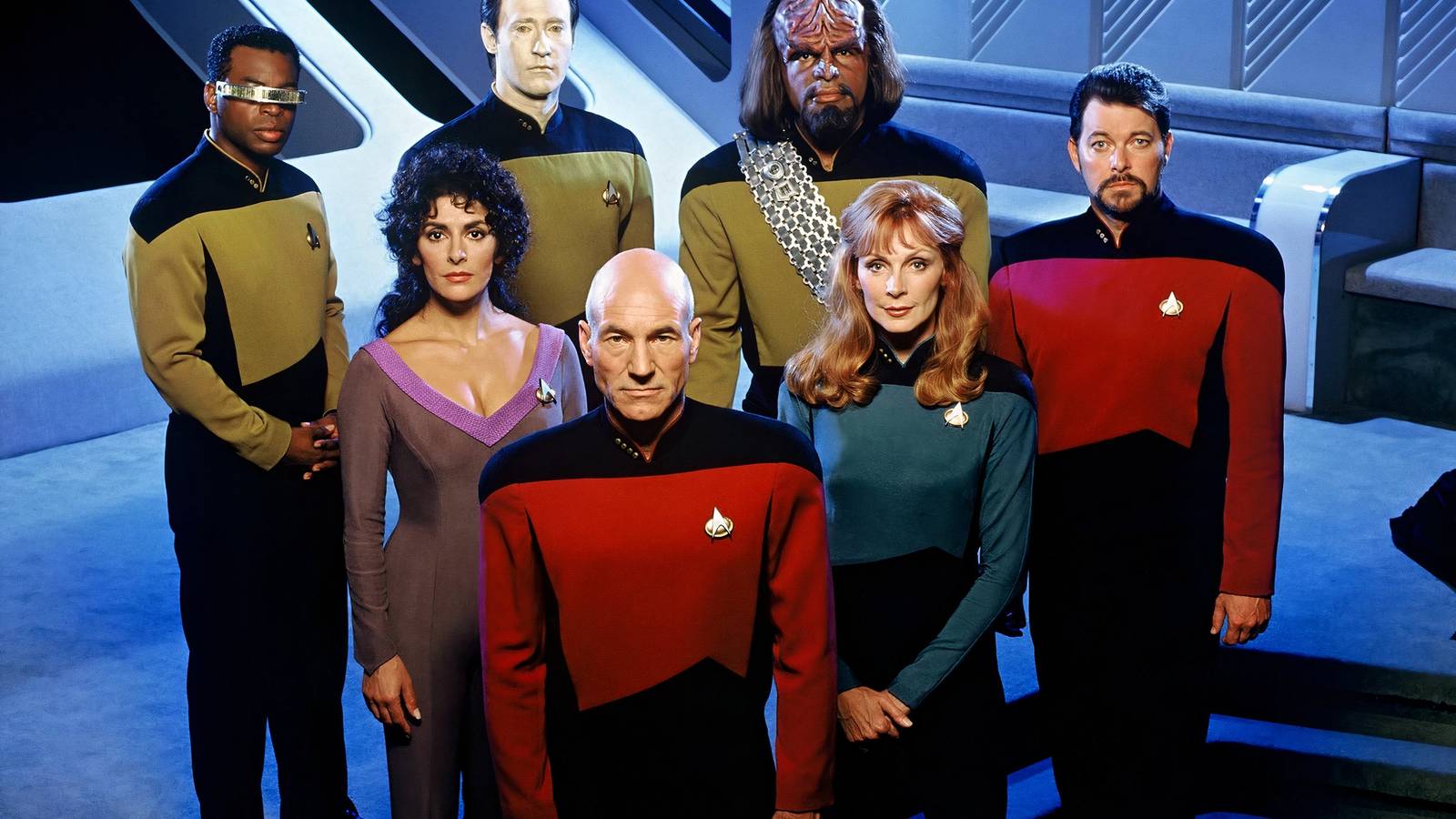
One of the great things about Star Trek: The Next Generation is that you never quite knew what kind of adventure you were going to get. One week, the Enterprise might be facing an enemy capable of destroying the Federation. The next, Captain Picard could be living an entire lifetime on an alien planet. And occasionally, Worf would find himself dressed as one of Robin Hood's Merry Men, looking like he'd rather be anywhere else in the galaxy. That variety was part of the show's appeal. Over seven seasons, The Next Generation could deliver thrilling science-fiction adventures, tackle complicated moral questions, and occasionally make viewers laugh out loud. But what made the series special wasn't just the stories. It was the characters and the relationships that developed among them, giving even the most far-fetched adventures a human connection. Nearly 40 years after its premiere, the best episodes remain just as enjoyable to revisit. Some are remembered for their ambitious ideas, others for a particular performance, a heartbreaking moment or a perfectly delivered line. Not every episode on this list is flawless, but each has something that makes it unforgettable. And that's a pretty good measure of great Star Trek. 10 "Cause and Effect" (season 5, episode 18) Paramount Few Star Trek episodes grab your attention like "Cause and Effect," which opens with the Enterprise exploding. The crew is trapped in a temporal loop that repeatedly ends in the ship's destruction, with each cycle offering clues that something isn't right. The episode is a wonderfully constructed science-fiction mystery, cleverly using the crew's regular poker game to help solve it. When Data begins dealing threes, the cards become a crucial clue to breaking the cycle. And just when the Enterprise finally escapes, Kelsey Grammer makes a surprise appearance as the captain of another Starfleet vessel. It's a terrific final twist in an episode that rewards repeat viewings. 9 "Qpid" (season 4, episode 20) Paramount Star Trek doesn't always get enough credit for its humor, and "Qpid" is one of the best examples of how funny The Next Generation can be. When Q (John de Lancie) interferes with Picard's relationship with Vash (Jennifer Hetrick), he transports the Enterprise's senior officers into a Robin Hood adventure, with Picard playing the legendary outlaw. The premise is delightfully ridiculous, but the cast makes it work. Worf (Michael Dorn) is particularly miserable in his new role, declaring, "I am not a merry man!" It's one of the funniest lines in Star Trek history and a reminder that the franchise doesn't always need to take itself seriously to deliver a memorable episode. 8 "Yesterday's Enterprise" (season 3, episode 15) Paramount When the Enterprise-C emerges from a temporal rift, history changes instantly. The Enterprise-D becomes a warship, the Federation is losing a conflict with the Klingons, and Tasha Yar (Denise Crosby) is alive again. Only Guinan (Whoopi Goldberg) senses something is wrong, leaving Picard to decide whether restoring the timeline is worth sacrificing another starship. "Yesterday's Enterprise" is one of TNG's finest alternate-reality stories, showing how dramatically familiar characters change under different circumstances. Its greatest achievement, however, is giving Yar a more satisfying farewell after her abrupt death in season 1. It's a moving exploration of courage, duty and sacrifice. 7 "Time's Arrow, Parts I and II" (season 5, episode 26; season 6, episode 1) Paramount The discovery of Data's severed head in a San Francisco archaeological excavation launches one of TNG's most entertaining time-travel adventures. The mystery sends Data into the 19th century, where he encounters Samuel Clemens, better known as Mark Twain (Jerry Hardin). Meanwhile, the Enterprise crew investigates mysterious aliens traveling through time to prey on humans. The episodes offer an irresistible combination of science-fiction mystery and historical adventure. Hardin's exaggerated portrayal of Twain is especially entertaining as the suspicious author tries to understand Data and his fellow visitors from the future. Add Guinan's unexpected connection to the past, and it's an imaginative, enormously rewatchable adventure. 6 "The Measure of a Man" (season 2, episode 9) Paramount One of TNG's earliest masterpieces, "The Measure of a Man," places Data's future in jeopardy when Starfleet cyberneticist Bruce Maddox (Brian Brophy) seeks to dismantle him for research. When Data refuses, a hearing determines whether he has the right to make that decision or is simply Starfleet property. What follows is some of Star Trek's most thoughtful storytelling. Rather than offering easy answers about artificial intelligence, the episode examines consciousness, individual rights and the dangers of treating sentient beings as objects. Stewart is particularly compelling as Picard argues that Data deserves the freedom to determine his own existence. Decades later, those questions feel more relevant than ever. 5 "All Good Things..." (season 7, episode 25) Paramount Ending a beloved television series is never easy, but The Next Generation delivers one of science fiction's most satisfying finales. Picard finds himself shifting between three periods of his life, attempting to solve a mystery involving an anomaly that threatens humanity's existence. Naturally, Q is involved. The finale celebrates everything that makes TNG special, but its most memorable moment is also its simplest. After years of maintaining a professional distance from his officers, Picard finally joins their regular poker game. Those games have become a familiar tradition throughout the series, making his decision to sit down at the table a beautiful farewell to the crew and the audience. 4 "Darmok" (season 5, episode 2) Paramount Communication is central to Star Trek's vision of the future, but "Darmok" presents one of the franchise's most ingenious obstacles. When the Enterprise encounters the Tamarians, a species whose language consists entirely of references to stories and metaphors, even the universal translator proves inadequate. Picard must learn to communicate with a Tamarian captain named Dathon (Paul Winfield) while the two face a dangerous creature. The brilliance of "Darmok" lies in its deceptively simple premise. Stewart and Winfield deliver terrific performances as their characters gradually develop an understanding through shared danger and experience. "Darmok and Jalad at Tanagra" has become one of Star Trek's most recognizable phrases, a testament to an episode celebrating the power of communication. 3 "The Inner Light" (season 5, episode 25) Image: Paramount An alien probe renders Picard unconscious, and when he awakens, he finds himself living as a man named Kamin on a distant planet. Although Picard initially insists he's a Starfleet captain, he gradually accepts his new life, building a family, growing old and experiencing decades of happiness and heartbreak. What's remarkable about "The Inner Light" is how little it resembles a typical Star Trek adventure. There are no space battles, threatening aliens or desperate attempts to save the Enterprise. Instead, the episode asks viewers to become invested in an ordinary life unfolding over decades. Patrick Stewart makes every stage of that journey believable, turning what could have been a clever science-fiction gimmick into one of the series' most affecting stories. It's an episode that proves just how much The Next Generation could accomplish without firing a single phaser. 2 "The Best of Both Worlds, Parts I and II" (season 3, episode 26; season 4, episode 1) Paramount The Enterprise crew gets its first terrifying glimpse of the Borg in season 2's "Q Who," but "The Best of Both Worlds" makes the threat frighteningly personal. Picard is captured and transformed into Locutus, a spokesperson for the collective. With his captain serving the enemy, Riker (Jonathan Frakes) must take command and make a decision that could determine the Federation's fate. The first part ends with one of television's greatest cliffhangers as Riker orders the Enterprise to fire on the Borg ship, knowing Picard is aboard. The resolution establishes consequences that continue shaping Picard for years afterward. Beyond the suspense, the two-parter demonstrates that even Star Trek's most capable captain isn't invulnerable. 1 "Tapestry" (season 6, episode 15) Paramount After Picard suffers a potentially fatal injury, he awakens to find Q waiting for him in what appears to be the afterlife. Q offers him the opportunity to revisit a youthful mistake: the confrontation that results in Picard being stabbed through the heart. Picard changes the past, only to discover the consequences are far more significant than he imagined. "Tapestry" brilliantly explores regret and the experiences that shape who we become. By removing the impulsive decisions of his youth, Picard also erases the ambition and willingness to take risks that define him. Stewart and de Lancie balance humor with genuine emotion as Picard confronts an uncomfortable question: If we could eliminate our greatest mistakes, would we still be the same people? It's The Next Generation at its best.
The 10 Best Star Trek: The Next Generation Episodes, Ranked
Full Article
Original Source
Read the full article at Polygon →KhanList aggregates and links to publicly available news content. We do not host full articles from third-party sources. Always verify important information with original sources.