
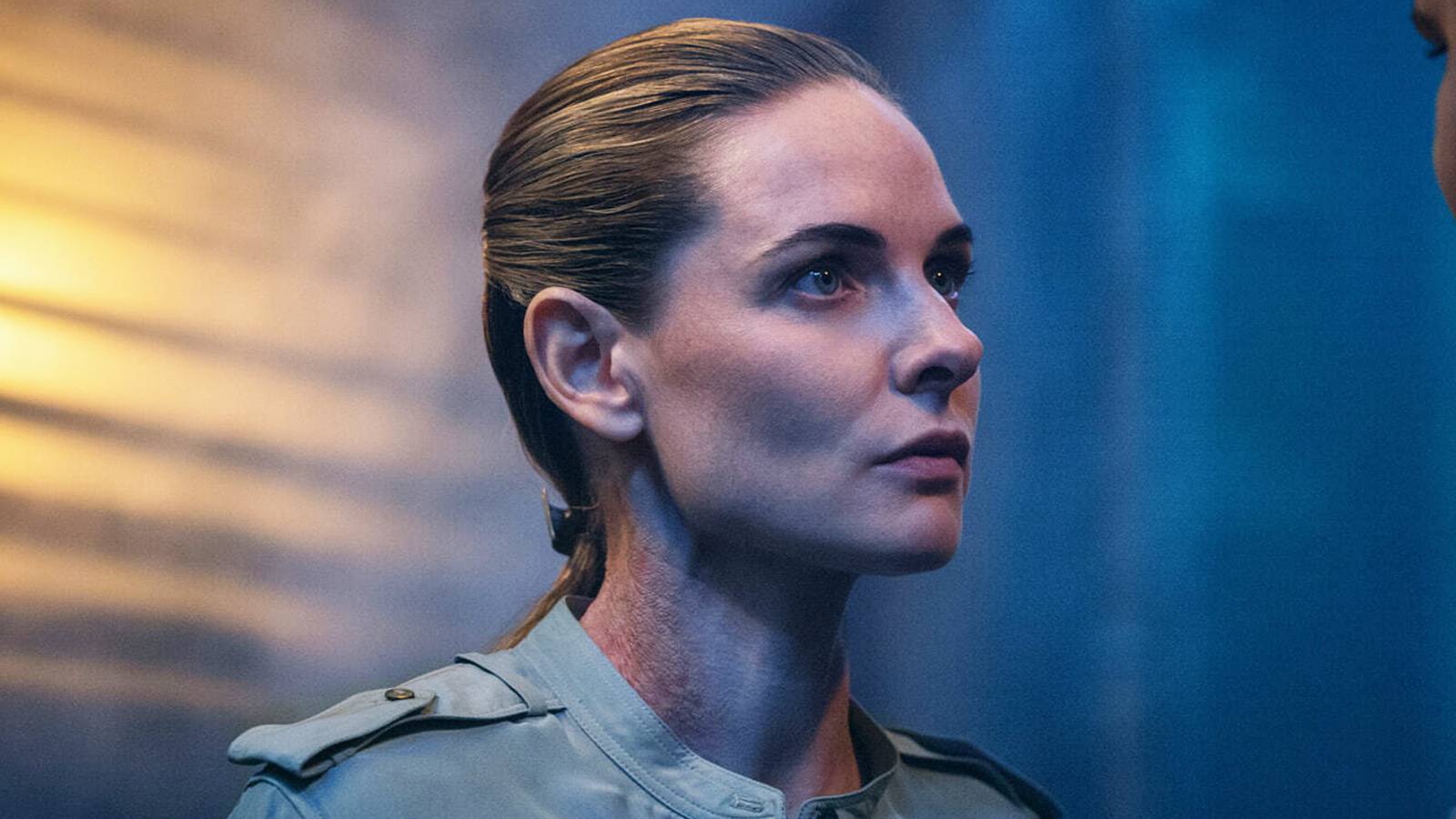
Image via Apple TV Published Aug 28, 2026, 7:22 AM EDT Diego Pineda has been a devout storyteller his whole life. He has self-published a fantasy novel and a book of short stories, and is actively working on publishing his second novel. A lifelong fan of watching movies and talking about them endlessly, he writes reviews and analyses on his Instagram page dedicated to cinema, and occasionally on his blog. His favorite filmmakers are Andrei Tarkovsky and Charlie Chaplin. He loves modern Mexican cinema and thinks it's tragically underappreciated. Other interests of Diego's include reading, gaming, roller coasters, writing reviews on his Letterboxd account (username: DPP_reviews), and going down rabbit holes of whatever topic he's interested in at any given point. Sign in to your Collider account The thing that has kept science fiction as one of television's most popular and prolific genres is the fascinating ways in which it can hold a mirror to contemporary society. Indeed, sci-fi is often at its best when it's making some kind of comment on the outlook of humanity's future—and remarkably often, that outlook isn't a particularly optimistic one. Several of the greatest science fiction TV shows in history, from modern classics like Battlestar Galactica to ongoing masterpieces like The Last of Us, are all about the doom of humanity. There are many ways in which that doom can manifest itself, whether it's in the form of an apocalyptic event or a tragic conclusion. Regardless, these are series which prove why sci-fi is still one of the small screen's most beloved genres. 10 'The 100' (2014–2020) Image via The CW Thanks to the popularity of book series like Harry Potter, Twilight, and The Hunger Games, the Young Adult genre saw a huge boom in popularity throughout the 2000s and 2010s, a boom that soon enough injected itself into the screen as well. From this wave of popularity came the CW's The 100, an adaptation of Kass Morgan's novel series that's every bit as great as the source material. It's one of those obscure sci-fi shows that became cult classics, as well as one of the network's best and most mature Young Adult shows. It's the sort of series that keeps growing darker and more complex as it goes on, through it all daring to ask the question of whether humanity's hunger for survival is inherently tribal and violent. At the core of it all, however, lies a level of empathy not often seen in post-apocalyptic series like this one. 9 '3 Body Problem' (2024–Present) Image via Netflix After the absolute disaster that was the Game of Thrones finale, no one knew what to expect next from David Benioff and D. B. Weiss. Thankfully, what came next was 3 Body Problem, which they co-created with Alexander Woo. Based on the Chinese novel Remembrance of Earth's Past by Liu Cixin, one of the most perfectly written hard sci-fi books ever, it's one of the best ongoing science fiction shows on streaming. There are very few examples of a "doomed humanity" sci-fi show than 3 Body Problem, a show about humanity having centuries to prepare for an alien invasion without really knowing exactly what they'll be up against. It's a premise that generates inevitable existential dread in the viewer, resulting in a real gem of a show whose second season cannot possibly come soon enough. 8 'The Last of Us' (2023–Present) Image via HBO Naughty Dog's The Last of Us isn't only one of the most universally acclaimed and beloved video games of all time, but also one of the most groundbreaking and important. As such, expectations for HBO's small-screen adaptation of the franchise were through the roof. In the end, though the show didn't end up being quite as flawless as the games it was based on, it's still one of the best sci-fi shows of the 2020s thus far. Rather than sticking to the usual tired tropes of zombie fiction, The Last of Us constantly subverts audiences' expectations in how it depicts this cataclysmic infection and its effects on humanity. But though the series constantly makes it clear that humanity is doomed and likely stuck living around infected for the rest of time, it also shows the beauty of the love, family, and hope that can still be found even in such a fearsome post-apocalyptic world. 7 'Fallout' (2024–Present) Image via Prime Video For the longest time, video game movie and television adaptations had a reputation that was, at best, dodgy. That has started to change throughout the 2020s, all thanks to shows as exceptional as Fallout, one of the best TV series based on video games. The eponymous RPG franchise is one of the most successful in the history of gaming, making the fact that this adaptation managed to live up to its source material's legacy all the more impressive. The Fallout games aren't just about survival, but more pointedly about humanity's vicious cycle of violence and self-destruction. Much like the games, the show explores how greed and thirst for power can ruin the world, contrasting it with how community and resilience can help bring it back to life. It's a powerful, emotionally stirring conflict of ideals that drives the show's entire narrative. 6 '12 Monkeys' (2015–2018) Image via Syfy Back in 1995, Terry Gilliam of Monty Python fame directed Twelve Monkeys, an adaptation of the avant-garde short film La Jetée. It was a critical and commercial success, and has since aged beautifully not just as one of the biggest sci-fi cult classics of 1990s cinema, but even as one of the most beloved time travel movies ever made. Exactly 20 years later came Syfy's 12 Monkeys, an adaptation of the movie that has likewise aged like fine wine. It's one of the most perfect shows with exactly four seasons, nothing short of one of the most underrated sci-fi series of the 21st century thus far. What makes this such a fascinating "doomed humanity" sci-fi series is the way it toys around with the idea of time loops and predestination. Aside from its philosophical complexity, it's a way of writing a time travel narrative which makes more sense than most other shows the genre has ever seen. Collider Exclusive · Sci-Fi Survival Quiz Which Sci-Fi World Would You Survive? The Matrix · Mad Max · Blade Runner · Dune · Star Wars Five universes. Five completely different ways the future went wrong — or sideways, or up in flames. Only one of them is the world your instincts were built for. Eight questions will figure out which dystopia, galaxy, or desert wasteland you'd actually make it out of alive. 💊The Matrix 🔥Mad Max 🌧️Blade Runner 🏜️Dune 🚀Star Wars TEST YOUR SURVIVAL → 01 You sense something is deeply wrong with the world around you. What do you do? The first instinct is often the truest one. APull on every thread until I understand the system — then figure out how to break it. BStop asking questions and start stockpiling — food, fuel, weapons. Questions don't keep you alive. CKeep my head down, observe carefully, and trust no one until I know who's pulling the strings. DStudy the patterns. Every system has a rhythm — learn it, and you learn how to survive it. EFind the people fighting back and join them. You can't fix a broken galaxy alone. NEXT QUESTION → 02 In a world of scarcity, what resource do you guard most fiercely? What we protect reveals what we believe survival actually requires. AKnowledge. If you understand the system, you don't need resources — you can generate them. BFuel. Everything else — movement, power, escape — runs on it. CTrust. In a world of fakes and informants, a truly reliable ally is rarer than any commodity. DWater. And after water, information — the two things empires are truly built on. EShips and credits. The galaxy is big — you survive it by being able to move through it freely. NEXT QUESTION → 03 What kind of threat keeps you up at night? Fear is useful data — if you're honest about what you're actually afraid of. AThat reality itself is a lie — that everything I experience has been constructed to keep me compliant. BA raid. No warning, no mercy — just the roar of engines and then nothing left. CBeing identified. Once someone with power decides you're a problem, you're already out of time. DBeing outmanoeuvred — losing a political game I didn't even know I was playing. EThe Empire tightening its grip until there's nowhere left to run. NEXT QUESTION → 04 How do you deal with authority you don't trust? Every dystopia has a power structure. Your approach to it determines everything. ASubvert it from the inside — learn its rules well enough to weaponise them against it. BIgnore it and stay out of its reach. The further from any power structure, the better. CAppear to comply while doing exactly what I need to do. Visibility is the enemy. DManoeuvre within it carefully. You can't beat a system you refuse to understand. EResist openly when I have to. Some things are worth the risk of being seen. NEXT QUESTION → 05 Which environment could you actually endure long-term? Survival isn't just tactical — it's physical, psychological, and very much about where you are. AUnderground bunkers and server rooms — cramped, artificial, but with access to everything that matters. BOpen wasteland — brutal sun, no shelter, constant movement. At least the threat is honest. CA dense, rain-soaked city where you can disappear into the crowd and nobody asks questions. DMerciless desert — extreme heat, no water, and something enormous living beneath the sand. EThe fringe — backwater planets and busy spaceports where the Empire's attention rarely reaches. NEXT QUESTION → 06 Who do you want in your corner when things fall apart? The company you keep is the clearest signal of who you actually are. AA tight crew of believers who've seen behind the curtain and have nothing left to lose. BOne or two people I'd trust with my life. Any more than that and someone talks. CNobody, ideally. Alliances are liabilities. I work alone unless I have no choice. DA community bound by shared hardship and mutual survival — people who need each other to last. EA ragtag team with wildly different skills and total commitment when it counts. NEXT QUESTION → 07 Where do you draw the line — if you draw one at all? Every survivor eventually faces a moment that tests what they're actually made of. AI won't harm the innocent — even the ones who'd report me without hesitation. BI do what I have to to protect the people I've chosen. Everything else is negotiable. CThe line shifts depending on who's asking and what's at stake. DI draw a long-term line — nothing that compromises my people's future, even if it'd help now. ESome lines, once crossed, can't be uncrossed. I know which ones they are. NEXT QUESTION → 08 What would actually make survival worth it? Staying alive is one thing. Having a reason to is another. AWaking others up — dismantling the illusion so no one else has to live inside it. BFinding somewhere — or someone — worth protecting. A reason to keep moving. CAnswers. Understanding what I am, what any of this means, before time runs out. DLegacy — shaping the future in a way that outlasts me by generations. EFreedom — for myself, for others, for every world still living under someone else's boot. REVEAL MY WORLD → Your Fate Has Been Calculated You'd Survive In…Your answers point to the world your instincts were built for. This is the universe your temperament, your survival instincts, and your particular brand of stubbornness were made for. The MatrixYou took the red pill a long time ago — probably before anyone offered it to you. You're a systems thinker who can't help but notice the seams in things. You're drawn to understanding how the system works before figuring out how to break it. You'd find the Resistance, or it would find you — your instinct for spotting constructed realities is the machines' worst nightmare. You function best when you have access to information and the freedom to act on it. The Matrix built an airtight prison. You'd be the one probing the walls for the door. Mad MaxThe wasteland doesn't reward the clever or the well-connected — it rewards those who are hard to kill and harder to break. That's you. You don't need comfort, community, or a cause larger than the next horizon. You need a vehicle, a clear threat, and enough fuel to outrun it — and you're good at all three. You are unsentimental enough to survive that world, and decent enough — just barely — to be something more than another raider. In the wasteland, that distinction is everything. Blade RunnerYou'd survive here because you know how to exist in moral grey areas without losing yourself completely. You read people accurately, keep your circle small, and ask the questions others prefer not to answer. In a city where humanity is a legal designation rather than a feeling, you hold onto something that keeps you functional. You're not a hero. But you're not lost, either. In Blade Runner's world, that distinction is everything. DuneArrakis is the most hostile environment in the known universe — and you are precisely the kind of person it rewards. Patience, discipline, and political awareness are your core strengths — and on Arrakis, they're survival tools. You understand that the long game matters more than any single victory. Others come to Dune and are consumed by it. You'd learn its logic and earn its respect. In time, you wouldn't just survive Arrakis — you'd begin to reshape it. Star WarsThe galaxy far, far away is vast, loud, and in a constant state of violent political upheaval — and you wouldn't have it any other way. You find meaning in being part of something larger than yourself — a cause, a crew, a rebellion. You'd gravitate toward the Rebellion, or the fringes, or whatever pocket of the galaxy still believes the Empire's grip can be broken. You fight — not because you have to, but because standing aside isn't something you're capable of. In Star Wars, that willingness is what makes all the difference. ↻ RETAKE THE QUIZ 5 'Travelers' (2016–2018) Image via Netflix Yet another instance of an iconic television cult classic about time travel, the Netflix Canadian-American co-production Travelers is also one of the greatest series the subgenre has ever seen. With a very well-earned 100% approval rating from critics on Rotten Tomatoes, it's most definitely the kind of time travel show that anyone who tends to enjoy those sorts of stories should check out sometime. It's also one of the best sci-fi shows to rewatch, thanks to how impeccably written a time travel narrative the whole thing is. The core question that the story revolves around is whether the doom of humanity can be stopped, offering a meditation on ideas of predestination and fate that's nothing if not absolutely fascinating. Despite how entertaining it is, Travelers is also deeply bittersweet. 4 'Station Eleven' (2021–2022) Image via Parrish Lewis / ©HBO Max / Courtesy Everett Collection It's not always recognized as such, but Station Eleven is far and away one of the best miniseries that HBO Max has produced thus far—and it just so happens to be a brilliant post-apocalyptic sci-fi story. Proof that the dystopian genre can be the basis of fully mature dramas rather than just YA soap operas, Station Eleven is one of the best-ever sci-fi shows with 10 episodes or fewer. The idea of a pandemic wiping out most of humanity and the survivors being left to pick up civilization's remaining pieces is an entirely familiar one, but what Station Eleven does with that premise is what makes it so special. Unlike most of history's best "doomed humanity" shows, this one isn't about time travelers trying to prevent the apocalypse, nor about people trying to rebuild civilization. Rather, it's a story all about interrogating the meaning of what's left after that doom event. 3 'The Handmaid's Tale' (2017–2025) Image via Hulu As far as "doomed humanity" narratives go, it doesn't get much more groundbreaking or thematically influential than Margaret Atwood's dystopian novel The Handmaid's Tale, which features one of the bleakest dystopias ever seen in a book. A television adaptation of such a big story was never going to be easy, but Bruce Miller's show of the same title ended up being one of the best dystopian shows ever created. This is a very stripped-down kind of sci-fi show, because it's one where the doom of humanity doesn't come from some spectacular asteroid strike or alien invasion. Rather, The Handmaid's Tale sees humanity doomed not just by the collapse of fertility, but by the patriarchal authoritarianism and totalitarianism that rise as a response to that crisis. Politically sharp and impeccably written, it's one of the quintessential "doomed humanity" shows of the 21st century. 2 'Silo' (2023–Present) Image via Apple TV Apple TV has been proving that they're forces to be reckoned with in the streaming game for years, particularly when it comes to science fiction—and few shows demonstrate that quality better than Silo. Based on the trilogy of novels by Hugh Howey, this post-apocalyptic gem is one of the greatest mystery box sci-fi shows the small screen has seen since Lost. It's also one of the most perfect sci-fi shows of the last 15 years, exploring the aftermath of this dystopia's big doom event in all sorts of unique ways. The mysterious atmosphere of Silo revolves almost entirely around exploring the sociopolitical control unleashed on the survivors, exploring an idea that should be perfectly familiar to all fans of these sorts of stories: That often, the real doom of humanity isn't the actual apocalypse, but the rigid control and manipulation that comes after it. 1 'Battlestar Galactica' (2004–2009) Image via NBC / Courtesy Everett Collection There are plenty of great sci-fi shows from the 20th century that should never be remade, but if there was any series from the era that was begging for a modern re-imagining going into the 21st century, it was 1978's Battlestar Galactica. After a 2003 miniseries that's among the best in the history of sci-fi came 2004's show of the same name, one of the greatest sci-fi TV masterpieces of the 21st century. The series came not only as a reimagining of the charming '70s classic, but also as a direct response to the post-9/11 themes of paranoia, trauma, and war that permeated American television for many years following 2001. But far from just being a product of its time, Battlestar Galactica is a timeless masterpiece that's among television's greatest apocalypse stories, a show of pure existential dread which asks whether humanity's cycle of violence and destruction really is inevitable. That's the philosophical pondering that seems to be at the heart of most of history's best "doomed humanity" series, and Battlestar is easily the best of the bunch.
The 10 Best Sci-Fi TV Shows Where Humanity Is Doomed, Ranked
Full Article
Original Source
Read the full article at Collider →KhanList aggregates and links to publicly available news content. We do not host full articles from third-party sources. Always verify important information with original sources.