
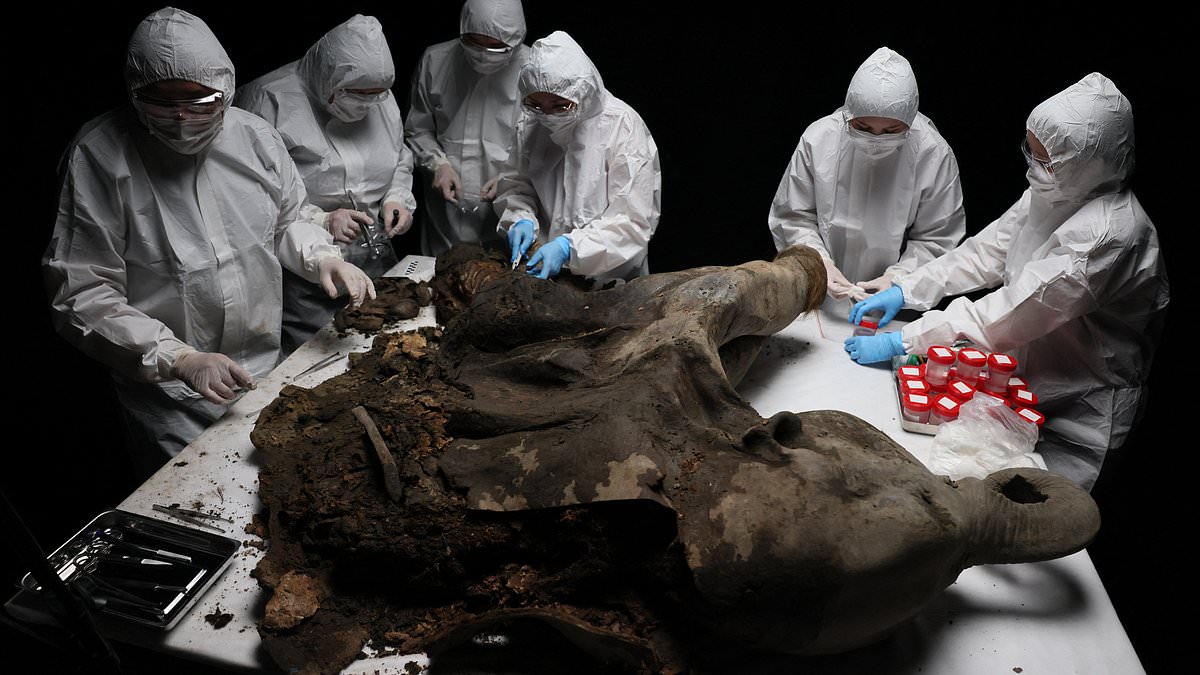
Scientists have warned that thawing woolly mammoths in Siberia could release a deadly 'zombie bacterium' that has spent 50,000 years dormant in permafrost.In an alert sounding like it came from the beginning of some Hollywood disaster movie, Russian mammoth specialist from the Academy of Sciences of Yakutia Albert Protopopov spoke of 'potentially dangerous infections' coming back to life.As the climate warms, 'the carcasses of ancient animals are emerging on the surface [of permafrost], and with them microflora, including pathogenic microorganisms that are also dangerous to humans,' he told Russian newspaper Izvestia.The warning comes after an international study found traces of ancient bacteria in mammoth remains, including DNA from a close relative of a microbe linked to fatal bloodstream infections in African elephants.There are particular worries that locals who discover ancient carcasses will come into contact with these infections and potentially spread them to other people.Often, found dead animals are only reported to scientists months after their discovery, risking weeks of possible exposure to 'zombie viruses', Mr Protopopov said.'This needs to be monitored,' he warned.The DNA of the bacteria found in the mammoth remains was tested in the international study, the findings of which were published in the journal Cell in September 2025. Scientists perform a necropsy on the 50,000-year-old baby mammoth nicknamed Yana at the North-Eastern Federal University in Yakutsk Russian mammoth specialist from the Academy of Sciences of Yakutia Albert Protopopov spoke of 'potentially dangerous infections' coming back to lifeA 28-strong team, led by Benjamin Guinet at Stockholm's Centre for Palaeogenetics, examined 483 mammoth specimens and identified six groups of bacteria that may have lived in the animals when they were alive.Among the specimens was Yuka, an exceptionally well-preserved juvenile woolly mammoth that died about 39,000 years ago and was discovered in northern Siberia in 2010. The investigation revealed that some of the ancient carcasses were host to a pathogen whose modern relative is deadly to elephants.This type of bacterium was linked to the deaths of six elephants in Zimbabwe in 2020. 'Only genomes have been discovered,' said Protopopov.'It is becoming clear that mammoths were also carriers of this bacterium.'In addition to this bacterium, genomes of other pathogenic and non-pathogenic microorganisms that accompanied mammoths were also discovered.'To combat the apparent threat, Mr Protopopov and his team are developing robots to scour terrain for hidden remains before rapidly thawing permafrost exposes the carcasses to air.The initial AI-driven prototype is being developed for £646,000 (70 million roubles) and has been provisionally named Pleistocene.They hope to use it to find buried remains while they are still locked in the frozen ground. Woolly mammoth excavation on Russia's Yamal Peninsula. Mr Protopopov said some of these carcasses are host to pathogens which are dangerous to humans The remarkably preserved 28,000-year-old Malolyakhovsky woolly mammoth discovered on Russia's Little Lyakhovsky Island in the Arctic in 2013'We are currently working on creating the Pleistocene robotic system to search for the remains of mammoths and other ancient animals, before they emerge on the surface,' Mr Protopopov said.This will also lead to scientists obtaining better-quality biomaterials from the bygone creatures.Warnings about so-called dormant frozen zombie viruses have been issued before.Scientists have known for years that 'Methuselah microbes', cells that have stayed dormant in permafrost for tens of thousands of years, carry the risk of propagating and spreading like wildfire if taken out of their icy confines.Jean-Michel Claverie, a geneticist at Aix-Marseille University in the south of France, told the Observer: 'The crucial point about permafrost is that it is cold, dark and lacks oxygen, which is perfect for preserving biological material.'You could put a yoghurt in permafrost and it might still be edible 50,000 years later.' Why are scientist worried about 'zombie viruses'? Mr Protopopov said that carcusses are often discovered by locals months before scientists are alerted, risking contaminationMammoths have been found to have been hosts to a pathogen whose modern relative is deadly to elephants Mr Protopopov warns that these ancient pathogenare 'are also dangerous to humans'
Thawing woolly mammoths in Siberia could release deadly 'zombie bacteria' that have spent 50,000 years locked away in ice, expert warns
Full Article
Original Source
Read the full article at Dailymail →KhanList aggregates and links to publicly available news content. We do not host full articles from third-party sources. Always verify important information with original sources.