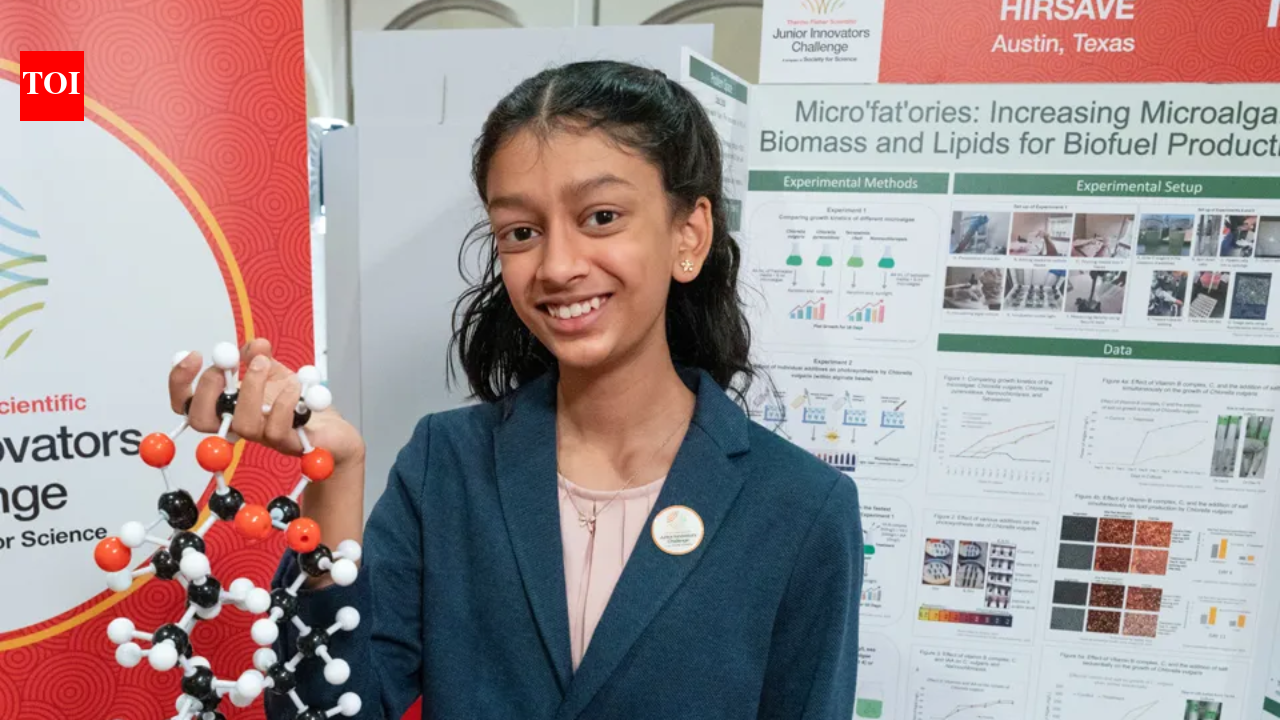
Arya Hirsave (Image: Lisa Fryklund Photography/ Society for ScienceBeyond the Project)A science lesson about biomass sparked an experiment that could offer a fresh way to think about renewable fuel. Arya Hirsave, a seventh-grader from Canyon Vista Middle School in Austin, Texas, wanted to understand whether microscopic algae could be made more productive as a source of biofuel. Her project, titled Micro’fat’ories: Increasing Microalgal Biomass and Lipids for Biofuel Production, explored how different treatments affected algae growth and the amount of lipids, or oils, they produced. According to the Society for Science, Arya found that a carefully timed combination of vitamins and salt increased lipid production by 77% in just five days. Her work was selected for the 2025 Thermo Fisher Scientific Junior Innovators Challenge, placing a middle-school researcher at the centre of a question usually associated with advanced energy research, how can scientists make biological sources of fuel more efficient?How a seventh-grader in Texas found a way to make algae produce 77% more biofuel oils in five daysArya’s interest began during a science class covering renewable and non-renewable energy. The word “biomass” caught her attention, leading her to investigate algae as a potential renewable source of fuel. As the Society for Science explains, she was particularly interested in the possibility of growing algae while also using them to absorb carbon dioxide from the atmosphere. Instead of simply asking whether algae could produce biofuel, Arya focused on a more practical problem, how could their growth and oil production be increased? For her project, Arya worked with four types of microalgae. Two were freshwater species, Chlorella vulgaris and Chlorella pyrenoidosa, while Nannochloropsis and Tetraselmis chuii represented saltwater algae. She compared how quickly the different organisms grew and how much biomass they produced. Her early results showed that Chlorella vulgaris and Nannochloropsis were among the fastest-growing varieties she tested, making them particularly interesting candidates for further biofuel research. The experiment then moved beyond simply growing algae. Arya began testing whether specific treatments could encourage them to produce more of the energy-rich lipids that are important when algae are considered for biofuel production.How a seventh-grader in Texas found a way to make algae produce 77% more biofuel oils in five days (Image: Society for Science)Vitamins helped the algae grow, while salt changed what they producedArya tested vitamins B and C alongside plant hormones to see whether they could stimulate the algae. The results suggested that the vitamins could help, according to the Society for Science, they boosted photosynthesis and produced a 6-7% increase in growth. That finding gave Arya an important clue, improving the conditions in which algae grow could potentially make the organisms more productive. But growth was only half of the challenge. For biofuel applications, researchers are also interested in the lipids stored inside microalgal cells because these oils can serve as feedstock for producing fuels. Arya therefore tested another approach, adding salt to freshwater algae. The treatment created an interesting trade-off. The algae did not grow as much under the high-salt conditions, but they produced more lipids. This suggested that stressing the algae could alter how they allocated their resources, shifting the biological response away from growth and towards lipid production. That distinction became central to Arya’s final experiment. Rather than choosing between rapid growth and high lipid production, she looked for a sequence that could encourage both at different stages.The five-day treatment that produced 77% more lipidsArya’s strongest result came from combining the two strategies in a specific order. The algae first received vitamins for three days, giving them time to grow under conditions that supported photosynthesis. They were then exposed to a high-salt treatment for two days. According to the Society for Science, this five-day sequence allowed the algae to continue growing while increasing their lipid production by 77%. The significance of the result lies not simply in the percentage increase, but in the way Arya approached the problem. Instead of treating algae growth and oil production as identical goals, her experiment recognised that the two can respond differently to environmental conditions. The initial vitamin treatment supported growth, while the subsequent salt stress encouraged greater lipid accumulation. Her findings point towards a possible strategy for making microalgae more useful as biofuel feedstock, optimise the organism's growth first, then manipulate its environment to encourage the production of the compounds needed for fuel. That does not mean the experiment has produced a commercially ready biofuel process. Further research would be needed to determine whether the approach works consistently at larger scales, across different cultivation systems and under practical production conditions. Nevertheless, the result demonstrates how changing the timing and combination of relatively simple treatments can influence what algae produce.From science fairs to a future among the starsArya’s algae project is part of a longer interest in experimentation. The Society for Science reports that she has participated in science fairs since third grade, using each year’s project to explore a different scientific category and help her discover what she might want to pursue in the future.Her interests extend well beyond renewable energy. Arya enjoys crafting, including sewing and making miniature flowers, but she is particularly fascinated by astronomy. She has explored subjects such as the enormous black hole TON 618 and uses a night-sky app to identify constellations. Her ambition is to become an astrophysicist. That combination makes her algae experiment especially striking. A seventh-grader interested in distant black holes chose to investigate something much closer to Earth, microscopic organisms that could one day contribute to cleaner energy systems. Her project was recognised as part of the 2025 Thermo Fisher Scientific Junior Innovators Challenge, where she was named a finalist. The competition gave her work a wider platform, but the experiment itself began with a much smaller question in a classroom, could algae be made better at producing the material needed for biofuel? In five days, Arya found a promising answer and increased lipid production by 77%.
Texas seventh-grader Arya Hirsave helps algae produce 77% more oil in five days
Full Article
Original Source
Read the full article at Timesofindia →KhanList aggregates and links to publicly available news content. We do not host full articles from third-party sources. Always verify important information with original sources.