
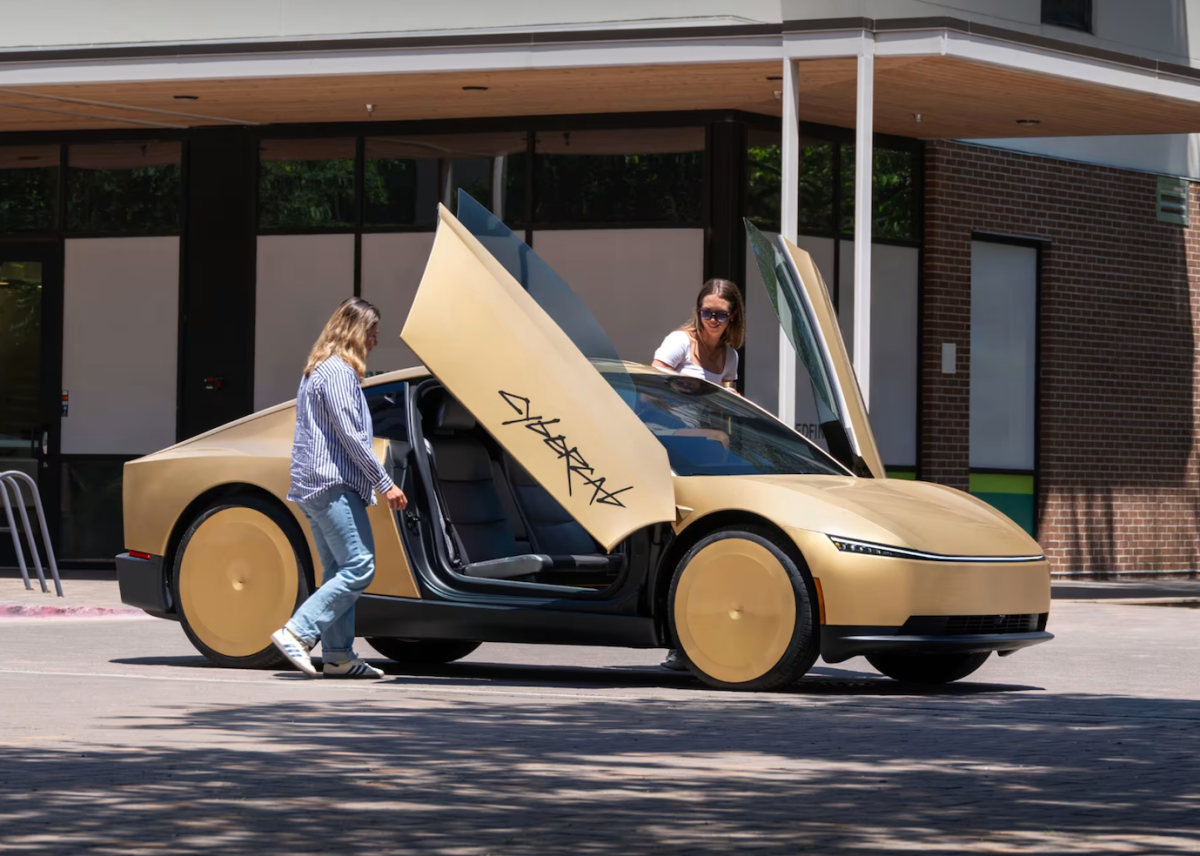
Tesla says it is preparing to launch its shiny gold Cybercab in new markets outside its home of Austin, Texas, in a bid to “literally take over every part of terrestrial transportation.” “We’re starting with getting people from one place to the other, but we want to basically own transportation of any kind on Earth,” Chief Financial Officer Vaibhav Taneja said on the company’s third-quarter earnings call Wednesday. Tesla has previously shown a concept version of a multi-passenger vehicle it calls the “Robovan,” but it’s unclear if Taneja’s bombastic comments mean the company is working on other types of transportation. What was clearer on the call is that Tesla’s Cybercab expansion will begin in Dallas next month and spread to other cities by the end of this year. Tesla already operates robotaxi versions of its Model Y SUV in small fleets in Dallas, Houston, and the Florida cities of Miami, Orlando, and Tampa. The company also said on its earnings call that it will start selling Cybercabs to fleet operators by the end of this year. Broader expansion of the Cybercab could set up a real fight with Waymo, which is currently the market leader for robotaxis in the United States, with more than 4,000 of them deployed across more than a dozen cities. Tesla has argued that its Cybercab is cheaper and easier to build, which should allow it to undercut Waymo and other robotaxi operators on price. But the company has to reach real scale outside Austin in order to prove that point. Tesla said it’s ready thanks to a dramatic increase in the number of miles its self-driving cars have traveled in recent weeks. While that may be true, Tesla was mum on Wednesday about how much money the overall robotaxi effort is bringing in. Tesla CEO Elon Musk said the new ride-hailing business won’t be noticeable in the company’s overall financial figures until the second quarter of 2027, “and probably a big deal by Q3 or Q4 of next year.” Tesla also made a change to its letter to shareholders that further obscures what little visibility there was into its robotaxi business. In Tesla’s second-quarter letter, the company included a chart for “Cumulative Paid Robotaxi Miles.” A close read of that chart showed a 36% decline from the first quarter of the year. In the new letter released on Wednesday, Tesla changed that chart to show “Cumulative Unsupervised Robotaxi Miles” — simpler indicator of how far the fleet cars are driving, whether or not they have paying riders on board. There wasn’t much more clarity on the call, either. When asked about paid robotaxi miles traveled, Taneja said the company is “seeing utilization improving,” but didn’t offer specifics. Instead, Taneja kept most of his comments generally focused on Tesla’s plans to scale the Cybercab. That included praise for Tesla’s engineering team for creating a vehicle that, according to the manufacturing team, is very easy to build — and build quickly. “They think this is one of the easiest products for them to scale in terms of manufacturing,” he said. “So scaling would not be that much of a challenge.” What might be a challenge, Taneja said, is that Tesla needs to make sure it has “all the regulatory approvals” so it can “start deploying the Cybercabs as fast as we can produce them.” That echoes many previous comments from Musk, who has long claimed that “regulatory approval” was the biggest barrier to Tesla’s robotaxi plans, not technical progress. Musk has always been a bit hazy about what approvals, specifically, he felt were needed. The company has run into a regulatory hurdle this year, though. In September, just hours after Tesla formally launched its Cybercab in Austin, the National Highway Traffic Safety Administration (NHTSA) opened an investigation into whether the vehicle complies with current federal motor vehicle safety standards. All automakers self-certify that their vehicles conform to these standards, and Tesla has claimed that the Cybercab is compliant. But it is missing features that the current standards require, like a brake pedal and side mirrors. The NHTSA has proposed removing some of these requirements, but that rule change is likely still at least a few months away. Not every Tesla executive agreed on this during Wednesday’s call. Asked about the remaining bottlenecks for a wider robotaxi rollout, Ashok Elluswamy, Tesla’s vice president overseeing autonomy, said they are “not purely regulatory.” “It’s technology driven,” he said. “We had initially had the robotaxi service from 6 a.m. to 9 p.m., and then expanded to 10 p.m. to 11 p.m, now it’s going to be pretty soon, [to] 2 a.m. So we’re slowly expanding the availability of robotaxi, and that is driven by the capability of the AI software.” That could be why Tesla’s service still doesn’t operate on highways, and in certain conditions, although it has been spotted operating in heavy rain many times in Austin — something Waymo’s robotaxis have largely avoided. Elluswamy said Wednesday that Tesla plans to tackle more of these challenging driving scenarios by the end of this year, before scaling further. “We just want to make sure that there’s not a single safety incident. That is our operating principle. And even if there’s the slightest possible risk at all, we don’t like take on that risk,” he said. When you purchase through links in our articles, we may earn a small commission. This doesn’t affect our editorial independence.
Tesla is prepping a Cybercab onslaught
Full Article
Original Source
Read the full article at Techcrunch →KhanList aggregates and links to publicly available news content. We do not host full articles from third-party sources. Always verify important information with original sources.