
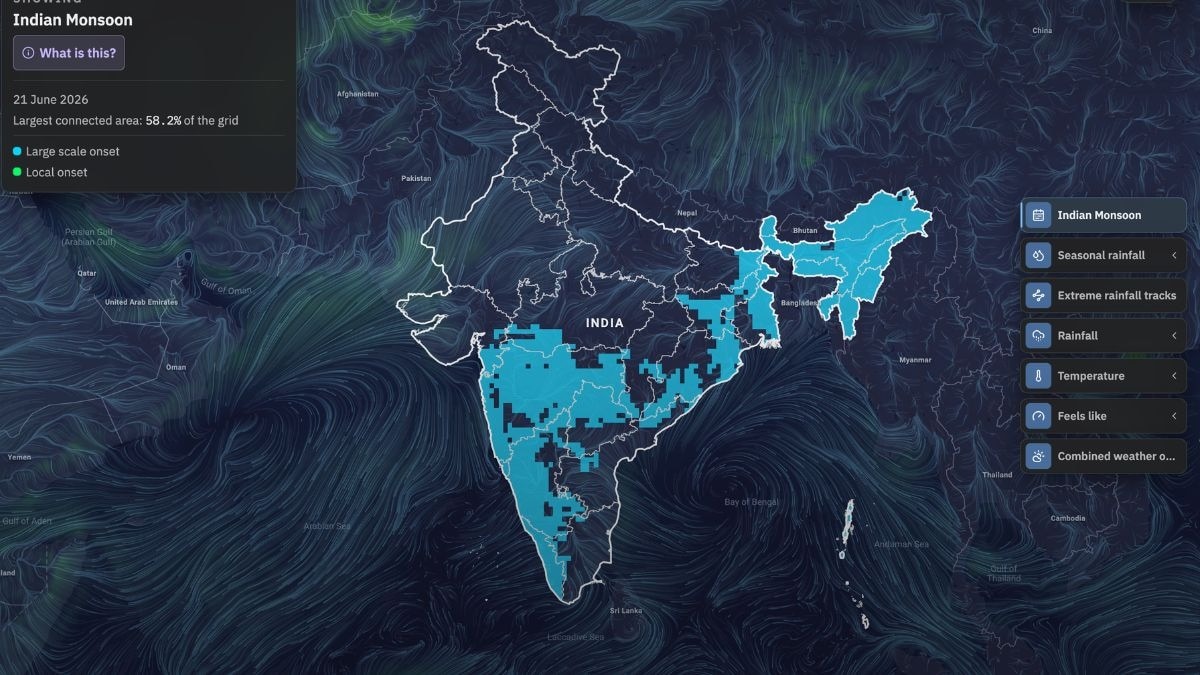
It was August 2018, and in Kerala, a two-storeyed house stood directly in the path of the rising Pamba river. The water did not simply rise. It climbed, faster than anyone inside could climb away from it, swallowing one floor, then reaching for the next, until there was nowhere left to retreat but the terrace. There, with the river still rising beneath them, the people who lived in that house could do nothing but wait, and hope that a Navy helicopter would reach them before the water did.Professor RI Sujith of IIT Madras was not there. But his father's childhood friends were, and years later, they told him what it felt like to wait on that terrace, not knowing. His own ancestral home did not survive the flood at all. It went under completely, and no longer belongs to his family.He travelled there with his father in 2019, not long after the water had gone down, to honour what both of them already sensed would be among his parents' last wishes together. What stayed with Professor Sujith from that visit was not only the grief of it, but details about the people themselves. Kerala, he says, is a land where people do not simply live beside water. They live with it, and in many ways, through it. Everyone there swims, as a rule, extraordinarily well. And still, in 2018, some of them very nearly did not survive it."Their traumatic experience made me reflect," Professor Sujith tells India Today Digital, "on whether the knowledge and experience we had accumulated over decades in thermo-fluid systems, non-linear dynamics and complex systems theory could be put to use in addressing problems associated with climate and society." That reflection became the starting point for a monsoon forecasting platform now live at ctcs-climate.in, built by a team at IIT Madras's Centre of Excellence for Studying Critical Transitions in Complex Systems, funded through IndusInd Bank's Holistic Rural Development Programme. Led by Professor Sujith, the platform promises something India's own weather agencies have not yet been willing to promise: a forecast of the Northeast Monsoon up to 10 months before it arrives.A TEAM, NOT A SINGLE SCIENTISTIt would be easy, and wrong, to tell this as one professor's story. Professor Sujith is careful on this point himself. The platform was built, he says, by "a wonderful team comprising Dr Devabrat Sharma, Dr Ajay Bankar, Dr Gaurav Chopra, Dr Shruti Tandon, Yogenraj Patil, S Balakrishnan, B Prasana Kumar, Maya Murali and Harini Shanmugham," with senior guidance from Professor B N Goswami and support from Bijit Kumar Banerjee of Gauhati University. Within that team, the labour was divided by expertise. Short-range forecasts of rainfall, temperature and heat stress come from dynamical prediction models. Monsoon onset is forecast through a complex network framework. The seasonal rainfall totals for India and Tamil Nadu are generated by separate artificial intelligence and machine-learning systems. Members of the Centre of Excellence for Studying Critical Transitions in Complex Systems at IIT Madras, the team behind the forecasting platform. (Photo: IIT Madras by special arrangement) Professor Sujith's own role sat specifically at the long-range, theoretical end of that chain. "I was not involved in short-range weather forecasting," he says plainly. His contribution was to bring the mathematics of complex systems to the question of monsoon predictability, work that fed three threads: using synchronisation theory to probe long-range predictability, identifying the onset and withdrawal of the Southwest Monsoon through phase transitions in a network of climate stations, and building the framework behind the Northeast Monsoon's 10-month outlook.Dr Devabrat Sharma has worked closely on extending how far ahead the Indian Summer Monsoon can be forecast, part of a wider body of research the team has published on predicting rainfall over southeastern India specifically. The platform, in other words, is the sum of several distinct scientific efforts stitched into one public interface, not a single theory applied uniformly across every timescale.FROM AN ENGINE STALLING TO A MONSOON ARRIVINGProfessor Sujith's own scientific path to this point did not begin in the weather at all. He spent his career studying combustion instability, the precise, often catastrophic moment when a stable flame inside an engine begins to oscillate and tip towards failure. It sounds like a strange inheritance to bring to the monsoon, until he explains the idea underneath it."A system can begin to reveal the signs of an impending transition well before the transition actually occurs," he says. In an engine, his research hunts for faint shifts in temporal and spatial patterns that appear before everything changes. Professor Sujith explains the climate as a complex system, where small processes such as droplet formation in clouds shape large systems such as the monsoon and storms. (Photo: IIT Madras by special arrangement) Both an engine and the atmosphere, he points out, are thermo-fluid systems at heart, and the physical intuition built studying one has turned out to be genuinely useful in asking the same questions of the other.He is careful, though, not to overstate the resemblance. An engine fails or holds within a fraction of a second, in response to a single control variable a technician can turn. The monsoon obeys no dial. It unfolds over weeks and months, inside a system more intricate than any machine humans have built. "In an engine, the central question is often, will the system become unstable," he says. "In climate science, the question is broader. What is the system going to do, and how far ahead can we predict it?"WHAT DOES IT MEAN FOR A MONSOON TO "TRANSITION"?The physics Professor Sujith and his collaborators study has a name for the moment a flame slips into instability: a critical transition, a sudden shift from one state of a system to another, rather than a gradual drift. Their central claim, laid out in a co-authored paper with Yogenraj Patil, Gaurav Chopra, Shruti Tandon and B N Goswami, is that the Indian monsoon behaves the same way.Monsoon onset, the paper argues, is an abrupt jump, from weak, scattered rainfall to something organised and widespread across the country almost overnight. Using what the team calls climate networks, small, locally defined pockets of rainfall onset across the country, they show these clusters coalesce suddenly, not gradually, into two large-scale transitions: one over Northeast India, and one, critically dependent on the first, across the Indian peninsula. Researchers and students from the group at IIT Madras behind the monsoon forecasting platform. (Photo: IIT Madras by special arrangement) That abruptness may sound intuitive to anyone who has lived through it. What the paper offers instead is a quantitative way to pin the moment down, and, from it, a forecasting framework for monsoon onset at individual locations across India."We are not claiming that the Indian monsoon is less chaotic than other atmospheric systems," Professor Sujith says, aware of exactly how the team's claims will sound to a sceptical physicist. "The key distinction lies in what we are attempting to predict." A seasonal forecast is not an attempt to call a single storm. It is an attempt to read the total rainfall of a season, a climate question rather than a weather one, and climate, the team argues, leans on slower, more patient signals, ocean temperatures above all, that linger and shift across months rather than hours.WHY DOES THIS MATTER OUTSIDE A LABORATORY?For a state like Tamil Nadu, the Northeast Monsoon is not the lesser of India's two rainy seasons. It is, in large part, the only one. Unlike most of the country, which depends on the Southwest Monsoon from June to September, the Tamil Nadu coast draws a significant share of its yearly rain from the Northeast Monsoon instead.A forecast that reaches 10 months into that season's future is not an academic flourish. It is, potentially, the difference between a farmer choosing a drought-resilient crop in good time, and finding out too late that the choice was already made for him by the weather.Mahesh Palawat, Vice President of Meteorology and Climate Change at the private forecaster Skymet, does not dismiss the promise. "If their prediction is that monsoon will be below normal, then they will select the crops which will be less water dependent, which can withstand drought-like conditions," he says. Reservoir managers, he adds, stand to gain just as much, planning releases ahead of a wet season instead of scrambling once the water has already arrived.But he sets the bar for trusting any such model unusually high. "At least 80 per cent accuracy should be there, otherwise there is no use," he says, and even then, he wants years of evidence behind the number. "At least five to six years, minimum. Otherwise, one decade. One or two years can be a fluke."WHAT DOES IMD ACTUALLY SAY?If there is scepticism in this story, it belongs to Dr Mrutyunjay Mohapatra, Director General of Meteorology at the India Meteorological Department, and he does not hide it.IMD's own models, he says, are technically capable of projecting out to 10 months. The agency simply does not trust what comes out the other end. "The skill of the climate forecast, especially for the forecast of monsoon rainfall, does not have scale up to 10 months at present," he says. What IMD issues instead is a forecast released every April 15, covering the four months of June to September, a horizon of roughly five months, built by combining the best of several global dynamical models rather than betting on any single one.Within that shorter window, he is unambiguous about the agency's own record. "Since 2021 our forecasts are all correct," he says, "within a model error of plus or minus 4 per cent for India as a whole." Asked whether the IIT Madras team's longer-range claim could ever be proven, his answer was pointed. "If somebody is providing that, then it needs validation, and they can utilise, we can utilise, if they can provide us with a proof that it is working." The validating body for such claims, he says, already exists: the Indian Institute of Tropical Meteorology has tested forecasting at a 10-month range, and found it not yet possible.He drew one line especially firmly. A seasonal forecast is never a single confident number. However, it may read in a headline. "It is not a single confidence figure," he says. "We are providing the map showing the expected rainfall in different parts of the country with the probability of occurrence."What troubles him is not research at long ranges, which he insists is welcome, so much as the idea of operational trust sitting anywhere outside the nodal agency. "Research has no boundaries," he says. "But operationally, long range forecast will be provided by the nodal agency only. Not by everyone." A forecast issued 10 months out, only to be revised months later, he warns, risks confusing the very public it claims to help. "It should be consistent also, na."IS THERE A WAY TO ACTUALLY CHECK WHO IS RIGHT?Here, remarkably, the record already exists. The 2026 Southwest Monsoon gave both the IIT Madras team and India's official forecasters a live test, and neither flinched from it.The season arrived late, and the country's final tally, confirmed by IMD, came in at 759.4 mm, 13 per cent below normal. The team, working five months ahead of the season, had forecast the delayed onset 12 days in advance, and projected the seasonal total at roughly 12.5 per cent below normal, 761 mm against an eventual 759.4 mm. Professor RI Sujith with a member of his research group in the thermoacoustics lab at IIT Madras, where his study of how engines tip into instability began. (Photo: IIT Madras by special arrangement) Their 10-month-ahead outlook for the Northeast Monsoon over Tamil Nadu, meanwhile, called for normal rainfall, a conclusion Professor Sujith notes sits in line with IMD's own Peninsular outlook issued on 30 September.It is an uncommonly tight result for a forecast made months before IMD's own forecasting window even opens. Professor Sujith does not pretend it settles the argument. "The true measure of success will not be a single forecast that turns out to be correct," he says, "but the consistent ability of our forecasting systems to demonstrate predictive skill over multiple years and under different climatic conditions." Palawat's clock, five or six years before a claim like this earns real trust, has not yet begun to run out. It has barely started ticking.WHAT HAPPENS WHEN THE FORECAST IS WRONG?For all his confidence in this year's result, Professor Sujith is unusually candid about what a public platform owes the people who use it, especially when it fails."No weather or climate forecasting model is 100 per cent accurate," he says, "and forecast errors are an inherent part of scientific prediction." The platform now carries a disclaimer stating as much, framing every forecast as scientific guidance rather than a guarantee. He also concedes, when pressed on how clearly the uncertainty behind a 10-month number is actually communicated to a visitor to the website, that the platform is still a work in progress. "We are open to making this information more accessible," he says.Pushed on what single piece of evidence would convince him, a decade from now, that the platform genuinely works rather than having simply sounded convincing at launch, his answer has nothing to do with any one correct call. "If our forecasts consistently demonstrate skill in anticipating seasonal rainfall variations, including during years with unusual climate conditions," he says, "that would provide strong scientific evidence of the platform's value." The real test, in other words, is not this monsoon. It is the next ten.A TEAM, A FATHER, AND A QUESTION NO ONE CAN ANSWER YETReturn, in the end, to where this began. Professor Sujith is not a climate scientist by training, and he does not pretend otherwise, nor does he claim this work as his alone. "I was doing well in thermoacoustics," he says, "so moving into climate science meant stepping away from a field where I was established and becoming a learner again.That was probably the biggest challenge." He leans openly on Sharma, Bankar, Chopra, Tandon and the rest of the team, on Goswami's decades of monsoon expertise, and on climate scientists abroad, approaching a field that is not natively his with what he calls humility.But somewhere beneath the complex networks and the phase transitions and the machine-learning frameworks sits a simpler motive, the one Professor Sujith carried home from his father's ancestral village, where the water once rose high enough to take a house with it. A monsoon forecast, however many months in advance, built by however many hands, is really just an attempt to give someone the one thing the people on that terrace in 2018 did not have. Warning, early enough to matter.Whether 10 months is early enough, or simply too far for meteorology to see clearly yet, is a question neither the IIT Madras team nor IMD can fully answer today. It is, by every account in this story, a question still being tested, one monsoon at a time.- Ends
Ten months before rains fall, an Indian scientist is trying to see the monsoon coming
Full Article
Original Source
Read the full article at Indiatoday →KhanList aggregates and links to publicly available news content. We do not host full articles from third-party sources. Always verify important information with original sources.