
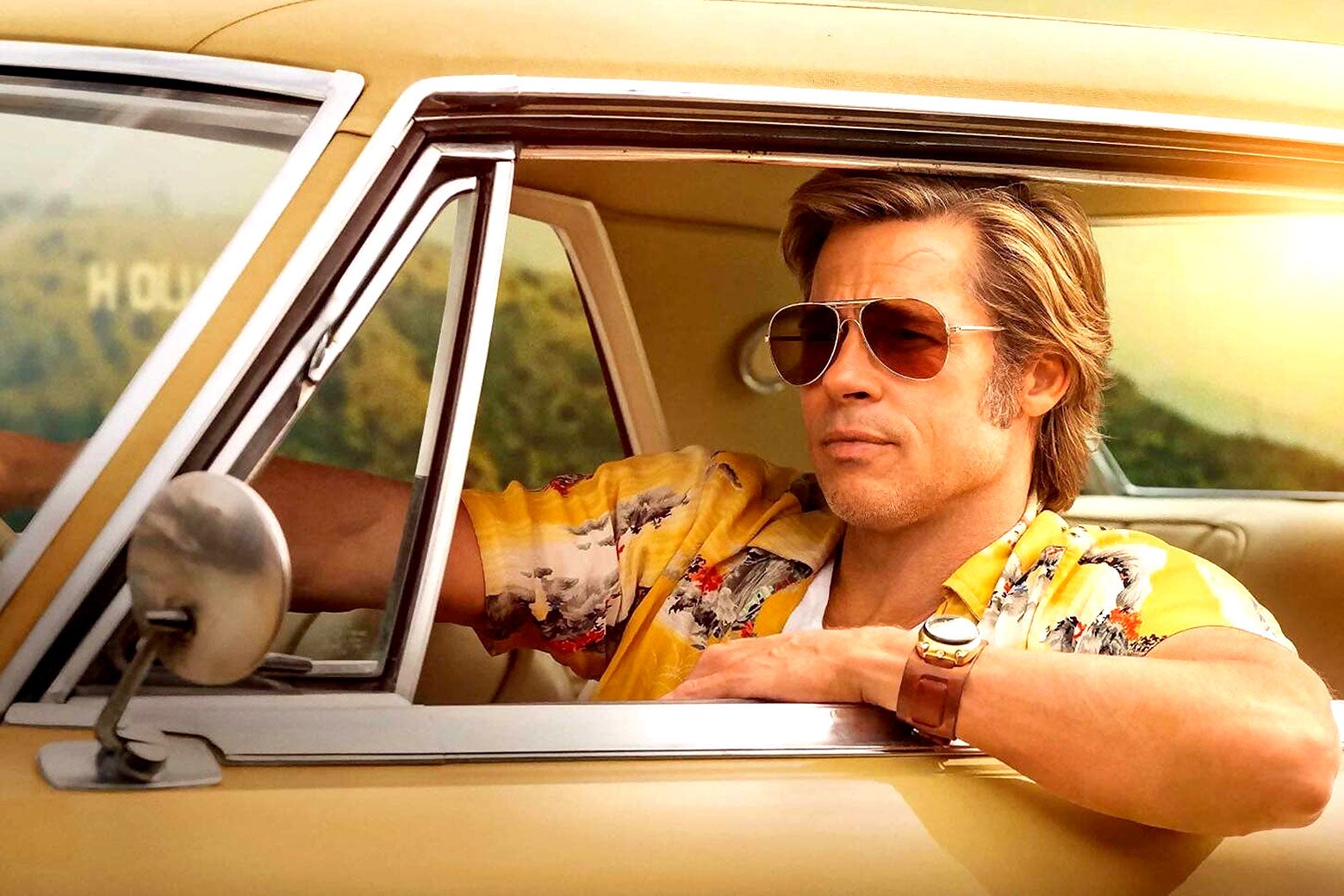
Movies The more I’ve thought about The Further Mis-Adventures of Cliff Booth, the more my feelings about it have begun to sour. By Enter your email to receive alerts for this author. Sign in or create an account to better manage your email preferences. Unsubscribe from email alerts Are you sure you want to unsubscribe from email alerts for Dana Stevens? Nov 25, 20265:45 AM Netflix Sign up for the Slatest to get the most insightful analysis, criticism, and advice out there, delivered to your inbox daily. Two years after the release of the 2019 hit Once Upon a Time in Hollywood, Quentin Tarantino published the novelization of his own movie, a nearly 400-page work of fanfic that went far beyond a mere prose retelling of the events of the movie’s already incident-packed screenplay. The book devoted whole chapters to the unexplored backstories of the film’s secondary and tertiary characters, including Charles Manson—a figure who barely appears in the film, though his cult followers play a key role in the story. But the novel’s most significant character, beside past-his-prime actor Rick Dalton (played in the movie by Leonardo DiCaprio), was Cliff Booth (played by Brad Pitt, who won an Oscar for the role), Rick’s longtime stuntman, driver, and unflappable gofer. Indeed, as we learn more about his past and present self over the course of the novel, Cliff begins to emerge as a rival contender for his buddy Rick’s leading-man slot. In the movie, it’s suggested that Cliff may have murdered his wife in an ambiguous incident on a boat; in the book, the truth about this long-rumored act of violence gets spelled out in gruesome detail. At another point in the film, a sexy hitchhiker comes on to Cliff from the passenger seat of his car; the prose version gives us the full-on, NSFW lowdown on exactly the show she puts on for him as he drives. Once Upon a Time in Hollywood the book is not especially successful as a freestanding work of fiction—it reads at times like a promising screenplay treatment in dire need of an edit—but it provides a fascinating snapshot of the way its author’s mind has continued to build out a fictional alt-film-history universe that has by now been obsessing him for years. That description may understandably seal the deal for Tarantino haters (of which I have been one in the past!) looking for an excuse not to see The Further Mis-Adventures of Cliff Booth. But it shouldn’t necessarily deter Tarantino skeptics, especially those who, like me, found Once Upon a Time to be among the best and most mature works of the filmmaker’s career. The Further Mis-Adventures of Cliff Booth picks up Cliff’s story in 1977, eight years after the events of Once Upon a Time. The script is by Tarantino, whose fascination for rearranging the elaborate dollhouse he created continues unabated, but this time the direction has been handed off to David Fincher. Brad Pitt returns as Cliff Booth—five words that could easily serve as this movie’s title, given how crucial that star’s particular charisma is to what seems to be less a sequel than what Pitt has described as an “episode” in the life of the character. Think of it as a video game side quest, or one of those episodes in a contemporary streaming show that focus entirely on a previously sidelined cast member. The Further Mis-Adventures of Cliff Booth never really settles on what its genre identity is, a choice that comes off less as a formally bold gesture than as a laconic unwillingness to commit. Then again, “laconic unwillingness to commit” is pretty much the default vibe exuded by this movie’s hero, who’s all loopy banter and So-Cal zen until it comes time—and come time it will—to kick some serious bad-guy ass. As we first meet 1977 Cliff, he is no longer doubling for Rick Dalton, who has moved to Australia to star in a Western TV show called Dingo Dan. Cliff lives in a modest Marina del Rey apartment with his elderly but still mentally sharp father (RoboCop’s Peter Weller), who runs a pawnshop by day and spends the rest of his time watching old movies on TV, often accompanied by a running commentary of behind-the-scenes gossip from his raconteur son. Cliff makes a living in three very Tarantinian ways: He’s a part-time projectionist at the New Beverly, a venue the director now owns and runs as an all-celluloid repertory house. He tends bar at a dive called Lucy’s, where he’s known for his elaborate rum-and-fruit concoctions. And most dangerously and lucratively, Cliff moonlights as a fixer for Hollywood bigwigs. In one early scene, that includes a closeted film director whose Oscar statuette has been stolen by a young gay hustler (Corey Fogelmanis), who in turn is apparently being controlled by an older man acting as his pimp (Anora’s Karren Karagulian). It’s an issue Cliff addresses in a manner that shows us both his softer side (he arranges for the exploited younger man to get out of the situation safely) and the brutality of which he is capable when he deems it necessary (the “chicken hawk” pimp doesn’t get off so easily). When Cliff gets called into a meeting by the agent of TV star Charlie Peters (Scott Caan, the son of, and near visual double for, James), the veteran stuntman is confused for two reasons. One, Peters is famous for doing his own stunts, as we witness in a mini-montage of his career as a small-screen action hero that’s narrated by Tarantino himself, and two, Charlie is far too short to be doubled by Cliff. Indeed, the diminutive actor is towered over by his agent, Karen Crosby (Elizabeth Debicki), a lanky beauty who radiates a self-possessed cool to rival Cliff’s own. As it turns out, Charlie is interested in Cliff’s skills not as a pratfall-taker but as an all-purpose problem solver. On a party trip to Manila some time back, Charlie made the mistake of drunkenly bonding with two Filipino hit men, the Verdusco brothers (JB Tadena and Matt Groove), and offering them money to murder his seemingly quite delightful wife (Carla Gugino), a job he now realizes was a terrible idea. But the Verduscos are set on collecting their full fee—and, as established in an early scene where we see them carrying out a particularly ruthless home invasion, these are dudes who will carry out their contracted missions, not just faithfully, but with casually sadistic glee. That setup—lethal hired killers, behind-the-scenes Hollywood intrigue, and a charming slow-boil flirtation between the quick-witted Karen and the increasingly smitten Cliff—would seem to provide material enough for a satisfying genre romp, but instead The Further Mis-Adventures of Cliff Booth’s two-hour-and-20-minute runtime feels as shaggy as its hero’s feathered tresses. Scene by scene, the story unfolds nimbly enough, with Tarantino’s trademark banter and plenty of well-choreographed action scenes, including a shoot-’em-up finale that matches Once Upon a Time in Hollywood’s in go-for-broke bravado. But given this film’s loping, episodic pacing—basically it’s a handful of violent set pieces separated by long stretches of low-stakes hanging out—I found myself struggling to invest in either the resolution of the crime plot, however cleverly laid out, or the final outcome of Cliff and Karen’s flirty badinage, however skillfully scripted. Debicki, always a standout, walks away with the movie in her too-rare scenes with Pitt. It’s a shame we don’t get to see more of what happens in Karen’s life when she isn’t either parrying Cliff’s well-worn pickup lines or scrambling to stay ahead of the bad choices of her hotheaded client. And without giving away too much about the ending, I can say that it’s a big disappointment that we never get another glimpse of Karen after the climactic dude-on-dude-on-other-dude fight sequence. Why spend so much time developing such a complex female character only to sideline her like a generic love interest as soon as the punches, bullets, and hammer blows start flying? The imaginative production design by Donald Graham Burt and the witty costumes by Trish Summerville—in particular the glamorously draped all-white wardrobe she creates for the statuesque Debicki—make The Further Mis-Adventures of Cliff Booth a pleasure to look at, even if Fincher’s underlit digital photography (the cinematographer is Erik Messerschmidt, who also shot Fincher’s 2020 old-Hollywood-set drama Mank) is an odd match with the movie’s sun-drenched setting. In the end, this unhurried meander through the elaborate fictional universe that exists in such detail in the screenwriter’s brain achieves what the wry Karen, a former film critic, describes in one scene as pretty much the highest goal any mainstream movie can aim for: It’s the equivalent of a decent fast-food hamburger. But that burger might leave behind an oily aftertaste, given recent revelations about both the star’s attempt to launder his reputation after an ugly divorce and the director’s apparent use of A.I. Even the movie’s strongest element, the screwball-worthy chemistry between Pitt and Debicki, takes on a different flavor when you consider the 26-year gap in the actors’ ages. Word on the street is that Tarantino has another novel set to release on Dec. 8, right in between this movie’s brief theatrical release on Thanksgiving weekend and its Dec. 23 streaming debut on Netflix. The new book will be dedicated entirely to the character of Cliff Booth—who, as it turns out, may be one of those characters who would do best to preserve an aura of mystery in order to keep us caring about them. Artificial Intelligence Movies Netflix Quentin Tarantino Los Angeles
Tarantino’s New Movie Is a Tasty Burger, but It Leaves a Bad Aftertaste
Full Article
Original Source
Read the full article at Slate →KhanList aggregates and links to publicly available news content. We do not host full articles from third-party sources. Always verify important information with original sources.