
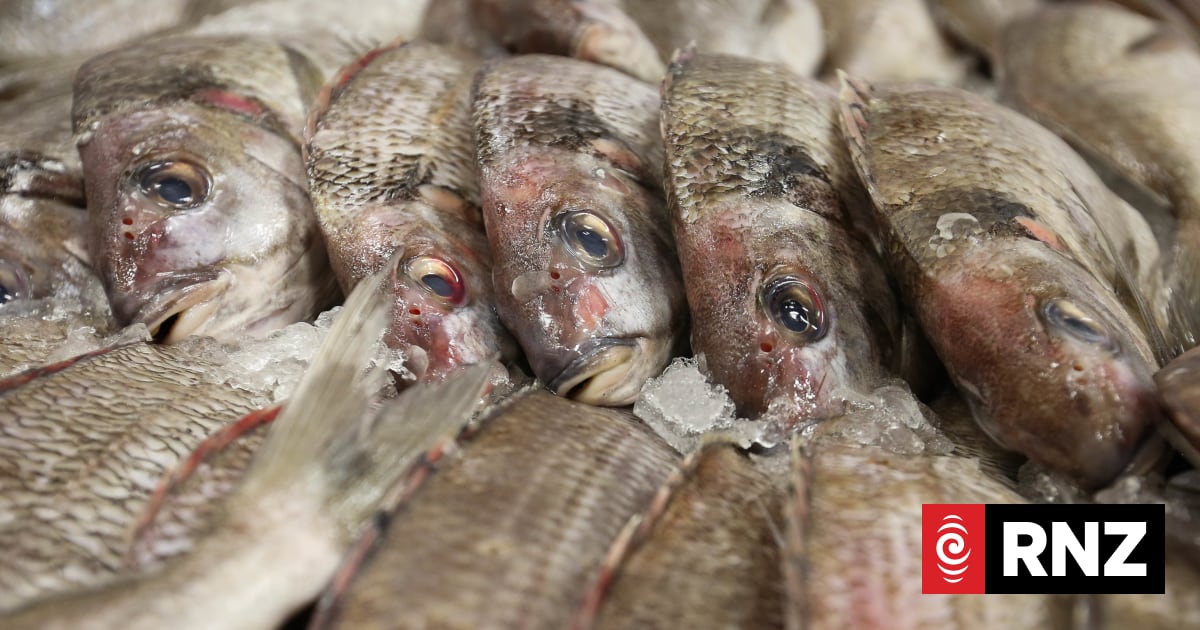
Fisheries Minister Shane Jones says tarakihi catch limits will be reduced, with a nationwide recreational fishing limit of 10 per person.Commercial limits for the eastern fishery are being reduced by 20 percent, and the western fishery by 55 percent.Jones said he has considered the latest science and catch information, uncertainty about future stocks of young fish, and the effects of use of the fishery in making the decision."These measures will immediately reduce fishing pressure on these tarakihi stocks and put them on more positive trajectories, while allowing a lower level of fishing to continue.Limits have been increased for snapper and trevally on the North Island's east coast, leatherjacket on the South Island's east and south coast, and frostfish and blue mackerel in deep water.Fisheries Minister Shane Jones.RNZ / Baz MacdonaldButterfish catch limits have also been reduced, with a five-per-person recreational limit.Seafood NZ chief executive Lisa Futschek said the quota management system was working as intended."This process matters. Sustainable fisheries management isn't about catch limits remaining static; it is about making changes when the evidence shows they are needed."The company's general manager for inshore fisheries Tiff Bock said they supported decisions to ensure tarakihi stocks continued to rebuild."Industry has been actively rebuilding east coast tarakihi since 2018 through catch reductions, avoidance measures, gear changes, improved monitoring and significant investment in research. We remain committed to rebuilding the stocks."Reduction 'does not cut it'Benn Winlove, a spokesperson for the LegaSea non-profit marine life advocacy group, said a 20 percent reduction on the east coast "does not cut it" and the government should expect further court cases."We have watched the stock fall dramatically, with little intervention from officials or successive fishery ministers. Court cases by Forest and Bird and the Environmental Law Initiative have made the government make bigger reductions, but it's not working."On the east coast, tarakihi is at 7.7 percent of its estimated original biomass. This is well below the 10 percent hard limit where closure is an option, and the rebuild plan is clearly not working."The Environmental Defence Society (EDS) said tarakihi fared better on the West Coast at 29 percent of its unfished biomass - but it was in rapid decline.Policy director Raewyn Peart said EDS sought a total closure of the fishery, until the stocks recovered. Seafood New Zealand and other commercial fishing interests sought the 20 percent reduction in the harvest that was adopted by the minister."Given how depleted tarakihi stocks are, and how important this fish is for New Zealanders, the minister's decision is extremely disappointing," said Peart."EDS called for a complete closure of the fishery given its perilous state. But the minister's decision doesn't even mention closure as an option. This is despite the eastern stock being below the hard limit, which is when closure needs to be considered under the Harvest Strategy Standard," she said.Fisheries New Zealand's analysis indicated that the harvest reductions adopted by the minister would mean the stocks would continue to be overfished, Peart said."It is also clear the western stock will continue to decline and the eastern stock will remain at very low biomass levels for an extended period. This brings the risk that any adverse event, such as a marine heatwave, could tip it over the edge so it never recovers.""EDS is now investigating legal options to challenge the decision," Peart said.Catch limit changes:InshoreSnapper, increase - SNA 2 - East Cape, Hawke's Bay, and WellingtonTrevally, increase - TRE 2 - East Cape, Hawke's Bay, and WellingtonLeatherjacket, increase - LEA 3 - east coast South Island, SouthlandEast Coast tarakihi, decrease - TAR 1E, 2, 3, 7E - east coasts North and South IslandWest Coast tarakihi, decrease - TAR 1W, 7W, 8 - West coasts North and South IslandStargazer, decrease - STA 7 - West Coast and top of the South IslandButterfish, decrease - BUT 7 - West Coast and top of the South IslandShortfin eel, decrease - SFE 13 - Te Waihora (Lake Ellesmere)Pāua, decrease - PAU 7 - MarlboroughElephant fish, decrease - ELE 3 and 5 - east coast South Island, Southland, and Sub-AntarcticLing, decrease - LIN 1 - Northland, Auckland, Waikato, and Bay of PlentyPāua, decrease - PAU 5D - Southland and OtagoDeepwaterBlue mackerel, increase - EMA 7 - west coast North Island, West Coast South IslandGemfish, increase - SKI 3 - east coast South Island, Chatham IslandsFrostfish, increase - FRO 3 - east coast South IslandScampi, increase - SCI 3 - east coast South Island, western Chatham RiseLing, decrease - LIN 7 - West Coast and Top of the South IslandAlfonsino, decrease - BYX 3 - east coast South Island, Chatham IslandsDeemed value rate adjustmentsSchool shark, increase - SCH 5 - SouthlandParore, increase - PAR 1, 9 - east and west Coast upper North IslandYellow-eyed mullet, increase - YEM 1, 9 - east and west coast upper North IslandSchool shark, decrease - SCH 3 - east coast South Island
Tarakihi catch limits reduce to 10 per person nationwide
Full Article
Original Source
Read the full article at Rnz →KhanList aggregates and links to publicly available news content. We do not host full articles from third-party sources. Always verify important information with original sources.