
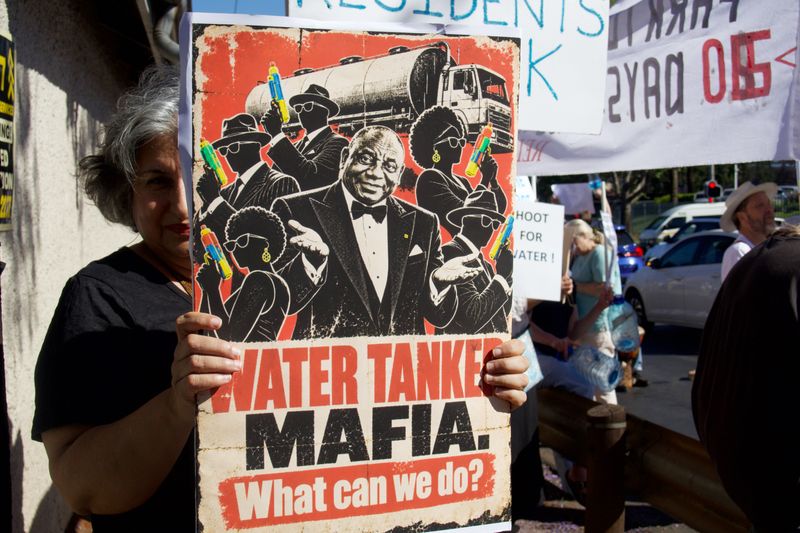
“Water is the lifeblood of human existence. Where there’s no water, there is no life,” said Henk Boshoff, a commissioner at the South African Human Rights Commission (SAHRC), as he unveiled the Chapter 9 Institution’s much-awaited report on Gauteng’s water and sanitation crisis on Monday, 2 November. The report – following hearings held from 19 to 21 May with eight water services authorities (WSAs) – was launched on the same day that frustrated residents descended on Johannesburg Water’s Newtown offices. The protest came after households in Parktown West and surrounding areas endured up to 12 weeks without tap water.Protesters in Johannesburg wave placards highlighting their anger at prolonged water outages. (Photo: Jamie Ho) On 3 November, less than 24 hours after the SAHRC report was released, Rand Water announced widespread supply disruptions across Ekurhuleni, Tshwane and Lesedi. The cuts followed a power outage in the East Rand that knocked out electricity to Rand Water’s Mapleton Pumping Station. The Govan Mbeki, Victor Khanye and Thembisile Hani municipalities in Mpumalanga were also affected.“Failure to repair a breaker and resolve this critical outage with the emergency it demands has left water supply to affected municipalities at risk,” said Rand Water spokesperson Makenosi Maroo.She warned residents across all six municipalities to expect water shortages, adding that the City of Ekurhuleni had yet to confirm when the electrical fault would be repaired.The latest outages highlight a broader pattern of failure: both the affected municipalities and bulk water suppliers were central targets of the SAHRC’s inquiry into systemic human rights violations.Although the Department of Water and Sanitation assured the commission that water supplies are ample, the report revealed that this has not translated into safe, reliable water for households and communal taps.“As we speak, people don’t have access to water. I thought municipalities would beef up their performance in the days before the local government elections. Instead, the opposite happened. Rather than improving, things just went haywire,” said Boshoff.Residents of Dube, Soweto, fill up water from water tankers on 7 January after taps in the area ran dry. (Photo: Fani Mahuntsi / Gallo Images) Commission’s findings and recommendationsThe report found that recurring service disruptions stem from ageing, deteriorating municipal infrastructure; excessive water distribution losses from unaddressed pipe leaks; insufficient pumping and reservoir storage capacity; and widespread wastewater treatment failures that severely contaminate rivers.Note that the DWS’s Green Drop and Blue Drop reports are not contemporaneous accounts of the state of wastewater and drinking water systems in South Africa. However, the reports help contextualise the difficulties and successes municipalities face in providing and managing water.The commission found that these physical constraints are compounded by governance and financial weaknesses, including critical shortages of technical personnel (such as engineers and process controllers), unaddressed irregular expenditure and poor revenue collection.The commission handed down eight far-reaching recommendations.Will municipalities comply?Before presenting the report’s findings, Boshoff held municipal managers to account for their lack of cooperation during the inquiry.This was further highlighted by the fact that eight out of the nine municipal or city managers had to be subpoenaed to appear before the commission. Rand West City was the only one that didn’t appear to give testimony; instead, it submitted written evidence after the hearing concluded.“Cooperation is not a matter of courtesy or etiquette; it is a legal obligation. When municipalities withhold cooperation, they undermine the constitutional mechanism established to monitor, protect and advance the human rights of the people they serve,” said Boshoff.The lack of cooperation the SAHRC experienced during the inquiry process mirrors similar responses from other municipalities across the country. This begs the question of how effective this latest report will be in spurring municipalities to action.To date, the SAHRC has conducted and released investigative reports on service delivery issues in six provinces: Limpopo (2021), KwaZulu-Natal (2022), Mpumalanga (2024), Free State (2024), Northern Cape (2026) and, most recently, Gauteng (2026).Similar to Gauteng, the SAHRC found widespread access issues, which led to adverse findings. (Image: Wikimedia Commons) Boshoff noted that the Supreme Court of Appeal has ruled SAHRC recommendations non-binding. Although the commission sought leave to appeal this ruling, the Constitutional Court dismissed the application in April 2026, confirming that the SAHRC lacks the enforcement powers granted to institutions like the Public Protector.He added that while the commission can seek court orders, prolonged legal battles are prohibitively expensive and slow and offer little immediate relief to distressed communities. Residents in Phuthaditjhaba, Free State, must walk long distances to collect water from communal taps, which sometimes run dry when electricity is cut off because of deteriorating infrastructure. (Photo: Leon Sadiki) However, despite delivering multiple landmark reports on service delivery failures and their impact on human rights, Boshoff had told Parliament in 2025 that municipalities had resisted implementing the commission’s recommendations.During the briefing to the Portfolio Committee on Water and Sanitation on the SAHRC’s provincial inquiry reports, a consistent point of friction was the commission’s inability to compel local governments to act. This track record, coupled with the non-binding nature of SAHRC reports, raises doubts about municipal compliance in Gauteng.However, Boshoff maintained on Monday that the commission can still enforce its mandate through the courts. Citing past successful lawsuits against municipalities in Gauteng, the Free State and North West, he noted that additional litigation remains an option.He called for immediate action, less rhetoric and increased collaboration from all organs of state, emphasising that the failure to deliver water and sanitation services is a serious human rights violation, undermining human dignity and life itself.“We cannot continue to sit in boardrooms. We cannot sit here, release reports or have meetings. Meetings have obviously not assisted. It has not contributed to the lives and livelihoods of ordinary people in Gauteng province,” Boshoff told municipal managers at the launch of the report. DM
TAPPED OUT: No water, no life — but who will force Gauteng’s municipalities to act?
Full Article
Original Source
Read the full article at Dailymaverick →KhanList aggregates and links to publicly available news content. We do not host full articles from third-party sources. Always verify important information with original sources.