
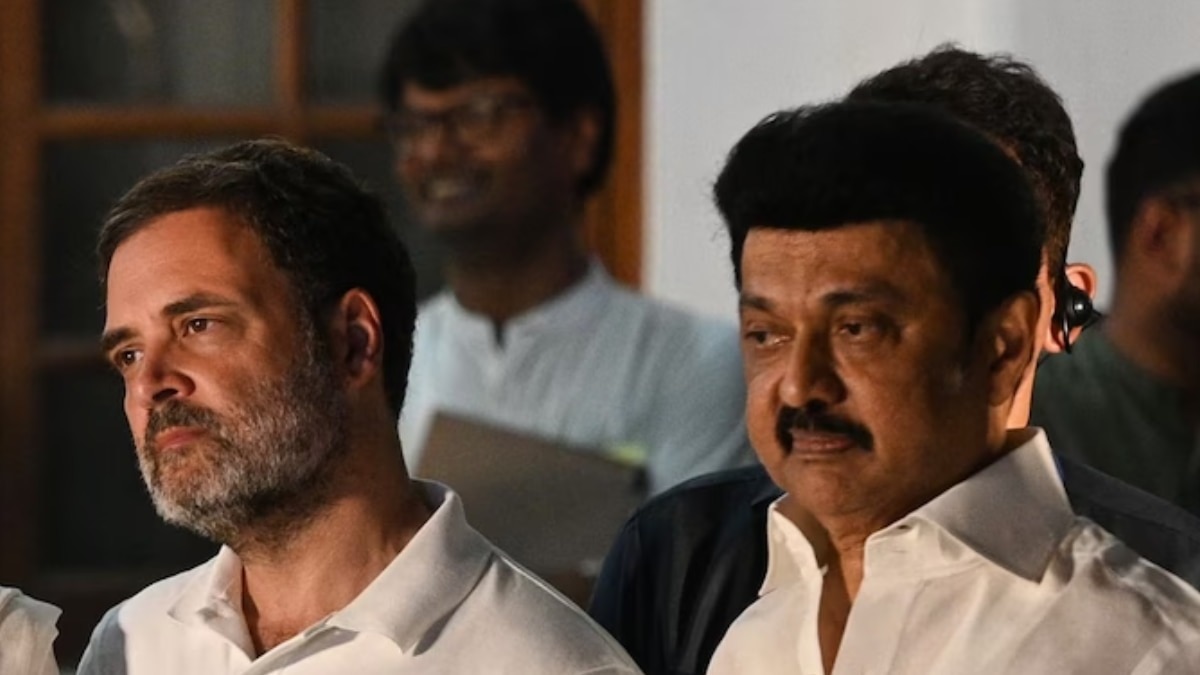
A high-powered delegation of INDIA bloc leaders, including Sonia Gandhi, Rahul Gandhi, Congress president Mallikarjun Kharge and West Bengal Chief Minister Mamata Banerjee, failed to persuade DMK chief MK Stalin to reconsider his party's support for the Centre's delimitation Bill on Sunday. Standing firm on his position, Stalin argued that defeating the legislation could leave Tamil Nadu without even the minimum safeguards for its political representation, insisting that there was no alternative but to back the Bill.Stalin said the DMK had managed to secure protection for Tamil Nadu's political strength for the next 25 years using its parliamentary numbers and that rejecting the proposed legislation would put the southern states at greater risk."Our stand is that if the delimitation Bill is defeated, we will lose even the minimum safeguard available for Tamil Nadu," Stalin told reporters after meeting the Opposition leaders at his residence in Chennai."There is no option but to support the Delimitation Bill. There is no other alternative proposal either. The parties that met me also do not have an alternative plan," he said. #TamilNaduFirst - , , ! , . , . , , .. , , . ... #DelimitationBill- . , . , . 2027 . 1971- #Delimitation ! , ! . . , 25 . Risk , ! , , ! ! ! Then, Now and Always: Tamil Nadu First!— M.K.Stalin (@mkstalin) November 29, 2026 Reiterating his party's priority, Stalin added, "For us, Tamil Nadu is first."In a subsequent statement, the DMK chief said leaders including Sonia Gandhi, Kharge, Rahul Gandhi, Mamata Banerjee, Communist Party of India (Marxist) general secretary M A Baby and Chief Ministers of three states had met him to convey their concerns and demands regarding the delimitation legislation. He said he explained to them that the demands the DMK had been raising from the beginning had been incorporated into the new delimitation Bill. While the leaders acknowledged this, they also raised other concerns, he added."Using the strength we currently have in Parliament, we have safeguarded Tamil Nadu's political power for the next 25 years. There is no room to take risks or make emotional decisions in this matter," Stalin said.WHY STALIN IS REFUSING TO CHANGE HIS STANDExplaining the DMK's position, Stalin said delimitation based on any Census conducted after 1971 could adversely affect Tamil Nadu's parliamentary representation and political strength. He warned that the consequences would extend to the other southern states, making the issue a question of political survival for parties in the region."If delimitation is carried out based on any Census conducted after 1971, Tamil Nadu's representation and political strength will decline," he said.Stalin also pointed to the Delimitation Commission, which he said was scheduled to be formed in January 2027, arguing that the DMK did not have the parliamentary strength to prevent southern states from losing their share of representation during the exercise."We do not have the parliamentary strength to prevent southern states from being betrayed in the Delimitation Commission scheduled to be formed in January 2027," he said.He said the party feared that the southern states' share of parliamentary representation could decline during the delimitation exercise, irrespective of political objections."In 2027, in the delimitation exercise, no matter who wants, no one can stop the states' percentage from decreasing. That is the fear," he said."For political parties in southern states, this is a do-or-die struggle," Stalin added, defending the decision to support the legislation as a strategic move to protect Tamil Nadu's interests.Invoking the DMK's political legacy, Stalin said the party's position on state rights had remained consistent across generations."Starting from Perarignar Anna, to Thalaivar Kalaignar, down to this Muthuvel Karunanidhi Stalin, we have held the exact same stance. We will fight for the rights of Tamil Nadu. We will win," he said.He also reiterated his message through the slogan: "Then, now and always: Tamil Nadu first."The DMK held a meeting of its MPs on Saturday and adopted a resolution reiterating its position on delimitation. Stalin said he conveyed the resolution and the party's reasoning to the INDIA bloc leaders during Sunday's meeting.The DMK has 22 MPs in the Lok Sabha and eight in the Rajya Sabha.THACKERAY ACCUSES STALIN OF BETRAYING TAMIL NADUWhile Stalin remained firm, Shiv Sena (UBT) chief Uddhav Thackeray launched a sharp attack on the DMK president, accusing him of betraying Tamil Nadu by backing the delimitation Bill.Thackeray appealed to Stalin to reconsider his position, alleging that the proposed exercise was an attempt to steal votes and redraw constituencies to benefit the ruling BJP."Stalin is betraying Tamil Nadu," he said at a press conference.Thackeray maintained that his party was not opposed to women's reservation but objected to linking it with delimitation. He said the Shiv Sena (UBT) would support the women's reservation Bill if the government separated it from the delimitation legislation."I could have supported the Bill, but I put the interests of Maharashtra and India above those of my party," he said.He argued that although the proposed legislation would increase the strength of the Lok Sabha, it would widen the existing gap in parliamentary representation between northern states and the rest of the country.Citing the difference between Uttar Pradesh and Maharashtra, Thackeray said the current gap of 32 Lok Sabha seats would increase to 48 after delimitation.Similarly, the gap between Tamil Nadu and Uttar Pradesh would widen from 41 to 61 seats, he claimed, arguing that this would be detrimental to Maharashtra and other states.The Centre is set to introduce a fresh Constitution amendment Bill in the Lok Sabha on November 30. The proposed legislation seeks to roll out one-third reservation for women by increasing the allocation of seats for every state and Union Territory in the Lok Sabha, as well as the strength of their legislative assemblies, by 50 per cent.The revised allocations and constituency boundaries are proposed to remain frozen until 2051.- Ends
Tamil Nadu comes first: Stalin backs delimitation Bill despite INDIA bloc pressure
Full Article
Original Source
Read the full article at Indiatoday →KhanList aggregates and links to publicly available news content. We do not host full articles from third-party sources. Always verify important information with original sources.