
In a parliamentary democracy governed by the First-Past-The-Post (FPTP) electoral system, multi-cornered contests possess their own peculiar, upside-down geometry: a five-cornered principal contest can favour the most cornered party.Ordinary logic suggests that a ruling outfit encircled by hostile armies on every flank should prepare for a swift, comprehensive burial. Electoral arithmetic in a fractured field, however, operates on cynical inverted mechanics. Beset by adversaries across the board, Chief Minister C. Joseph Vijay's rookie TVK finds itself sitting in the catbird seat not despite the encirclement, but because of it.When an electoral terrain is splintered into five jagged shards, the bar for victory no longer requires securing a commanding majority of popular approval; it can drive the effective threshold down towards a modest 28-to-32 per cent plurality. While four mutually loathing opposition factions charge into the ring swinging at one another in a blind, deafening melee, the encircled ruling party needs only to stand still, protect its consolidated bunker, and let its opponents execute an involuntary circular firing squad.Nowhere is this mathematical farce on more garish display than in the October 6 by-elections notified for the reserved constituencies of Madurantakam (SC) and Dharapuram (SC). On paper, this is billed as the first popular referendum on Vijay's nearly five-month-old administration. In reality, it is a five-ring circus where democracy is treated as a revolving credit facility for political mercenaries, while the weary taxpayer is conscripted to foot the bill.THE DEFECTION CIRCUS: RESIGN, RE-NOMINATE, REPEATBefore examining the arithmetic, one must confront the sheer moral squalor that necessitated these by-elections in the first place. Constitutional vacancies in a legislature are historically designed to accommodate human mortality, sudden judicial disqualification, or profound crises of conscience. Here, the vacancies arose out of unadulterated political horse-trading dressed up as democratic realignment.Two AIADMK legislators — K Maragatham Kumaravel in Madurantakam and P. Sathyabama in Dharapuram—had barely finished posing with their winning election certificates and taking their solemn legislative oaths before discovering an overwhelming, mystical urge to serve Chief Minister Vijay’s treasury benches.Within fifteen days of the new ministry taking charge, both MLAs abruptly discarded their seats like used bus tickets. Having already helped sustain Vijay in the confidence vote, they abruptly resigned on May 25 and formally crossed over to reinforce his fragile political position.In any healthy democracy, such cynical floor-crossing would be met with political quarantine. Instead, TVK demonstrated a breathtaking contempt for the electorate: it promptly rewarded both quislings with candidacies to contest the exact same seats under its own whistle symbol.The message to the voter is as insolent as it is unmistakable: Your franchise was merely a provisional draft; now line up in the sun once more to countersign our private trade-in bargain.The indelible ink had barely faded from the voters’ cuticles, the electronic voting machines had scarcely cooled inside district strongrooms, and the public exchequer is already being compelled to cough up crores of rupees to re-stage an election that was concluded only yesterday.It turns representative democracy into an absurd theatrical encore where the actors rewrite the script mid-act and demand that the audience buy fresh tickets at the door.THE CONSTITUTIONAL LOOPHOLE: RIGHTS VS REPRESENTATIONThis spectacle inevitably collided with the corridors of justice. When Saidapet-based advocate K. Suthan approached the Madras High Court with a Public Interest Litigation seeking to stay the by-elections and enforce financial accountability on premature resignations, he struck an intensely raw constitutional nerve.Before a Division Bench comprising Justices S. M. Subramaniam and Krishnaswamy Govindarajan, the legal paradox stood fully exposed. Under Article 190(3)(b) of the Constitution, an elected legislator may resign by writing to the Speaker, who must be satisfied that the resignation is voluntary and genuine before accepting it. Concurrently, Section 151A of the Representation of the People Act, 1951, ordinarily requires the Election Commission to fill a casual vacancy through a by-election within six months.The law recognises the legislator’s liberty to leave once that constitutional threshold is satisfied. But where, prayed the petitioner, is the law that protects the sovereign electorate from frivolous, manufactured vacancies?The High Court’s oral observations cut through the legalistic fog like a scalpel. Justice Subramaniam noted with searing clarity that an elected representative resigning only to re-contest immediately on another party's symbol amounts to "mocking democracy" and "insulting the voters".The Bench asked whether the Election Commission possessed any mechanism or could frame guidelines under Article 324 to address such opportunistic walkouts. The petitioner, meanwhile, sought an “Election Expenditure Security” deposit to be extracted from serial resigners to indemnify the public treasury.Predictably, the court declined to stay the elections, observing that it could not interfere after the statutory poll machinery had been set in motion. The court directed the Registry to place the PIL before the Chief Justice’s Bench on September 18 to be heard alongside connected matters.Yet the ethical indictment remains etched in stone. While the Tenth Schedule punishes the vulgar defector who switches parties while keeping his seat, it leaves a cavernous, yawning loophole for the clever defector who launders his betrayal through a tactical resignation.The Supreme Court has previously made it clear that without an explicit statutory prohibition, no authority can bar an elected representative from re-contesting. Enforcing a mandatory cooling-off period—barring premature resigners from seeking immediate re-election—or recovering poll costs from the turncoat therefore demands decisive parliamentary legislation.Until Parliament acts, the Constitution remains an open playground for political arbitrage.THE COMMUNIST INSIDE OUT: INSIDE SUPPORT, OUTSIDE COMBATIf the defection choreography is cynical, the ideological acrobatics performed by the Left parties elevate the by-election into pure dialectical vaudeville.The CPI and CPI(M) have long prided themselves on public principles and intellectual rigour. In these by-elections, however, their ideological twists would leave seasoned circus contortionists weeping with professional envy.Both parties have entered the electoral fray independently—the CPM fielding P. Suganthi in Madurantakam and the CPI nominating P. Lakshmanan in Dharapuram.Their stated justification? Righteous indignation! CPM State Secretary P. Shanmugam and his CPI counterpart took to public pulpits to thunder against TVK’s horse-trading, correctly decrying the moral hazard of re-nominating turncoats who forced costly by-elections within twenty days of the election.Yet, in the very same breath, both comrade leaders hastened to reassure the press that their decision to fight TVK in the dusty streets of Madurantakam and Dharapuram in no way diminishes their "committed outside support" to the Vijay government inside Fort St George!Observe the magnificent Marxist metaphysics at work: TVK's candidates are unprincipled horse-traders on the campaign trail, but Chief Minister Vijay remains a secular messiah who must be shielded at all costs from the bogey of Governor’s rule and the central designs of the BJP!The Left has perfected the art of hunting with the hounds at the hustings while running with the hare on the floor of the House. Opposing the government on Monday’s ballot paper while guaranteeing its constitutional longevity on Tuesday’s confidence vote is a red-lettered coalition absurdity at its most surreal.By dividing the anti-establishment and working-class votes, the comrades are not punishing TVK’s horse-trading; they are merely smoothing the path for the very turncoats they condemn.BATTERED OPPN: DMK'S LONELINESS & ADMK'S BETRAYAL PLANKAcross the rest of the field, the opposition enters the battle not as a cohesive front, but as mutually suspicious combatants nursing distinct, festering grievances.For the principal Opposition DMK, the by-elections are an unfamiliar, solitary trial. For over a decade, the party waged electoral warfare comfortably cushioned by an expansive, ready-made coalition umbrella—the Congress, the VCK, the IUML, and the Left dutifully guarding its flanks.Today, that grand tent lies dismantled. With Congress, VCK, IUML, and Vaiko’s MDMK climbing aboard Vijay’s Secular Social Justice Victory Alliance (SSJVA) Oops, that took some deep breaths the DMK finds itself marooned in unaccustomed isolation.In Madurantakam, DMK nominee I. Paranthamen has launched into a broadside against the four-month-old TVK administration, decrying tariff hikes, rising prices, and stalled welfare disbursements. In Dharapuram, S. Suganya fights an uphill battle.But rhetoric cannot mask strategic arithmetic: neither reserved constituency has historically been an impenetrable fortress for the DMK, and fighting a disciplined ruling alliance without most of its traditional partners turns an ordinary by-election into an existential survival test.Meanwhile, Edappadi K Palaniswami's AIADMK enters the contest with an undeniable moral grievance, yet handicapped by an eroding apparatus. Having lost two sitting legislators to wholesale treasury poaching, the party has made "betrayal" its central battle cry, fielding K. Kanitha Sampath in Madurantakam and K. Bhanumathi in Dharapuram.Yet EPS’s righteous fury is severely undercut by coalition paralysis. His principal regional ally, the PMK of Anbumani Ramadoss, had, at the time of writing, offered no emphatic commitment of its forces, remaining conspicuously non-committal.In Madurantakam, where the Vanniyar electorate exercises decisive demographic clout, the PMK’s cold neutrality pulls the rug straight from beneath the AIADMK’s campaign platform. Vowing ferocious vengeance against backstabbers while one’s own alliance partners refuse to saddle their horses is political tragedy masquerading as an offensive.Adding further turbulence to the fray is Seeman’s Naam Tamilar Katchi (NTK). Fielding G. Janakiraman in Madurantakam and mounting a high-voltage campaign in Dharapuram, the NTK may not win the seats, but it can play the relentless, unsparing spoiler.By preaching a purist, fiery gospel of Tamil nationalism and castigating all established players alike, Seeman reliably sponges up floating youth and anti-incumbency votes—the exact demographic that the DMK and AIADMK desperately need to consolidate if they hope to unseat the ruling candidates.THE MATHEMATICS OF FRAGMENTATION: THE 2026 BASELINEWhen these crosscurrents collide with the cold, immovable numbers of the 2026 Assembly election, the geometry of the five-cornered contest reveals its full mathematical tilt.Consider Madurantakam (SC). In the general election, the contest was essentially a razor-close three-way dogfight where the AIADMK's Maragatham Kumaravel polled 69,284 votes, the nascent TVK secured 62,090 votes, and the DMK trailed with 59,838 votes, leaving a wafer-thin winning margin of just 7,194 votes.In that April election, Maragatham won under the two-leaves symbol, while TVK fought in isolated infancy. Today, Maragatham brings a substantial chunk of her personal vote bank into the TVK camp, reinforced by the institutional machinery of Congress, VCK, and IUML. Meanwhile, the anti-TVK vote does not coalesce; it splinters four ways among the wounded AIADMK, the solitary DMK, the crusading CPM, and the purist NTK.In such an atomised field, even a modest retention of TVK's base allied with Maragatham’s personal following comfortably glides past the finish line.Now examine Dharapuram (SC), where the initial numbers suggested a far more formidable divide. The AIADMK’s P. Sathyabama had captured 81,100 votes, the DMK followed with 64,373 votes, and the TVK was marooned in third place with 46,438 votes, yielding an imposing AIADMK lead of 16,727 votes. On the surface, Dharapuram appears a significantly steeper hill for the ruling party. TVK trailed in third place.Yet the political alchemy has completely transformed. Sathyabama, who captured that towering 81,100 tally, is now the candidate wearing the TVK whistle. Even if half of that original tally belonged to the institutional loyalty of the AIADMK cadre, the remaining portion—tied to patronage, local influence, and alliance support mobilised through the Congress and VCK—transfers across.The one crucial variable that arithmetic cannot settle is how much of each legislator's 2026 tally belonged personally to the candidate, and how much was bound irrevocably to the two-leaves symbol. Yet with the opposition tally shattered into four warring camps — AIADMK nominee Bhanumathi, DMK's Suganya, CPI's Lakshmanan, and the NTK — the threshold required to capture Dharapuram no longer hovers near 80,000 votes. It drops precipitously into the low 50,000s.Fragmentation acts as a great leveller: it reduces the mountain the ruling party must climb, while dispersing the opposition into competing valleys. Across both constituencies, the post-poll realignment and the four-way fracturing of the anti-establishment pool turn what should have been an arduous defence into an arithmetical walkover.THE DEMOCRATIC VERDICT: CITIZEN AS HOSTAGEIn Tamil Nadu’s cynical political legend, by-elections have long ceased to be democratic audits; they are notoriously celebrated as "buy-elections". Ever since the inauspicious Thirumangalam by-election entered folklore for its alleged formula of crisp currency notes folded inside morning newspapers, tokens for quarter-bottles of liquor, and steaming packets of election-eve biryani, the contests in casual vacancies had effectively degenerated into an open-air retail auction.Chief Minister Vijay has repeatedly and sanctimoniously proclaimed that he would rather perish than pay for a vote, claiming to have broken the corrupt Dravidian mould in 2026. Yet, while his campaign may indignantly withhold envelopes of tainted cash, his party has embraced what looks unmistakably like the oldest, most tragicomic trick in the subcontinental playbook: welcoming and rewarding sitting legislators whose premature resignations created artificial vacancies, forcing an expensive by-election upon an exhausted public simply to inflate its own legislative buffer.When the voters of Madurantakam and Dharapuram saunter into the polling booths on October 6, they will not be participating in a majestic democratic pageant. They are participating in a damage-settlement hearing engineered by political ambition.The FPTP system is democracy’s most capricious servant. Designed to deliver stable legislative majorities, it frequently rewards the fractured, the condescending, the self-obsessed and the expedient. By deflating the opposition into four squabbling camps, it permits a ruling regime to capture a seat with the assent of less than a third of the electorate.The opposition parties will expend their energies decrying TVK’s governance, cursing deserters, and singing songs of ideological purity. But in their stubborn refusal to unite, even if only tactically, they remain the architects of their own undoing.October 6 will deliver its plurality. The renegades will likely return to the Assembly clutching fresh certificates under a new symbol, the ruling party will proclaim a glorious popular referendum, and the pundits will parse vote shares.But behind the din of victory whistles and concession speeches lies an inescapable democratic tragedy: the ordinary citizen, whose mandate was torn up within twenty days of the general election, remains an unpaid spectator to a farce—forced to queue in the sun to ratify a conspiracy, while picking up the tab for the privilege of being taken for a ride.- EndsPublished By: Abhishek DePublished On: Sep 19, 2026 11:44 IST
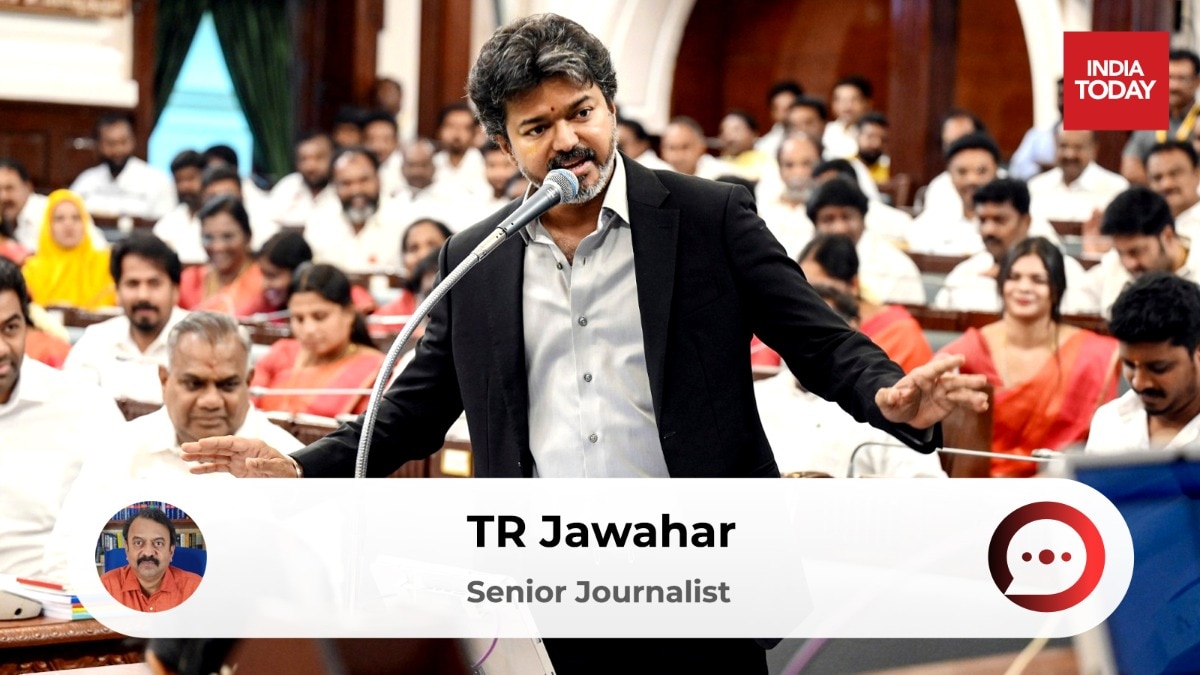
Tamil Nadu bypolls: Being the most cornered suits Vijay just fine
Full Article
Original Source
Read the full article at Indiatoday →KhanList aggregates and links to publicly available news content. We do not host full articles from third-party sources. Always verify important information with original sources.