
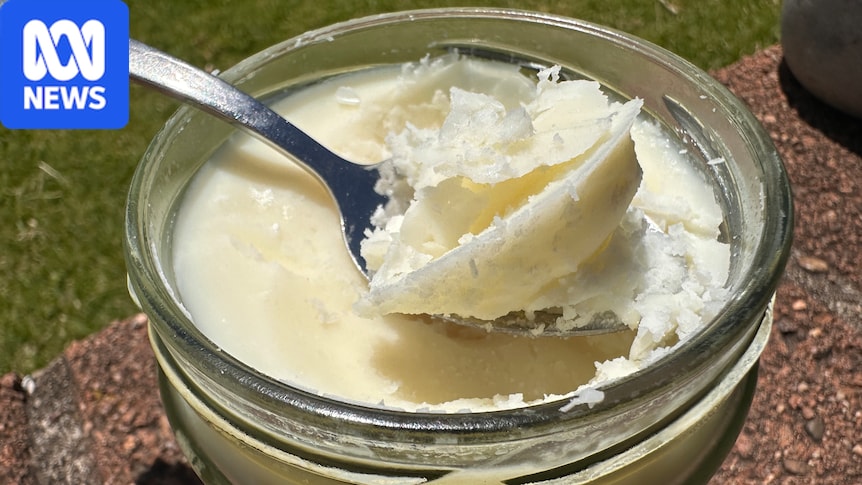
Australia imports 90 per cent of its diesel, which is vital for transport, agriculture, mining and more.The disruption of global oil supplies from the Iran war has highlighted Australia's fuel import dependence and increased momentum for alternative energy supplies."What's happened in the Strait of Hormuz is fuel security has become really important," GrainCorp's head of agri-energy, Jeff Summerville said."So, how can Australia be more self-sufficient?"Jeff Summerville says Australia's tallow industry could play an important role in improving the country's fuel security. (ABC Landline: Cameron Lang)Mr Summerville believed part of the solution could be found in tallow, a by-product of meat processing.The hard, whitish product is made by rendering, or melting and purifying, fat, oils and bones from cattle, sheep, poultry, pigs, goats and aquaculture.It can be combined with used cooking oils and canola oil to produce renewable fuels.Global demand drives record tallow exportsAustralia is the world's biggest exporter of tallow and animal oils.Last year, exports soared to a record $1.5 billion due to surging global demand, particularly from the United States.Tallow has made a comeback as a food ingredient in recent times. (ABC Landline: Tim Lee)"We still use some tallow for food refining whether it's pastries or good old-fashioned meat pies, but by far the bulk of it is exported into those renewable fuel markets," Mr Summerville said."We have about 3 million tonnes a year of raw materials to render," Jess Bloomfield, executive officer of the Australian Renderers Association, said. Last financial year, that resulted in more than a million tonnes of rendered products, primarily from beef, following the biggest cattle slaughter numbers in Australia since 1978.Jess Bloomfield oversaw exports of $ 1.5 billion last year. (ABC Landline: Tim Lee)"That went into pet food, poultry feed and pig feed and aquaculture," Ms Bloomfield said."Pet ownership is increasing across the globe, so is poultry and pig production. So the demand for animal protein meals is increasing every year."But the real driver is the growing demand for renewable, non-fossil fuels.US demand pushes tallow prices higherLast year's record tallow production resulted in the value of the commodity rising by a staggering 26 per cent."The US has a really strong renewable fuels policy, and they don't have enough feedstock for their own fuel production, so about 80 per cent is exported to the US at the moment," Ms Bloomfield said.Australia is the world's largest exporter of tallow and animal oils, with growing global demand for renewable fuels driving record exports. (ABC Landline: Cameron Lang)But there is movement to have Australian tallow made into renewable fuel at a refinery at home."The Australian government has already committed to the Cleaner Fuels Program, and there are policies being written at the moment," Ms Bloomfield said."We're really hopeful that we can support a domestic industry and our fuel security."Though primarily a grains exporter, GrainCorp is also the country's largest exporter of tallow and used cooking oil in Australia and New Zealand.It already has plans for a domestic renewable fuel refinery."GrainCorp, with our partners Ampol and IFM Investors, is working with the government to start up a low-carbon liquid fuel industry," Mr Summerville said."That would be a refinery here at Lytton in Brisbane and GrainCorp would be the feedstock supplier to that project."Renewable fuel boom drives investment in rendering plantsThe emergence of the renewable biofuel market has seen increased investment in new high-tech rendering plants across Australia.Parwan Protein and Tallow, north-west of Melbourne, opened in 2023 at a cost of about $40 million.Pietro Failli inside his family's high-tech rendering plant in Victoria. (ABC Landline: Tim Lee)Owners, the Failli family, are looking to double, perhaps even triple, production within the next few years.It takes in low-value material from its own meatworks and others from across Victoria and produces bone meal for animal feed and high-grade tallow."You've got your stomachs, you've got your heads, you've got your hoofs, you've got your fat and bone. So all that product goes into rendering," Pietro Failli said.Parwan Protein and Tallow in Victoria is one of a number of new rendering plants across Australia. (ABC Landline: Tim Lee)For centuries, tallow was used primarily for making candles and soap, and tallow plants were notoriously smelly and low-tech.It is a contrast to newly built rendering plants."We supply the food for animals and today's market, and the way we treat our pets and animals is like [the way] we treat our human beings, so we've got to make sure this is no different from any other food processing plant," Mr Fialli said.GrainCorp’s Jeff Summerville said tallow's transformation was remarkable.Tallow, a by-product of meat processing, can be combined with used cooking oil and canola oil to produce renewable fuels. (ABC Landline: Cameron Lang)"We often joke on the tallow trading desk that we're now the prettiest person at the dance. It used to be a really dirty, stinky product, but we're really seeing now it has become a globally traded product, an important product," he said."We think it's a great opportunity for farmers. We think it's a great opportunity for Australia in terms of fuel security."Watch ABC TV's Landline at 12:30pm AEST on Sunday or stream anytime on ABC iview.
Tallow could help solve Australia's fuel shortages
Full Article
Original Source
Read the full article at Abc →KhanList aggregates and links to publicly available news content. We do not host full articles from third-party sources. Always verify important information with original sources.