
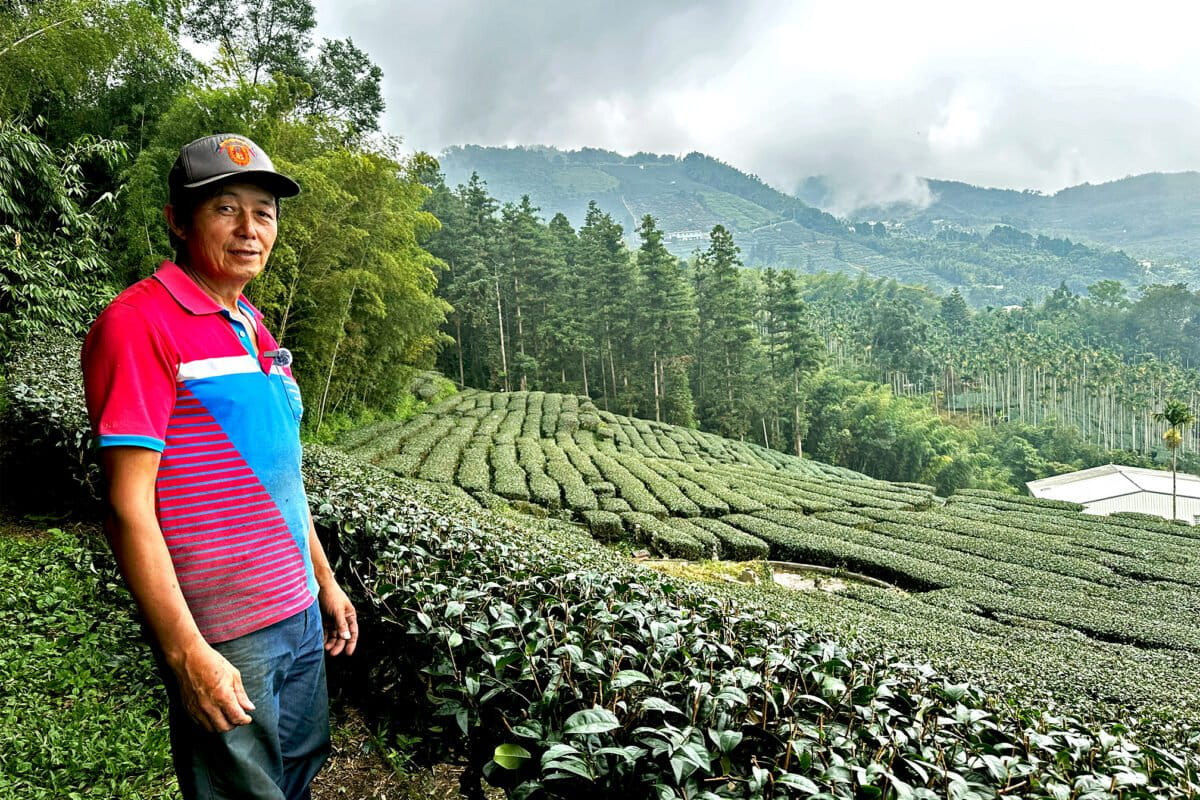
Alishan, a mountain region in central Taiwan, is famous for producing the prized high-mountain tea, but its tea production has declined in recent years.Tea growers are facing threats not only from soil degradation but also from climate change, leading a handful of tea growers to adopt more environmentally friendly farming methods and nature-based solutions.Tea farmer Lin Kuang-lin credits his nature-based approach for enabling his plants to weather the ecological challenges.Tea growers Yeh Hsin-wen and Chang Chih-tsung have chosen an even more radical approach with their tea farm, with their yefang, or wild-grown, method. MEISHAN TOWNSHIP, Taiwan — Lin Kuang-li’s tea plants blend in among the dozens of others that blanket this tea-producing village in Alishan, a mountain range in Taiwan. Yet the leaves he produces are slightly different from those of his neighbors. The 60-year-old is the sixth generation of his family to grow tea, primarily high-mountain Ch’ing-hsin (Qing Xin) oolong, in Longyanlin village, in Meishan township, Chiayi county. In 1976, his late father, Lin Yun-fa, started the business to boost the village’s struggling economy. Today, it has been half a century since the hills of Longyanlin began to be intensively cultivated. The plantations are aging, and the soil is becoming depleted. It seems fortunate that 30 years ago, Lin Kuang-li decided to switch to natural farming and stopped using pesticides. It was a risky bet, but he is proud of the results. The farmer takes a handful of soil and squeezes it in his hands. “My soil is now in excellent health,” he tells Mongabay. Alishan, in the central part of the island, is famous for producing Taiwan’s highly prized high-mountain tea, known as kao-shan cha in Mandarin. These oolong tea varieties, grown at elevations higher than 1,000 meters (3,300 feet) in Alishan and other misty alpine regions, are famous for their fragrant aroma, smooth texture and low bitterness. Lin Kuang-li stands among his Ch’ing-hsin oolong tea plants in Longyanlin village, Meishan township, Chiayi county, in Taiwan’s Alishan tea-growing region, on Sept. 24, 2026. Image by Aylin Ho for Mongabay. However, tea production in Alishan declined by 13.5% from 2014 to 2023, as its farmers are facing threats not only from soil degradation but also from climate change. This growing sense of ecological crisis has led a handful of tea growers like Lin to adopt more environmentally friendly farming methods and nature-based solutions. They forsake chemical fertilizers and even grow other plant species alongside tea rows to enrich soil chemistry. They give up pesticides and instead use natural pest control methods. Lin says he lets the tea plants grow fairly tall. Now and then, he prunes them and uses the cut branches as ground cover to protect the soil. “In winter, when it is dry, the soil is vulnerable to exposure to the sun, and the branches protect it,” he explains. “The nutrients produced by these cut branches are something humans cannot manufacture. The soil needs microorganisms to remain alive and active,” he adds. “For these microorganisms to survive, the topsoil has to remain moist. They also need a food source. Grass and leaves provide that food source.” Lin Kuang-li shows the soil in his tea plantation. Image by Aylin Ho for Mongabay. From vanishing mist to spring droughts Tea farmers usually use chemical fertilizers to replenish soil nutrients and boost crop yields. However, the use can be damaging in the long term. And that’s what happened in Alishan. “Over the years, the use of chemical fertilizers has made the soil more acidic and has reduced the availability of certain nutrients to plants,” says Jiang Hong, an associate professor in the Department of Geography and Environment at the University of Hawai‘i at Mānoa. Alishan also bears the brunt of climate change. The mountain region has warmed by 0.7°Celsius (1.26°Fahrenheit) over the past 10 years, nearly three times the average increase recorded in Taiwan over the same period. Warming temperatures have led to diminishing mountain fog. The mist plays an important role in blocking some of the intense sunshine and helping tea leaves stay moist. Its disappearance could alter the tea’s fresh and sweet flavor, experts say. Then, there are droughts. “Over the past five years, tea growers have experienced two or three spring droughts, at a time when they need water the most,” says Huang Cho-ying, chair of the Department of Geography at National Taiwan University in Taipei. Heavy rainfall has also increased in frequency, particularly in winter. “Landslides send excessive amounts of water down onto the tea plants, which cannot absorb it all,” Huang tells Mongabay. Chang Chih-tsung and Yeh Hsin-wen’s “wild-grown” tea farm, with Taiwan’s Alishan in the background. Image courtesy of Chang Chih-tsung. Lin credits his nature-based approach for enabling his plants to weather these ecological challenges. Instead of using chemical fertilizers, he plants alfalfa among tea bushes to use it as green manure. “My soil has a better capacity to absorb and drain water than soil treated with chemical fertilizers. So whether there is a drought or too much rain, the impact is less severe,” he says. The grower also says he still has his old irrigation system but rarely uses it. “Sometimes you have to let the tea plant experience periods of stress. When there is a drought, you should not immediately give it water,” Lin says. “You have to let the tea plant adapt to the climate. If it does not have the ability to withstand stress, it can easily become diseased and die.” It wasn’t an easy journey, however. He says the first three years were difficult, especially after he stopped using chemical fertilizers and pesticides. “Pest insects initially destroyed my tea plants,” he says. “But with patience, the balance of the ecosystem gradually returned. Predators arrived to kill the pests. And a healthy tea plant produces a thicker waxy layer that pests are less attracted to.” Tea plants cultivated by tea grower Chien Chia-wen, using a wild-grown method, in Meishan township, Chiayi county. Image by Aylin Ho for Mongabay. Growing wild In the neighboring village of Taihe, also located in the Alishan tea-growing region, a couple, Yeh Hsin-wen and Chang Chih-tsung, have chosen an even more radical approach. On a small patch of forest, their 3-meter (10-foot) tea plants grow wild. Their oolong tea, from the Jhin-hsüan (Jin Xuan) cultivar, is cultivated in a self-sustaining ecosystem with minimal human intervention, without pesticides and fertilizers. “We don’t prune them, we don’t water them, and we don’t add any products,” Chang, 51, tells Mongabay. The couple moved to Alishan in 2010 and spent the next decade developing their tea plantation under a farming method called yefang in Chinese, meaning “wild-grown,” with the help of another grower, Chien Chia-wen. Their wild tea plants grow beneath trees, drawing water and nutrients from deep within the soil. “Our plants have to search for water and nutrients deep underground: They grow downward, and their roots are deeper,” Yeh says. “A conventional tea plant of the same size can be pulled out by hand, with roots that only reach around 30 centimeters [12 inches] deep, whereas a ‘wild’ tea plant resists being pulled out,” Yeh, 45, tells Mongabay. Early this year, the spring drought was particularly severe, the couple says. Many tea plants on conventional farms, especially those without access to irrigation, died. While Yeh and Chang’s plants did not produce new shoots, they survived. Chang Chih-tsung, left, and Yeh Hsin-wen at their home in Meishan township on Sept. 24, 2026. Image by Aylin Ho for Mongabay. Yeh Hsin-wen harvests spring tea in her and Chang Chih-tsung’s plantation in Taihe village, Meishan township, Chiayi county, Taiwan, in 2024. Image courtesy of Chang Chih-tsung. Like Lin, the couple also found the first few years challenging. Insects like the tea green leafhopper (Empoasca onukii) ate tea leaves. However, after they let wild grass grow, the leafhoppers preferred to feed on the grass. “The wild grass around the tea plants is also important,” Yeh tells Mongabay. “It stays shorter than the tea plants, so leafhoppers, small insects that feed on it, are less likely to attack the tea plants.” For the tea growers, it is their way to make peace with nature, including creatures usually considered as “pests.” “If nature gives us something, why not share it with the insects?” Yeh says. “We no longer see insects as enemies: They have rights too, because this land does not really belong to us.” Lower yields Fewer than 10 growers in the Alishan tea-growing region choose the natural method, said Jiang, who has been studying tea farmers in Alishan. It is no surprise because going au naturel means accepting much lower output than the conventional method. “There is renewed interest in natural production, but low yields remain the main obstacle,” Huang says. Chang Chih-tsung and Yeh Hsin-wen’s “wild-grown” tea plantation in Taihe village. Image courtesy of Chang Chih-tsung. Yeh Hsin-wen harvests spring tea in 2024. Image courtesy of Chang Chih-tsung. Chang and Yeh’s plantation, for example, only produces between 24 and 36 kilograms (53 to 80 pounds) of tea a year, far fewer than conventional farms, making it difficult for them to solely depend on it. Chang also works as a photographer, painter, and documentary filmmaker. “We minimize the risks,” he says. Lin, meanwhile, opens a guesthouse to supplement his income. “Not all the organic farmers I’ve met have yields comparable to those of conventional farms,” Jiang says. “All of them are committed to a model of degrowth; they produce less and therefore have lower incomes, which goes hand in hand with producing in an environmentally friendly way.” Lin shares a similar philosophy. “My goal is to listen, and listen to the rhythm of nature,” he says. “Most growers are now seeking efficiency: you have to move quickly, produce a lot, and reduce production time. But if you poison your production, you will also be poisoned.” Banner image: Lin Kuang-li stands among his Ch’ing-hsin oolong tea plants in Longyanlin village, Meishan township, Chiayi county, in Taiwan’s Alishan tea-growing region, on Sept. 24, 2026. Image by Aylin Ho for Mongabay. Photos: Taiwan’s tea revival blends ancient terraces with new climate adaptations Citations: Scott, E. R., Li, X., Wei, J. P., Kfoury, N., Morimoto, J., Guo, M. M., … & Orians, C. M. (2020). Changes in tea plant secondary metabolite profiles as a function of leafhopper density and damage. Frontiers in Plant Science, 11, 636. doi:10.3389/fpls.2020.00636 Credits Topics
Taiwan’s tea growers let nature take back control as climate pressures mount
Full Article
Original Source
Read the full article at News →KhanList aggregates and links to publicly available news content. We do not host full articles from third-party sources. Always verify important information with original sources.