
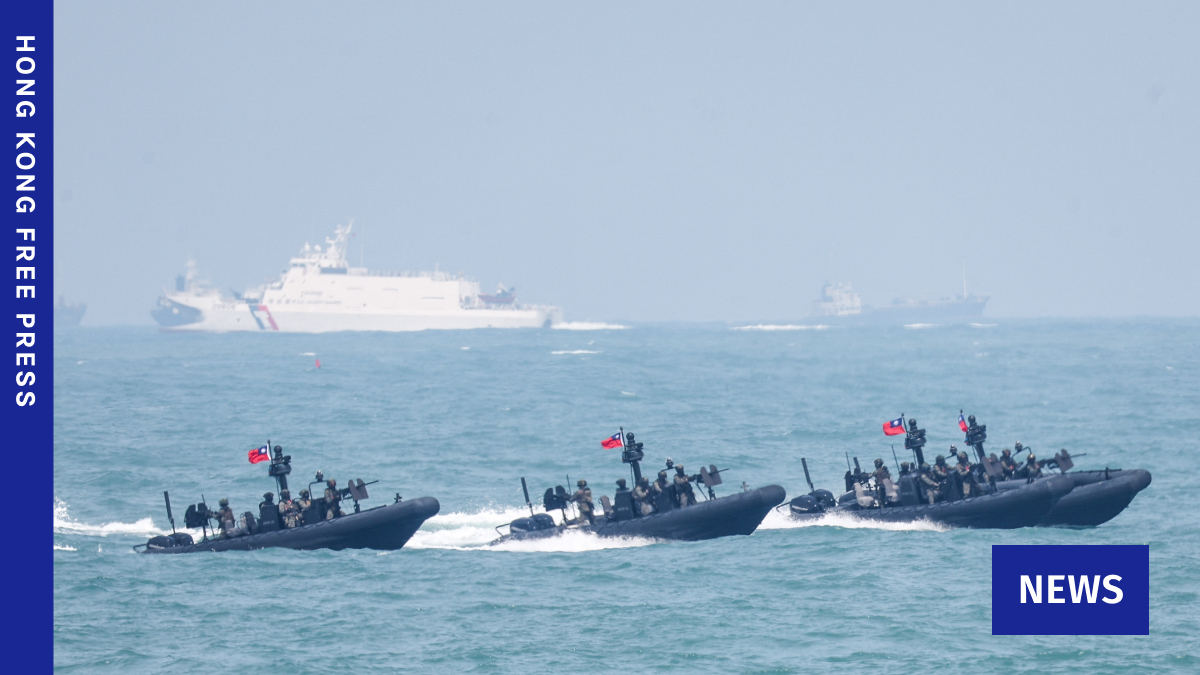
Taiwan said on Sunday it had driven away 16 Chinese coast guard, research and fishing vessels involved in simultaneous “maritime harassment” operations. An “unusually large” number of Chinese vessels took part in the coordinated operations around Taiwan’s main island and Pratas, a disputed island to the southwest, the Taiwanese coast guard said in a statement. Four M109 Special Operations Assault Boats sails through with a Taiwan Coast Guard patrol vessel (back) at a navy base as part of annual Han Kuang military exercise in Kaohsiung on August 8, 2026. File photo: I-Hwa Cheng/AFP. The Chinese vessels, including four fishing boats, carried out “simultaneous operations at multiple locations and engaged in hybrid warfare,” the statement said. The locations were off Taiwan’s eastern, southern and southwestern coastlines, and around Pratas. Some of the Chinese vessels entered Taiwan’s restricted waters. Beijing claims Taiwan is part of its territory and also asserts jurisdiction over the waters around the island, which Taipei rejects. China has long threatened to use force to seize Taiwan. China has intensified its maritime pressure on Taiwan in recent months, deploying record numbers of coast guard, research and other vessels around the island. Sunday’s operation comes after Taiwan’s coast guard used a water cannon against a Chinese recreational fishing vessel near Pratas, in the northern part of the South China Sea, on October 1, which sparked an angry response from China. Taiwan controls Pratas, also known as Dongsha, but Beijing also claims the island along with most of the strategic waterway. ‘Forceful action’ Taiwan’s coast guard said its vessels took “forceful action immediately to effectively neutralise the threats”. “China is attempting to unilaterally alter the status quo across the Taiwan Strait and create the false impression of jurisdiction,” the statement said. “Such actions will only lead to resentment among the people of Taiwan, and the Coast Guard Administration condemns them in the strongest terms.” China began conducting law enforcement patrols in waters to the east of Taiwan in June, which Taipei branded as “provocative” and “expansionism in disguise”. Beijing has since dialled up pressure, deploying a record 244 coast guard, scientific research and other ships around Taiwan’s main island in July, Taiwanese official data show. That compares with 55 ships detected in June and 30 in May, and 58 in July last year. In the first 21 days of August, 152 vessels were detected. About 60 percent are coast guard ships, with research vessels and other government boats making up the rest. The figures do not include Chinese warships, which China’s military deploys around Taiwan on a near-daily basis. Safeguard press freedom; keep HKFP free for all readers by supporting our team Support HKFP | Policies & Ethics | Error/typo? | Contact | Newsletter | Transparency & Annual Report | Apps Make a one-off donation. Type of Story: News ServiceProduced externally by an organization we trust to adhere to high journalistic standards. James Lee is a reporter at Hong Kong Free Press with an interest in culture and social issues. He graduated with a bachelor’s degree in English and a minor in Journalism from the Chinese University of Hong Kong, where he witnessed the institution’s transformation over the course of the 2019 extradition bill protests and after the passing of the Beijing-imposed security law. Since joining HKFP in 2023, he has covered local politics, the city’s housing crisis, as well as landmark court cases including the 47 democrats national security trial. He was previously a reporter at The Standard where he interviewed pro-establishment heavyweights and extensively covered the Covid-19 pandemic and Hong Kong’s political overhauls under the national security law. More by James Lee
Taiwan says drives away 16 Chinese ships involved in ‘maritime harassment’
Full Article
Original Source
Read the full article at Hongkongfp →KhanList aggregates and links to publicly available news content. We do not host full articles from third-party sources. Always verify important information with original sources.