
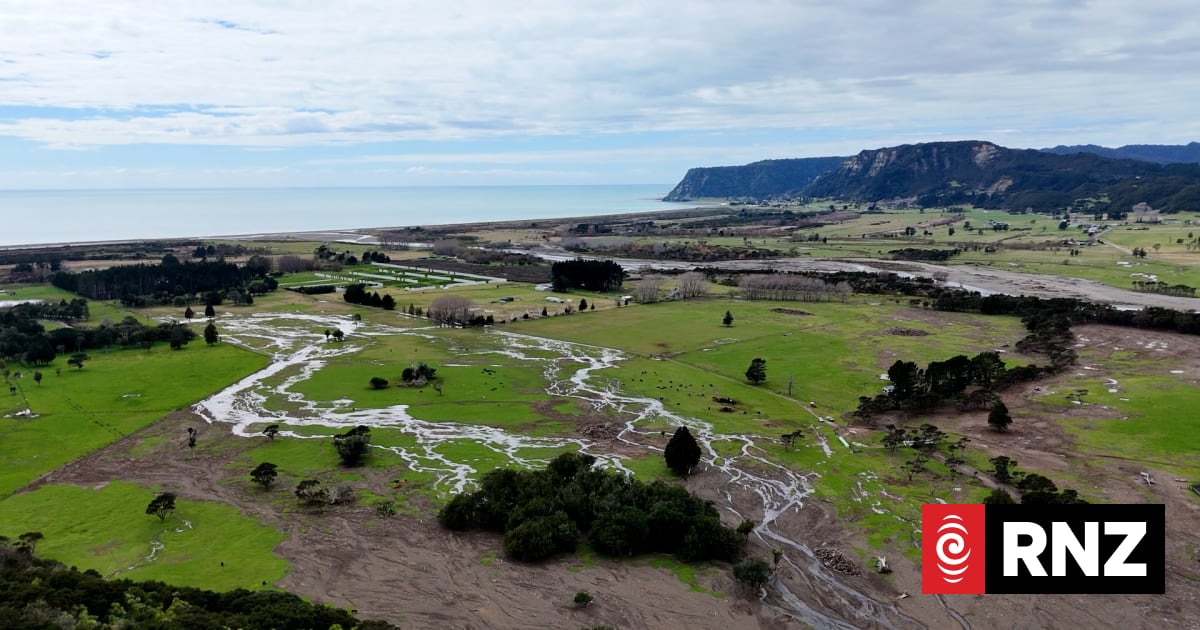
Seven months after communities on Tairāwhiti's East Cape were hammered by a destructive summer storm, locals are facing new problems related to its aftermath. Checkpoint's Teuila Fuatai has been in the coastal settlement of Te Araroa, where regular flooding is now adding to the damage.Something isn't right with Carl Mullany's land.When he greets us, it's a typical spring day. There are clouds overhead and enough of a breeze that we've all got a warm layer on. But it's the water around our feet, pooling on the gravel driveway and heading down Tokata road that's a bit puzzling.Since my cameraman Baz and I arrived in Te Araroa the previous night, there's been no rain. In fact, it's been dry skies for at least a couple of days, according to Carl.The water at our gumboots, he says, is the Wairenga stream - only it's no longer flowing down the stream bed that goes through his 57 hectare land block. Instead, it is spreading across the property and grazing paddocks and onto the neighbours' places.It started after the January storm, he says.Te Araroa resident Carl Mullany says the Wairenga stream no longer flows down the stream bed that goes through his 57 hectare land block and is instead spreading across the property.RNZ / Baz Macdonald"The water here is the Wairenga, and the Wairenga comes out of Pukeamaru, and it's supposed to head down in a straight line to Karakatūwhero river. But after the January flood, it's all changed."Pukeamaru is the maunga that borders Carl's land. It's covered in native bush, and like many of the hillsides, slopes and maunga in the area, it bears scars from January storm. According to research organisation Dragonfly, the sheer amount of rain that came down triggered more than 11,000 slips across the East Cape area.Carl shows us videos of what that looked like on his property. The deluge coated his land in mud, silt, bush and trees washed from the surface of Pukeamaru and the range behind his property."It was crazy," he says.The immediate emergency response was about cleaning up the obvious damage, he says.Diggers were brought in to help clear the land. Uprooted trees and logs were stacked into piles and burned."I've got to be thankful to the [Gisborne District] Council because they spent two-and-a-half to three months in here with diggers… and tidied it all up. They did a lot of work and burnt some of the stacks."However, it wasn't until after the initial clean-up the full effects of the storm on the land and waterways became clear, Carl says.Standing on the edge of a bridge on his property - which has been closed by the Gisborne District Council due to damage from January's storm - Carl shows us the stream bed where the Wairenga used to flow. The day we visit, it's dry and almost level with the rest of the land."You can see all the shingle there - it's just all built up and that's come out after the flood and it's just filled our Wairenga stream," he says."I could ride a horse under this bridge before, and now you can hardly walk under there."A dry creekbed after in Te Araroa after its water was diverted by January's storm.RNZ / Baz MacdonaldWhen we put the drone up, we can see why the stream bed is dry.The Wairenga is forming a new path to the sea, across Carl's land and the surrounding properties. It's a network of waterways winding through different sections, even pooling in some. Significantly, it's separate from the route the stream previously took which didn't interfere with people's use of the land and their homes.'I can't drive down my drive anymore'Sarah Jamieson's property is a few blocks over from Carl's.We meet at her aunt's house, and she walks us through a paddock to get to her place."I lost access in January after the [storm]," she tells us. "I can't drive down my drive anymore."When we get to her property, its two dwellings look out onto a pond filled with noisy ducks basking in the afternoon sun as it peaks between clouds.Sarah Jamieson can't drive down her driveway anymore.RNZ / Baz MacdonaldIt's only when Sarah gets us to look closer that we see the tracks which used to be her driveway. The pond, which has been there since the January storm, has made it unusable."That paddock's usually just under water now, doesn't go anywhere - it's got nowhere to go."Sarah has been parking at her aunt's house since then, traversing the neighbouring paddock on foot to get to her place. The wheelbarrow has been critical for trucking groceries in and rubbish out, she says."It's a bit inconvenient, but it is what it is."Rainfall, she says, changes things dramatically.After a few hours, the water begins to pool on three sides of her property. The pond creeps up at the eastern side of her land, where one of the two homes is located.That house was flooded in the January storm, and while it's managed to stay dry since, Sarah says she has abandoned plans to move into it. Instead, she has chosen to stay in the property's second dwelling, which is about 10 metres away but located on slightly higher ground."It gets pretty bad," Sarah says."[It's] scary because it's getting worse so I don't know if I'm going to be able to stay here for my lifetime, which sucks."Around the back of Sarah's property, the landscape has also changed since the January storm.Sarah Jamieson's driveway has been cut off by stormwater following January's storm.RNZ / Baz MacdonaldA new wetland is forming between paddocks, with one steer even taking a dip to get to the grazing spot he wants. The area is filled with logs and debris which has added to the water accumulating around the back of Sarah's land. It also means the water level rises steadily when there is enough rainfall."It's a wetland so I'm not sure if we can touch it. We have to talk to the Council on that. But as far as I know, we're not allowed to touch it to clean it," she says."So I'm not sure what we can do….It's a bit uneasy, not knowing."'Within hours of the rain, it's just all up'Our next stop is Lynda Akuhata-Brown's place. Like Carl, she is on Tokata road, just further away from Pukeamaru maunga and closer to the sea.I spoke to Lynda and her brother Marcus before travelling to Te Araroa. Both sent me videos of their family land soaked in ankle-deep muddy water due to rainfall.The afternoon we meet Lynda, she is mowing the lawns and the property looks to be in pretty good nick.Lynda Akuhata-Brown's property has been flooded at least five times since January.RNZ / Baz MacdonaldShe smiles and shows us around, starting with where the water has started to pour in when it rains.It comes from the western side of the property, downhill from Carl's place, Sarah says. She takes us to the fenceline, and points to the water which now sits on the surface amongst tall grass permanently - even on dry days and weeks."So within hours of the rain, it's just all up and then it just continues. It just fills up really fast so it floods really quick," Lynda says.Since January, the property has been flooded at least five times. Lynda, like many residents, is a keen gardener growing her own vegetables and herbs for kai. The day we're there, the rows of lettuce and silver beet look pretty good, but the potato patch is a whole in the ground.Lynda says it simply didn't make it through the ongoing floods and she dug it out. Her planter boxes also loose soil every time it rains."The last time it rained our toilet system went out so I had to leave the property."That's the first time since I've been here it's done that. So obviously the water table's really high. So even though it might be dry here, it's pretty wet under land."Like Sarah, Lynda says the pattern of flooding has raised questions about her future on her family land."[It's] definitely getting worse."My concern is that I want to live here and I want to grow my kai on here and my rongoā, and my business is on here as well."So that means sometimes I have to shut my business on days where it's toilets out or it's too wet."She also reckons she is lucky both homes on the property are slightly raised, meaning they haven't been flooded during a rainfall yet."I mean, I spend a lot of time on this land too, taking care of it and looking after it. So it's really, really disheartening when it floods."'The Wairenga stream's got to be cleaned out'It's a kind of stress and uncertainty that Carl and Sarah are also grappling with.Carl says he's now spending up to $300 a day on hay bales for his stock because the grass in his paddocks isn't growing."Because all our [land], it's all covered in shingle and water, the grass won't grow anymore. So you actually have to feed your animals with hay bales and stock feed."It's probably taken like 80 percent of my grazing [land]."Slash collected on Carl Mullany's farm following January's storm.RNZ / Baz MacdonaldHe says he and some of his affected neighbours met with the Gisborne District Council last month to see what could be done. He is mindful that while the flooding starts on his land, it's affecting at least half a dozen other properties and big land blocks."We had a meeting with the Council right here, and we've all came to the same conclusion that the Wairenga stream's got to be cleaned out from Karakatūwhero river to Pukeamaru."Carl says a stop bank has also formed near the top of the stream on Pukeamaru, which also has to cleaned out."And once they get the creek done, we can fix everything else. I can do everything else and get it back to how it was."Despite that, Carl says he has heard nothing from the council since the meeting.Checkpoint asked the Gisborne District Council about the ongoing flooding and the Wairenga stream bed.It says in a statement that a "technical assessment of the stream and surrounding catchment" has been completed."The assessment considers the changes that have occurred in the stream and potential options for addressing the resulting flooding issues."It says that while the council has undertaken work in the area following weather events, like removing woody debris and restoring access across the stream ford, the Wairenga stream does not fall under its responsibility.Specifically, it says "Wairenga stream is not part of a council-managed river control or land drainage scheme, so council does not have the same maintenance responsibilities it has for waterways within those schemes".The council also points out it's the regulatory body for waterways, therefore any work on the stream bed must be approved by them."We can provide technical advice to landowners about what work may be appropriate for them to carry out and what consenting requirements apply," it says.When I ask Carl about what's happening, he shakes his head.Rivers diverted across properties in Te Araroa following January's storm.RNZ / Baz MacdonaldAs far as he understands, he is not allowed to remove anything from the stream bed. He also says he and the other landowners simply can't come up with the cash for the kind of machinery and clean-up job needed on their own.Meanwhile, Sarah reckons it's not hard to know what people need. In addition to dealing with the new pond and wetland around her property, she's also among a group of residents who still haven't had their water supply restored since the January storm. They're either collecting it in big plastic barrels off their roofs, or carting in external containers as they wait for tanks."Help," she says. "Help us."
Tairāwhiti floods: 'That paddock's usually just underwater now'
Full Article
Original Source
Read the full article at Rnz →KhanList aggregates and links to publicly available news content. We do not host full articles from third-party sources. Always verify important information with original sources.