
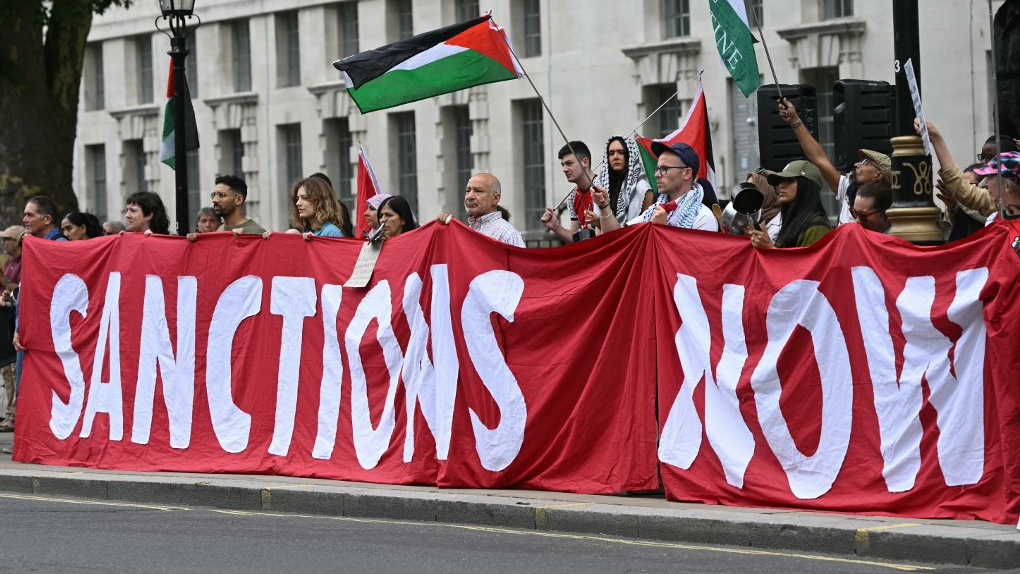
Prime Minister Andy Burnham arrived in Downing Street promising to deliver change - and a break with the political and economic settlement that has prevailed in Britain since the late 1970s. That necessarily implied an indictment of his predecessor, Keir Starmer. Starmer himself came to power promising change, failed to deliver it, and ultimately paid with his political career. There were also hints that perhaps Burnham might take a different approach on the defining issue of Starmer’s failed premiership: Palestine. He offered an apology for Labour’s handling of Israel’s onslaught on Gaza, though stopped short of recognising it as a genocide - an implicit acknowledgment that Starmer’s support for Israel was not only morally indefensible, but had been politically highly damaging for the Labour Party. Certainly, there have been some signs of a change in approach and tone. Foreign Secretary Ed Miliband has announced a prohibition on British companies investing in illegal West Bank settlement projects, while Burnham has introduced a ban on goods imported from Israeli settlements in the occupied territories. So deranged and surreal are the times we live in that Mike Huckabee, US ambassador to Israel and Christian Zionist fanatic, this month accused Miliband (himself Jewish, of course) and the British government of “Jew hate”. New MEE newsletter: Jerusalem Dispatch Sign up to get the latest insights and analysis on Israel-Palestine, alongside Turkey Unpacked and other MEE newsletters Huckabee makes an unconvincing anti-antisemite, given that his own end-times worldview mandates that, upon the second coming, Jews must either convert to Christianity en masse or be smited. But Huckabee’s zealotry is beside the point. However bitterly the Trump administration and its representatives complain about the Burnham government’s supposed hostility towards Israel, the reality is that Britain continues to line up obediently behind the US and Israel when it actually matters. The political noise masks an underlying continuity. If anything, the incessant whining of US President Donald Trump and his acolytes flatters Burnham and Miliband. Litmus test As the investigative journalist Matt Kennard recently reported, since Burnham became prime minister, at least 10 military flights have travelled to Israel from Royal Air Force bases. Eight US KC-135 Stratotanker refuelling aircraft travelled to Israel from RAF Mildenhall, and a US C-17 transport plane from RAF Lakenheath, and an RAF A400M from Akrotiri, on Cyprus, flew to Tel Aviv. Despite being RAF bases, Mildenhall and Lakenheath are operated by the US Air Force; nevertheless, those flights would have required UK government authorisation. The UK government has explained the A400M flight as resupplying British embassy personnel, but there has been no comparable account for the others. While we don’t know what these aircraft were transporting, the A400M can carry up to 37 tonnes of cargo, including a Patriot missile system, helicopters or as many as six Land Rovers. Britain's settlement trade ban is cosmetic. For it to work, it must sanction Israel Read More » It is thus clear that RAF bases are being used, with the assent of the British government, to facilitate military traffic to Israel while it continues its assault on Gaza and accelerates the expansion of settlements in the West Bank, while also occupying large swathes of southern Lebanon, bombing and flattening villages there, and expelling their populations. Rhetoric or political gestures are one thing, but this is another. Under Starmer, of course, the RAF itself conducted hundreds of surveillance flights over Gaza, with British intelligence being passed on to Israel while it exterminated tens of thousands of Palestinians en masse, possibly more, thus directly implicating Britain in enabling Israel’s genocide. The litmus test of Burnham’s sincerity, then, is not whether he is prepared to introduce this or that sanction, or maybe make some critical remarks about Israeli Prime Minister Benjamin Netanyahu (even the most disingenuous liberal Zionist is prepared to do that). It is whether he is prepared to dismantle and end the practical cooperation between Britain and the genocidal Israeli regime. So far, the evidence available to us suggests far more continuity than rupture. None of this is to say that a ban on imports from illegal settlements in the occupied Palestinian territories is not welcome, or that it represents no improvement on the status quo. But there is reason to question whether the announced ban would be effectively enforced. There is already a UK trade rule that bars goods produced on illegal settlements from receiving preferential tariff treatment. However, the Global Echo Litigation Center, a US non-profit, has threatened HM Revenue and Customs with legal action amid allegations that goods produced on settlements, mislabelled as Israeli, have been allowed into the UK tariff-free. If British authorities have failed to enforce rules already on the books, as alleged, the announcement of new restrictions has to be viewed with a sceptical eye. There must be rigorous enforcement and traceability, with meaningful penalties for any companies that try to circumvent the rules; otherwise, any such ban risks turning out to be far weaker in practice than the surrounding controversy might indicate. 'Special relationship' What would constitute more meaningful pressure on Israel? Cutting off military cooperation; ending the provision of intelligence; imposing a genuine arms embargo; blocking the use of RAF bases to facilitate supply flights to Israel; and imposing robust economic sanctions on the institutions and individuals enabling its genocide, theft of Palestinian land and ethnic cleansing of its people. Targeting the settlements alone, as if they somehow stood in isolation from the rest of Israel’s genocidal, settler-colonial project, is not enough. However, this is where the so-called “special relationship” kicks in. No wonder that UK diplomats have been keen to assure the White House that these new sanctions are 'largely symbolic' Britain’s military and intelligence apparatus, and its foreign policy establishment, are deeply integrated with the US. Britain’s role in the world since Suez has been that of a willing, if not obedient, junior partner in the US-led world order, especially in the Middle East. To do anything else would be looked on by Washington as insubordination, potentially incurring real economic and political costs for the UK. Trump, needless to say, is a particularly intolerant president. It is therefore no wonder that, as Bloomberg reports, UK diplomats have been keen to assure the White House that these new sanctions are “largely symbolic and will have no material impact on the UK’s wider relationship with Israel”. The ban on investment in and trade with West Bank settlements, provided it has some teeth, is still better than nothing. But a more fundamental shift in UK-Israel policy would amount to a challenge to Britain’s long-held position as an underling of US imperialism. Seriously confronting Israel means incurring the wrath of Washington. This is the third rail that Burnham will not touch. The views expressed in this article belong to the author and do not necessarily reflect the editorial policy of Middle East Eye.
'Symbolic' UK sanctions on Israel aim to avoid Washington's wrath
Full Article
Original Source
Read the full article at Middleeasteye →KhanList aggregates and links to publicly available news content. We do not host full articles from third-party sources. Always verify important information with original sources.