
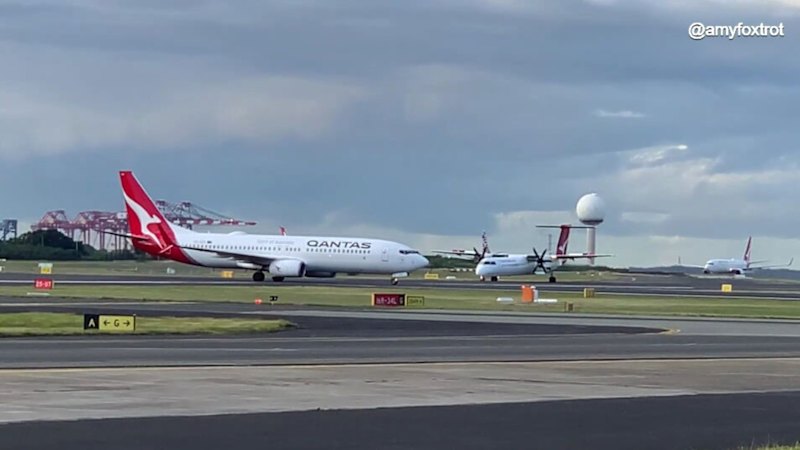
Updated September 30, 2026 — 12:08pm,first published 11:49amA near miss runway incursion at Sydney Airport has been categorised at the most serious level on an international scale, as investigators reveal predictions of “elevated fatigue risks” for staff at the time.The Australian Transport Safety Bureau released four preliminary reports on Wednesday related to six recent incidents at Sydney Airport.The Boeing 737 (left) and the Bombardier DCH-8 involved in a breakdown of co-ordination at Sydney Airport in July.YouTube/@amyfoxtrotThe reports do not make findings or recommendations, but set out the sequence of events and operational context in which the incidents took place, Australian Transport Safety Bureau Commissioner Angus Mitchell said.“In all six incidents, safety defences operated in some form. Air traffic controllers, pilots, or ground crew acted to prevent more serious outcomes. Nonetheless, we need to understand why those interventions were required,” Mitchell said.The first incident, involving a Boeing 747 and a Bombardier DCH-8, on the morning of July 27, has been assessed as a “Cat A runway incursion”.“The most serious level on the international scale, and only the third such incident in Australia since our records began in 2003,” Mitchell said.Air traffic control staffing has emerged as a recurring line of inquiry.Quentin JonesAir traffic control staffing levels have been strained globally and emerged as “a recurring line of inquiry” during the investigations at Sydney Airport, Mitchell said.“I will stress that we have not determined whether staffing resources directly contributed to any occurrence, or whether they were simply underlying conditions that were effectively being managed by Airservices [Australia].“However, our report also notes that Airservices’ own roster modelling predicted elevated fatigue risks for staff at the time of many of the occurrences, in some cases applicable to multiple personnel on the shift.“Whilst an elevated fatigue risk does not necessarily mean a controller was fatigued, or that fatigue affected performance, we are, however, examining the effectiveness of the measures that were in place to manage this pre-identified risk,” Mitchell said.Measures put in place to manage the risks are being examined as the ATSB probes “whether recent events reflected a growing trend or a more localised issue to Sydney”.Airservices Australia said the interim reports would be reviewed and the organisation would continue working with the bureau as it finalises its investigations.“The aviation safety system is designed to manage operational risks through multiple safeguards and, based on the information currently available, the recent occurrences do not indicate an immediate safety risk to the travelling public,” an Airservices spokesperson said.“We have publicly acknowledged workforce pressures at Sydney and are addressing them through our Sydney Service Resilience Plan.“Our individual occurrence reviews noted no correlation to fatigue.“The ATSB in its preliminary reports has not determined that staffing, overtime or fatigue contributed to these occurrences, and has noted that an elevated modelled fatigue risk does not mean a controller was fatigued or that fatigue affected their performance.”Get alerts on breaking news as it happens. Sign up for our Breaking News Alert.Jack Gramenz is a breaking news reporter at The Sydney Morning Herald.Connect via email.From our partners
Sydney Airport near miss assessed at ‘most serious level’
Full Article
Original Source
Read the full article at Smh →KhanList aggregates and links to publicly available news content. We do not host full articles from third-party sources. Always verify important information with original sources.