
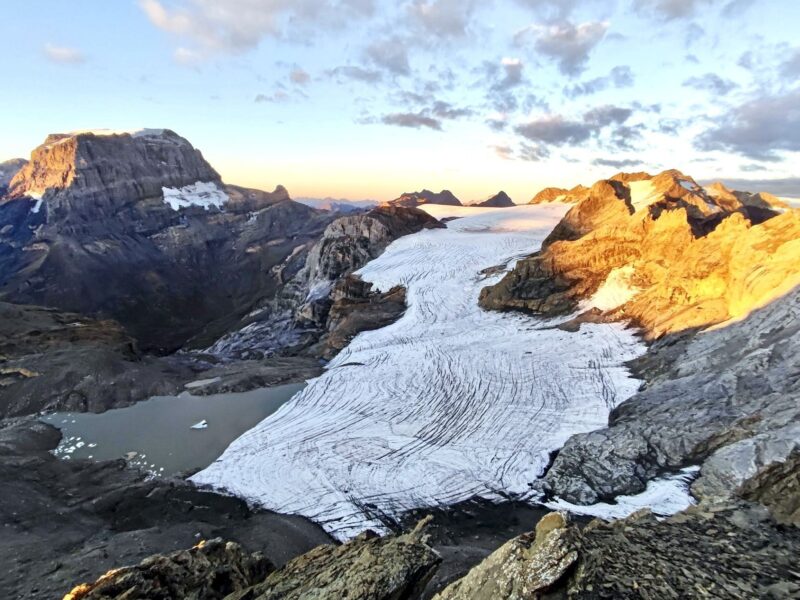
Switzerland's iconic glaciers are quickly melting as climate change heats the planet. This year, they shed about four times as much water Swiss households consume a year.(CN) — Over the past five years of record-breaking heat, glaciers in the Swiss Alps lost nearly 20% of their ice mass, more than twice as much as any previous five-year period, Swiss scientists said Thursday.This year’s extreme summer heat and a scarcity of winter snowfall accounted for about 5.5% of that loss, according to Switzerland’s annual glacier monitoring report.Glacier loss this year was slightly below that of 2022, the worst year on record. But the biggest glaciers, including the famous Great Aletsch Glacier, the largest in the Alps, saw record levels of loss, the report added.“You can see it every year if you go up to glaciers,” said Andreas Linsbauer, a glaciologist who helped write the report. “They are really losing a lot of mass and they’re retreating really fast.”The Glacier Monitoring in Switzerland Network and the Swiss Commission for Cryosphere Observation of the Swiss Academy of Sciences produce the annual reports.Like much of Europe, the Swiss Alps saw long-lasting and intense heat waves between May and September, raising the temperature even on the highest mountains.“This year’s results show an extraordinary ice loss,” the report said. “For some glaciers, even all-time records were reached.”June to August were the hottest months on record in Switzerland, according to MeteoSwiss, the national weather agency.Scientists estimate about 80% of Switzerland’s glaciers will disappear by the end of the century even in the best-case scenarios for climate change.Scientists walk on the Rhône Glacier in Switzerland next to a deep collapse on the glacier. Huge cavities beneath the ice can suddenly collapse and further accelerate a glacier's retreat. (Photo by Matthias Huss of the Glacier Monitoring Switzerland Network)“For the Swiss glaciers, there is not much chance that they will survive until the end of the century,” Linsbauer said, speaking by telephone.Already, many smaller glaciers have disappeared. More than 1,000 glaciers vanished between 1973 and 2016. Between 2016 and 2023, about 100 more glaciers disappeared and “many more will follow,” the report warned. This year, at least two glaciers, the Bella Tola and Griessfiren/Plattalvafirn, melted away.Increasingly, scientists are finding “internal decay” taking place inside glaciers where cavities carved by water and warm air appear beneath the ice, the report said.These cavities “may grow over several years and then collapse,” the scientists said. When this happens, deep craters form and accelerate glacier retreat.Climate change is the culprit. The planet is about 2.5 degrees Fahrenheit warmer than the pre-industrial era and the average temperature is expected to rise further even if carbon emissions are drastically reduced.The shrinking of Switzerland’s glaciers is an emblematic example of climate change and underscores its disastrous effects on Europe, which is warming about twice as fast as other continents.This year, snow depths on glaciers at all elevations were far below the long-term average due to a dry winter, making melting worse, the report said. This was among the ten least snowy winters since measurements began. Snow acts as a protective cover on glaciers, but snow had partly disappeared by June and it was almost entirely gone by September even on mountain slopes 11,462 feet above sea level, the report said.The loss of glaciers and the water they release poses major problems for farmers, river levels, hydropower plants and supplies of drinking water.There’s a lot of water stored in glaciers. Between July and September, the melting Swiss glaciers released about 581 million gallons of water, or the equivalent of about four times the annual consumption of water by Swiss households, the report said.“For now, glacier melt is therefore still helping to ease summer water shortages,” the report said. “However, this effect is already diminishing significantly as the ice-covered area shrinks.”Glacier melt heightens the risk of ice avalanches and catastrophic flooding too. In August, more than 1,000 people were killed when a glacier, likely weakened by climate change, collapsed along the border of Nepal and Tibet, releasing a massive flood.Courthouse News reporter Cain Burdeau is based in the European Union.Subscribe to our free newslettersOur weekly newsletter Closing Arguments offers the latest about ongoing trials, major litigation and rulings in courthouses around the U.S. and the world, while the monthly Under the Lights dishes the legal dirt from Hollywood, sports, Big Tech and the arts.Additional Reads
Swiss glaciers are vanishing: 20% gone in 5 years
Full Article
Original Source
Read the full article at Courthousenews →KhanList aggregates and links to publicly available news content. We do not host full articles from third-party sources. Always verify important information with original sources.