
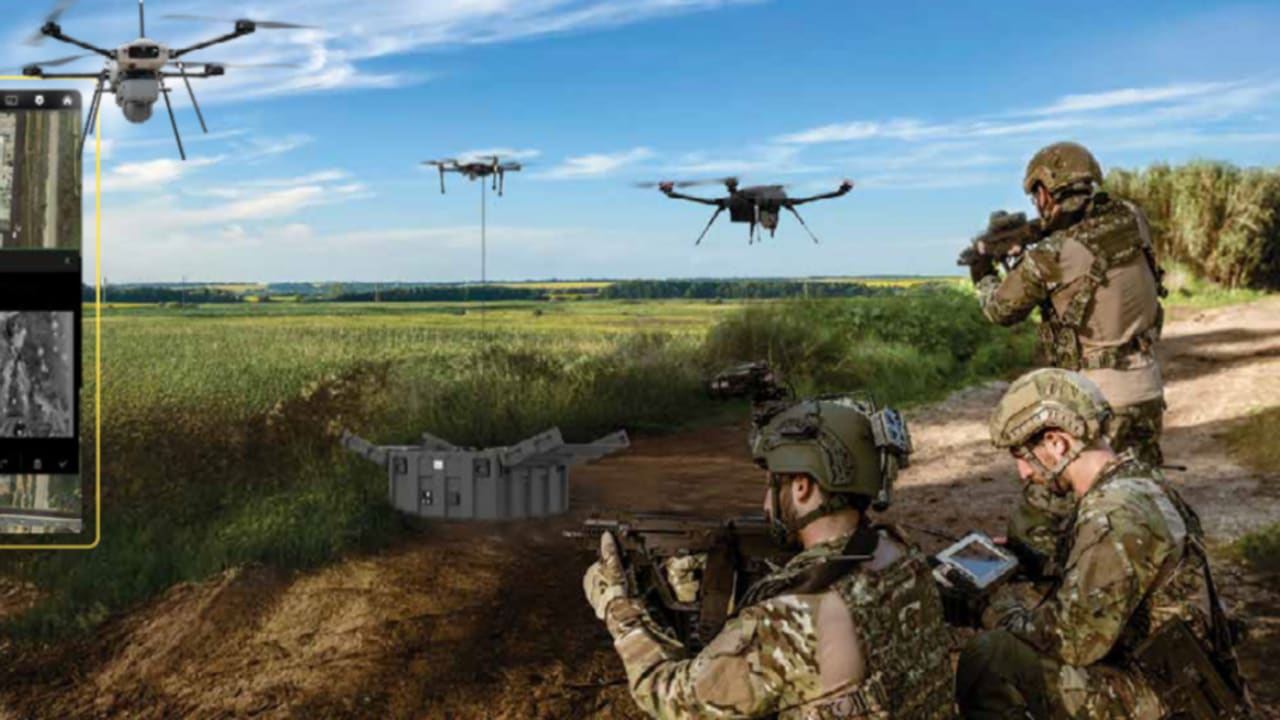
SEPTEMBER 9, 2026 15:47The Jerusalem Post and a limited number of other media outlets on Wednesday visited Elbit-FUSE's facility for building mass-scale robot and drone armies.The visit was timed to Elbit-FUSE's unveiling of a range of new and updated products relating to enabling small numbers of human soldiers to direct dozens or even hundreds of robots and drones to perform defensive and offensive functions in large-scale swarms.Imagine hundreds of drones combining with dozens of tank-style autonomous vehicles and smaller tactical bat-shaped, dog-shaped, and otherwise specialized robots to defend a border or take over an enemy urban neighborhood.The drones provide air cover, the autonomous tank-style vehicles provide tactical firepower, and the smaller robots enter structures where the enemy forces are hiding to defeat them up close or neutralize their booby traps without a single soldier setting foot in the neighborhood.This is the vision that Elbit-FUSE presented to the Post and some other media on Wednesday.View of Elbit Systems offices in Jerusalem on December 3, 2024. (credit: Chaim Goldberg FLASH90)Drones, autonomous weaponry increasingly defining global warfareElbit-FUSE did not enter this arena in a vacuum.Ukraine announced in July that it has reached a rate of producing 10 million small tactical drones per year and is looking to double that volume.China, the US, and others are all starting to mass-produce drones and robots in astronomically larger quantities than in the past.In line with these developments, IDF Chief of Staff Lt.-Gen. Eyal Zamir on Tuesday night announced that by Chanukah-December, the IDF will have opened an entirely new branch to focus on robots, drones, and AI battle forces."Military forces are entering a new operational era in which combat effectiveness will increasingly depend not only on autonomous platforms themselves, but on the ability to integrate and coordinate large numbers of autonomous systems within existing maneuver forces in real time," said Eyal Dahan, CEO of FUSE, which is a subsidiary recently developed by Elbit to focus on these issues, having combined at least four other related entities into one."FUSE was established to deliver that capability today - combining autonomous platforms, operational AI and scalable One2Many command capabilities into integrated operational solutions that can be rapidly deployed and integrated into modern combat formations."Speaking at a private briefing on Wednesday, Dahan said that even mass swarms of robots and drones would not completely replace human soldiers.Other Elbit officials clarified that, on defense, fewer human soldiers may be needed in general to manage the autonomous vehicle swarms.In contrast, on attack, these officials clarified to the Post that a larger number of soldiers could be required, depending on the mission.As an ethical matter, Elbit officials said that humans will and must remain in the loop to sign off on targeting decisions and to reduce collateral harm to civilians.In that sense, the AI systems installed in the myriad kinds of drones and robots that Elbit sells, including extremely advanced sensors for distinguishing combatants from civilians, are still not the final line for approving an attack.If an attack is in an area where few civilians and sensitive items are known to be in play, fewer human soldiers may need to be involved.But if an attack is against a highly sensitive location or one where many civilians could be at risk if the strike is not precise, then more soldiers will be involved to analyze the situation, the same way that occurs now.At the facility, the Post saw five different versions of the Firefox drone, with each version having different uses, abilities in day versus nighttime, and different price ranges depending on whether a client-buyer seeks cheaper, less fancy machines versus smarter, high-end machines.Some drones might cost as little as $2,000, while some might cost hundreds of thousands of dollars.Large variety of machines in productionThe Post also saw FPV drones, drones disguised as items in nature, something which has been previously reported on, machines with shorter and longer range capabilities, and machines with laser-guided capabilitiesIn another section of the facility, the Post witnessed multiple stages of drone and robot assembly.Some Elbit-FUSE technicians were assembling single parts, such as cameras or wings; others were meeting to discuss ongoing technical issues, while yet others were bringing all of the many parts of a drone or a robot together.Many dozens of robots and drones were already assembled on shelves, and many others were already secured in special delivery wrapping material for delivery.There were special rooms for simulating intense wind environments as well as for handling special laser-related issues.These laser-related issues are important, but not as complex as those in a different Elbit facility which the Post visited in June, which is at the heart of Elbit's most complex laser production.FUSE has 160 employees, with 110 at the main facility which the Post visited, of which around 65% are engineers, with many others being programmers or having other special skills - all of which is just one subsidiary of Elbit's much larger operations.Dahan emphasized that having many engineers available was critical to constantly updating each product, noting that one drone had been updated four times in the last three years to stay on the cutting edge of developing technologies.A major focus of the FUSE product launch was its "One2Many" operational capabilities, which are powered by a unified AI operating system enabling centralized coordination of autonomous swarms and distributed aerial and ground formations at scale.FUSE said that it "delivers mature military-grade autonomous systems designed for scalable and resilient multi-domain operations, supported by Elbit Systems’ operational experience and high-volume manufacturing infrastructure."According to Dahan, FUSE's solutions have accumulated more than 1,000,000 operational flight hours and over 100,000 autonomous ground operation hours, with thousands of platforms delivered worldwide.Generally, its products are focused on medium- to long-range missions, as opposed to competitors like SpearUAV, an Israeli defense tech company based in Tel Aviv, which announced on Monday that it has close to 1,000 Viper 300 loitering munitions (LM) ready to deliver to customers around the world.While Elbit-FUSE is focused on Israel first as a client, the US and many European countries remain strong customers.Although there are large American and other foreign competitors in this field, Elbit-FUSE has shown that its products not only perform at a higher level from product to product, but that it excels more than many others in being able to connect the operations of swarms of products in both the air and on the land simultaneously.Dahan said that FUSE is also working on expanding into drone and robot swarm operations at sea.It has been previously reported that the Israeli navy has been operating autonomous sea vehicles already in recent years, though it is unclear when operating swarms at sea will be ready to be rolled out.Elbit Systems has already been among the Israeli companies developing such technologies, including its already publicized 12-meter Seagull autonomous surface vessel that is designed to patrol offshore infrastructure for up to four days. It also "incorporates mine countermeasures (MCM), anti-submarine warfare (ASW), maritime security (MS), electronic warfare (EW), and other advanced systems and technologies."Follow us on Google
Swarming the battlefield: Elbit-FUSE reveals mass drone and robot armies as IDF plans new AI branch
Full Article
Original Source
Read the full article at Jpost →KhanList aggregates and links to publicly available news content. We do not host full articles from third-party sources. Always verify important information with original sources.