
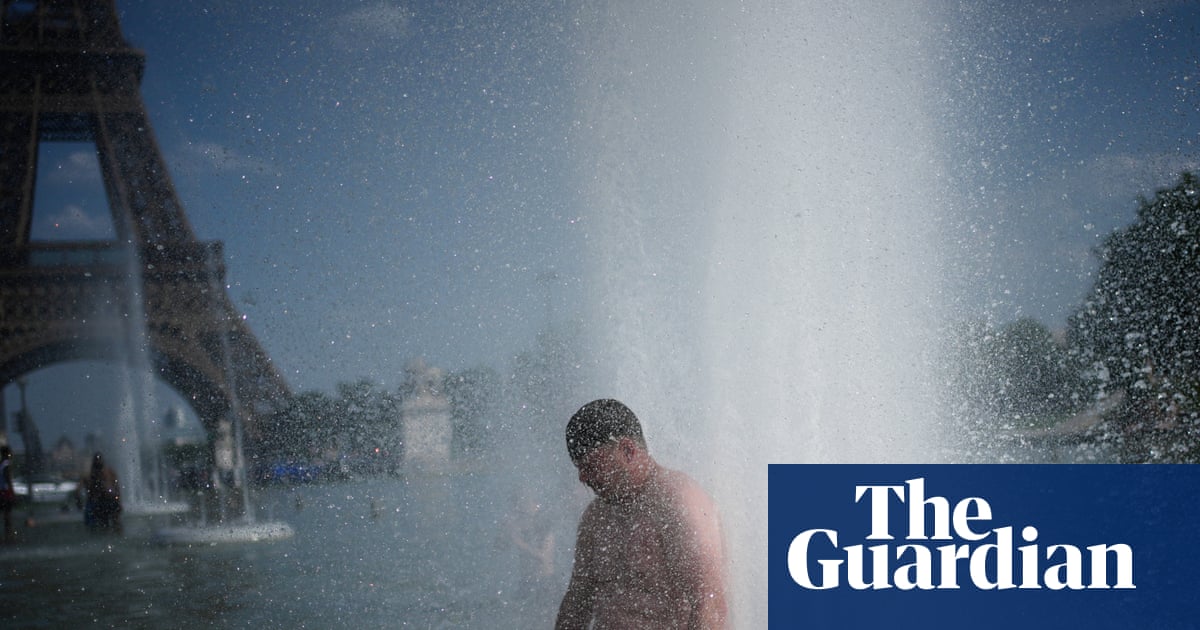
It was, according to the European Commission president, Ursula von der Leyen, the “summer of truth”. Climate chaos ripped through Europe and the northern hemisphere, sending heat records tumbling, scorching crops in the fields, burning forests, emptying rivers and reservoirs, warping train tracks, melting roads and killing about 35,000 people in Europe alone.The EU has estimated the damage at about €180bn, and the full bill is yet to arrive: harvests have been depleted, which will probably raise food price inflation, and expensive repairs to infrastructure have only just begun.“All of this is a mere preview,” said von der Leyen in her state of the EU address on Wednesday. “These were the hottest summer months ever – but probably the coolest of the years to come. Science is clear. Europe is warming at double the global rate. Europe can, must and will stay the course on its climate targets.”Streets were flooded in Bangladesh this summer as extreme rainfall fell across Asia. Photograph: Monirul Alam/EPABut while Europe has heated faster than any other continent, no region of the world is being spared. In the US, this summer’s heat eclipsed that of the “dust bowl” years of the 1930s, and drought gripped 60% of the country from spring, a record for the time of year. Extreme rainfall across Asia brought flash floods and typhoons, displacing hundreds of thousands of people and causing severe damage to crops.So what has the political response been? Tepid at best from centrist and leftwing politicians, say campaigners, with few rays of hope to brighten the gloom; denial and dangerous, provocative incoherence from the right and far right.“It was the hottest of summers – it was the meekest of responses,” said Magda Stoczkiewicz, the EU programme director for Greenpeace, of von der Leyen’s intervention. “The EU Commission continues its crusade to dismantle and defund environmental action. It is planning to cut green funding in the next EU budget, continues to support fossil fuels like gas, and is speeding up permitting of environmentally harmful projects.”Water levels dropped in Baitings reservoir, West Yorkshire, this summer as more than two-thirds of the UK reached drought conditions. Photograph: Jon Super/APVon der Leyen promised to “double down” on low-carbon energy and to “make Europe’s future electric”, as well as build resilience to climate impacts with a heatwave plan. There have been other positive moves: the Netherlands produced its long-awaited roadmap to “transition away from fossil fuels”, and France adopted a speeded-up plan for electrification. The UK saw the first “down payment” on a promised £1bn community energy programme, and the prime minister, Andy Burnham, committed to “net zero by 2050”.In the developing world, Thailand decided to stop building gas-fired power stations, while Indonesia continued to scale up solar energy under a three-year plan to halt oil imports. India, which has already achieved its 2030 target to have 50% of its installed electricity generation capacity from renewables, vowed to push further, to reach 500GW by 2030 from about 260GW today. China’s emissions, meanwhile, are likely to fall this year under the acceleration of the country’s switch to electric vehicles and vast build-out of solar and wind energy.Yet, as campaigners have noted, these positive developments are outweighed by governments stalling on climate commitments, or pushing for more fossil fuels. In the UK, the government is mulling the opening of new oil and gasfields. Germany is building new gas-fired power stations; France is falling behind on its greenhouse gas reduction targets.India has already achieved its target for renewable sources to fuel 50% of its installed electricity generation capacity. Photograph: Rajesh Kumar Singh/APEven the co-hosts of the next UN climate summit, Cop31, which will take place this November in Turkey but with Australia in charge of negotiations, are failing to walk the walk on climate. This month, Australia approved the expansion of a coalmine that will continue producing until 2055; the same mine supplies Turkey, which has refused to set a phaseout date for coal use.On the right, the record-breaking summer has not slowed US efforts to reverse and remove climate legislation: most recently, the Trump administrationhas repealed the Environmental Protection Agency rule that cuts emissions from power plants, and pressed ahead with dismantling renewable energy and boosting coal.Populist politicians on the far right are on the rise, and almost all embrace climate denial as one of their key tenets and paint attempts to cut greenhouse gas emissions as economy-crippling. Extreme heat and the coming of climate impacts that scientists have long predicted might be expected to give them pause; instead, their denial has often intensified – as is the case in the US under Donald Trump – or switched focus to clamorous demands for a huge expansion of air conditioning as the only means of adapting to the heat.Meanwhile, their anti-immigration policies ignore the potential impact of the climate crisis on immigration. Rather than address the root causes of immigration and fund clean energy and development, they prefer to claim that countries should build huge walls around themselves, and to demonise immigrants.Under the leadership of Donald Trump, the US has sought to gut its climate regulations. Photograph: Alex Brandon/AP“Climate has become the central part of the far right’s culture war in defence of the economic and energy status quo that bankrolls it,” says Romain Ioualalen, the global policy lead at Oil Change International. “When the brutality of climate impacts has made their previous climate denialism untenable, like in France, their fallback strategy has been to present adaptation [to the impacts of extreme weather] as a substitute for cutting emissions. All round the world, the far right has weaponised legitimate concerns about affordability and living standards generated by decades of neoliberal policies to protect the fossil fuel status quo.”The populist task is made easier in a world bombarded by threats: from AI, conflicts, geo-politics and rampant inequality. Memories are short, even for significant events. Previous climate disasters were quickly erased from global attention, says Laurence Tubiana, the chief executive of the European Climate Foundation. “We can’t ignore what has happened in Nepal, and we have forgotten what happened in Pakistan just a few years ago,” she says, referring to the deadly climate-driven floods that affected a third of the country’s population in 2022. “There is a big silence around all this.”Some of the most vulnerable countries are struggling to protect their people, and face a vicious cycle of debt, but are seeing little help from the rich world. “Many are being forced to choose between servicing enormous debts and investing in the infrastructure that could save lives when the next disaster strikes,” says Mohamed Adow, the director of the Power Shift Africa thinktank.If politicians in some of the world’s biggest economies are failing to act, it is not for a lack of demand among their voters. John Marshall, the founder and executive chair of the Potential Energy Coalition in the US, says recent polling by his organisation has found that politicians in many large economies are failing to keep pace with their voters on the issue. “The disconnect we’re seeing is not between the public and climate action,” he says. “It’s between what people are experiencing and how much they’re hearing from their leaders about it. People want more clean energy and less of the fossil fuel pollution that’s overheating the planet.”A rally held in New York this week calling for an end to the use of fossil fuels. Photograph: Bryan Woolston/APThis calls into question the strategy of “climate hushing” that some Democrats in the US – and even progressive politicians in other countries – have embraced, amid a widespread perception that voters care only about the cost of living.According to the Potential Energy Coalition polling, that is not the case: about two-thirds of people in the US believe that if public officials refuse to acknowledge the reality of global heating, they are putting people at risk. A similar number said societies could not prepare for extreme weather if they were not willing to talk about the climate crisis.In Europe, polling by Climate Opinion found the shattered heat records elevated the climate to one of the top five concerns in France, Germany, Italy, Spain and the UK. (Denmark, which was less affected by extreme weather, was also included in the poll, but the number citing it as a top concern stayed flat at 28%.) About 68% to 83% of respondents in all countries identified the heatwaves as climate-related.“It’s difficult for the public to get their heads round,” says Michael Jacobs, an emeritus professor of political economy at the University of Sheffield. “And the [far right] are not wrong in one respect, which is that we do need to adapt to the heat. But what we need people to understand is that net zero is literally a description of scientific fact. If we don’t reach net zero emissions, we will see temperatures continue to rise.”If weather as extreme as this year’s “summer of truth” fails to make a lasting political impact, we will be doomed to repeat it – over and over, until acting on it is no longer a choice.
‘Summer of truth’: will political leaders act as climate chaos comes knocking?
Full Article
Original Source
Read the full article at Theguardian →KhanList aggregates and links to publicly available news content. We do not host full articles from third-party sources. Always verify important information with original sources.