
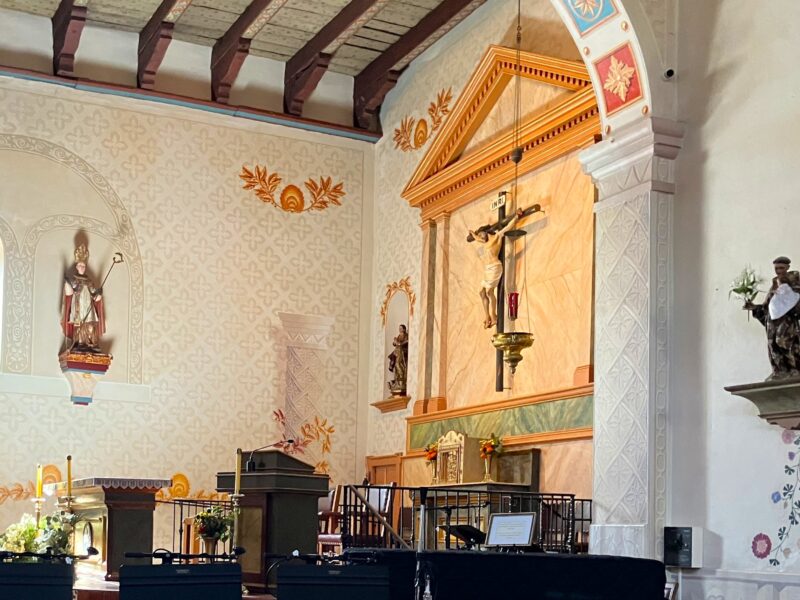
Editor’s note: This is the third installment in a series about the California missions. The first featuredthe lead bell ringerat Mission San Luis Obispo de Tolosa. The second feature explored how the missions remain vital to the state’s identity despite more recent backlash regarding the lasting impact of colonial rule.On a spring day in 1806, a German scientist and explorer visited the San Francisco Bay, where he met with Spanish missionaries and observed Ohlone natives dancing while playing locally made traditional instruments.While those who visit the California missions today might associate the art with collections imported by the Franciscans, George Heinrich von Langsdorff’s ink drawing of the Ohlone people, donning traditional body paint and attire, shows the Indigenous people continued to practice their art despite strong colonial efforts to convert them to their religious beliefs and culture.And while some modern-day Native Americans call for the missions to be destroyed, citing colonial genocide, Langsdorff’s piece demonstrates that the missions are also places that reflect Indigenous culture.“Most of our communities don’t have reservations, especially the more coastal communities that were missionized,” said Yve Chavez, assistant professor of art history at the University of Oklahoma and a member of the Gabrieleño Native American community. “So I see the missions as kind of a more physical place where we can remember our ancestors.”The first California mission was founded in San Diego in 1769, as the Spanish sought to both expand its territory and convert Indigenous people to Catholicism. As the 21 missions were being built, art played a key role in the messaging.This ink, wash and gouache drawing by a German visitor depicted Native Americans dancing and playing music despite being under colonial rule. Some colonialists were more tolerant of Indigenous art forms than others. (Yve Chavez, Bancroft Library, University of California Berkeley)“Paintings and statues weren’t to be worshipped in themselves, but they were vehicles to help tell biblical stories,” said Julia Costello, an archeologist and co-author with Edna Kimbro of “The California Missions: History, Art and Preservation.” “They helped people who weren’t literate — the Indians they were trying to convert.”She notes in her book that the churches were made into “theaters of conversion,” where religious dramas played out through statues and paintings.Junipero Serra, the priest often credited as the “Father of California,” was very deliberate about the art inside the missions. In the 1770s, he repeatedly requested art, often imported from Spain or Mexico — predating the missions themselves and reflecting Baroque aesthetics. Advancing the Catholic narratives, images of the Virgin Mary, Christ and the mission saints were popular. Paintings were especially appealing as instructional devices, at times offering deterrents with dark images of suffering souls in hell.The Virgin Mary was a common subject of mission art, which was intended to help convert Indigenous people. This statue was obtained for the mission in San Luis Obispo. (Pat Pemberton/Courthouse News)The missions collected pieces from many artists, some well known, other less so, but one painter was a clear favorite.“José de Páez was already a very well-established painter in Mexico City and painted religious subject matter but also secular matter, and Serra liked his work,” Chavez, also the author of “Indigenizing California Mission Art and Architecture,” said. “When Serra would request paintings of saints to decorate the mission churches, he would request to the church leadership back in Mexico, ‘I want paintings from this guy.’”As the colonialists pursued imported art, they used the Indigenous people for a variety of tasks, including farming, making clothing and building.Langsdorrf’s drawing depicts natives conducting their art in a public place controlled by colonists, but missionaries in other places weren’t so tolerant. And the overall experience of the native population was grim.“They would do the labor for the settlers, and they weren’t really allowed to leave,” said Martin Rizzo-Martinez, a historian and assistant professor in the Film & Digital Media Department at UC Santa Cruz, who has researched the missions and the history of Indigenous people of California. “There would be constant flights of fugitives, but fugitives were hunted down, and they were brought back to the missions, and they were punished for not following Catholic law and Spanish and Mexican law. They were given to whippings, they were held publicly in stocks and pillories as punishments.”While much of the labor they were expected to perform was menial, they also performed more creative work.“In terms of decorating the churches, you have missionaries reliant on the local labor, and the main labor base is Native people,” Chavez said. “So if you want your churches painted with murals on the walls and have sculptural adornments, you have Native people there.”Unlike Páez’s pieces, Indigenous work was rarely credited with signatures or documentation.While they often retained the qualities of art that was important to their identity, through the years, the neophytes — those subjected to a religion — accommodated foreign ideas and incorporated them into their existing traditions. Living in two worlds, Chavez said, the Indigenous artists were often subversive about keeping their traditions alive.“It speaks to the resilience of our ancestors to not give up that they did what they had to do to survive,” she said.Animals important to Indigenous beliefs, including bears and eagles, often found their way into mission art, as did materials that had long been local custom, including abalone shells and local plants.The work the Indigenous artists performed included architecture, sculptures, baskets and more. But because their works aren’t signed, it requires a bit of detective work to conclude which pieces they created.The materials used to create this tabernacle at the Santa Barbara mission, including the shell inlays and conifer wood, offers clues to Chumash artistry. (Yve Chavez)“You have to look for the more subtle imagery and then the materials that would indicate that these were native people who were kind of making the most of a difficult situation,” Chavez said. “They were given the opportunity to use the skills they had while also complying with the wishes of the missionaries.”At the Santa Barbara mission, for example, local materials used to create the tabernacle included materials, such as conifer wood and abalone shell inlays, that were significant to Chumash culture. Meanwhile, sandstone fountainheads are unique representations of Chumash ingenuity in stone carving, depicting a mountain lion and a bear, creatures which were linked to Chumash beliefs.“The fact that they’re animals from local landscapes rather than gargoyles or some kind of European animal that you would expect to find in a European context to me is a visual representation that the sculptor, who is attributed as being a Chumash artist, was working based on what he knew,” Chavez said.When Mexico won independence from Spain in 1821, it abandoned many of the missions, though some continued to operate as churches. Those remaining churches amassed even greater art collections.“At the end of the mission period, when many were closing, they would send their artwork to a neighboring mission that was still in business,” Costello said. “And so a few of the California missions amassed large collections because they became the repository for the missions that were closing.”In the later 19th and 20th centuries, several painters — including English “artist historian” Edwin Deakin — played a key role in romanticizing the missions, according to Costello’s book, leading to “the birth of the mission myth” and helping California’s emergence as a destination for both travel and relocation.As the missions enjoyed a resurgence in popularity, mission-style architecture began to spread, beginning with the designs at Stanford University, which opened in 1891.By the 1920s, the automobile and travel industries actively promoted the missions. As secular romanticism grew, the missions were featured in ads and other promotional materials for products, painting a rosier picture of California’s colonial past.“Entrepreneurs made a lot of money getting people out here, and they used the missions as kind of a gimmick,” Costello said. “The other things that interestingly came at the same time was the camera — Kodak perfected that little hand-held camera, and suddenly everybody could take pictures. The automobile club wanted to promote coming to California, and the car was coming in fashion. So you get in your car and go to the missions, the ruins, and take pictures.”As photos, postcards and posters expanded the culture of mission art, efforts to preserve the restore missions intensified in the middle of the 20th century.After the mission era, building designs inspired a wave of mission-tyle architecture. Pictured here is a gate outside the mission in San Miguel, CA. (Pat Pemberton/Courthouse News)In 1948, the Hearst Mission Restoration Fund provided key financial resources to further this goal. William Randolph Hearst, the media mogul, was famous for his museum-worthy art collection, much of it featuring religious imagery. A tapestry donated by his mother, Phoebe, can still be found at the Mission San Luis Obispo de Tolosa.That piece is signed by H. Molitor, of Munich, Germany, who specialized in textiles and religious depictions.Less recognized at the mission, the local Chumash neophytes painted the altar and walls, employing the same pigments used in their rock paintings, according to historian Dan Krieger, writing in the San Luis Obispo Trbune.So while the missions represent a troubled history for Indigenous ancestors, as Chavez wrote in her book, those buildings are a part of the California Indian identity — even though it’s less obvious.“I have heard the argument from other California Indians that they would prefer that the missions just burn down, and I know in the mission era, people back then did burn them down,” Chavez said. “Even though they are very difficult places, there can be positive associations.”Subscribe to our free newslettersOur weekly newsletter Closing Arguments offers the latest about ongoing trials, major litigation and rulings in courthouses around the U.S. and the world, while the monthly Under the Lights dishes the legal dirt from Hollywood, sports, Big Tech and the arts.Additional Reads
Subversive resistance: Mission art in early California
Full Article
Original Source
Read the full article at Courthousenews →KhanList aggregates and links to publicly available news content. We do not host full articles from third-party sources. Always verify important information with original sources.