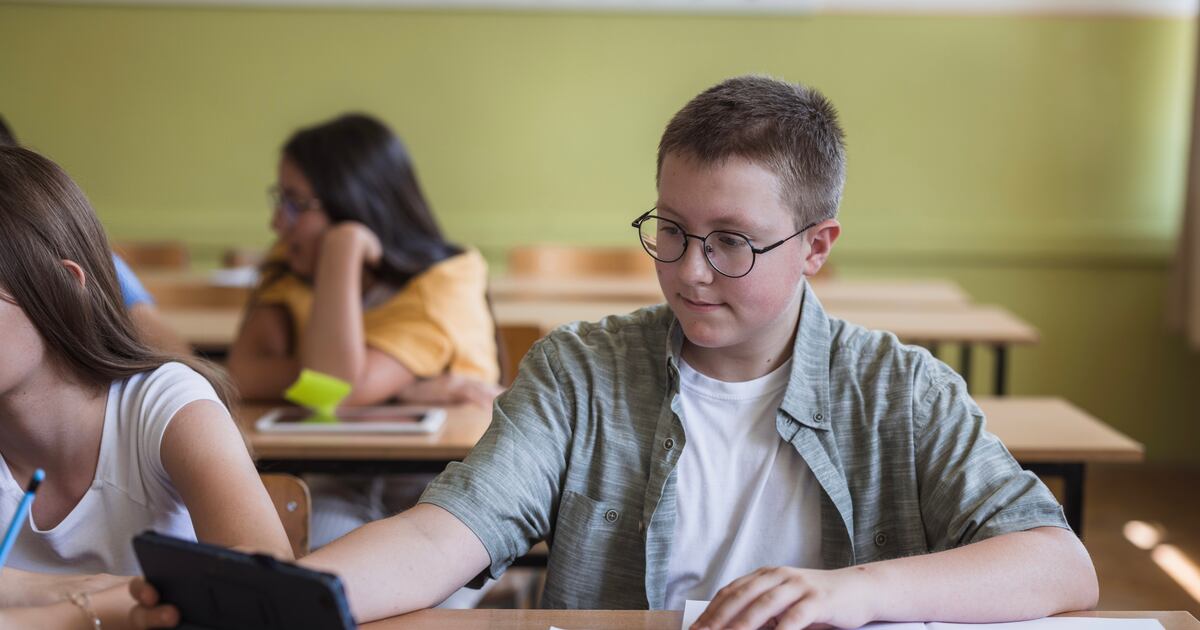
When Oatlands College in Stillorgan, Co Dublin, decided to switch to iPads for learning in 2019, it was an experiment of sorts. Technology was being integrated in Irish classrooms over a number of years, so the introduction of individual devices to Irish students would be a natural next step. But six years on, the school has reversed course, driven by its students. Last year’s first-year cohort were the first in six years not to have iPads. The difference, principal Caroline Garrett says, has been remarkable. The change was initially sparked by the senior students in the school, who had begun relying on their books as their main source of material, with the tablets as a secondary aid. “They preferred to work with books. They found it better, they were better able to concentrate. And they also are very conscious of screen time,” she says. READ MOREThe school consulted its parents council, which represented each year group, and with teachers to get their views. “One of the greatest sources of information for us was the SNAs [special needs assistants], because they are sitting within the classroom body. They were able to explain how much distraction there was, if the boys were not staying on task and going on to other sites – nothing of a negative nature, but [sites] that were not relevant to what was being discussed.”Everyone was on board with the plan to return to books. So far, it has been a success. “We found the students didn’t notice the difference because we have all other forms of technology in the school,” Garrett explains. “The teachers found the classes were calmer. They were more in control of what was being taught, and it was a better learning environment.”For parents, the cost of starting secondary school suddenly got a lot lower. Technology is still an integral part of the classroom. Instead of one-to-one devices, however, the school has invested in laptops that can be used in the classroom and it has two computer labs that are fully equipped.The cost of individual devices such as tablets or iPads is not covered by Government funding. Photograph: iStock Oatlands may be an outlier at the moment. Wriggle, one of the largest suppliers of educational technology to Irish schools, says more schools are opting to adopt individual devices, prompted by changes in the senior cycle curriculum that takes the focus off the Leaving Certificate exam and adds in assessment components that can account for a significant proportion of the grade in some subjects. Sean Glynn, Wriggle’s chief learning officer and a former teacher, says schools are increasingly adopting one-to-one technology, particularly for the final years in school. Those laptops, he says, can then be removed from the school’s management system, allowing the students to use them through their early college years. The company works with about 200 schools across the State as a supplier of educational technology and associated services. That can include managing the devices or providing filtering software to lock down internet access on the device. One of those schools is Sancta Maria College in Louisburgh, Co Mayo, where Áine Moran is principal. It became an iPad school four years ago. Older students in the school were already using Chromebooks, but Moran’s experience with the technology in a school in Tyrellstown in Dublin soon saw the school shift to Apple’s platform instead.“It was an interesting journey to introduce one-to-one technology in a very rural setting and in a well-established school,” she says.[ ‘Like a dirty little secret’: How is AI being used in Irish primary schools?Opens in new window ]“You need to have training in place for staff and a vision that ties in with the rest of your vision for the school, and [ensure] the technology very quickly becomes seen as a tool for school, not a toy.” Parents wanted reassurance that it was going to be used effectively and enhance teaching and learning, rather than serve as an expensive e-reader for students. “The big plus is that people see very quickly the way that it acknowledges different types of learners – a more visual learner who is very well supported with technology. Rote learning no longer works for exams. We need to be teaching with creativity and innovation so that people can learn with creativity and innovation.”Key to that is management of the classroom and the technology. Moran compares it to more traditional forms of distraction such as passing notes.“Teachers need to be on their feet, walking around. They need to have an engaging lesson,” she says. “There is obviously the ability to be distracted in the same way that you or I would have looked out the window and daydreamed, not hearing a word that was going on in the classroom.”The device is intended to be used for the duration of the post-primary education, but it comes with limitations around installing programmes and accessing certain content that is outside what would be classed as educational material. The cost factor Funding the technology can be a hefty cost for parents, about €500 to €600 depending on what system the school has chosen. For stretched parents, the additional cost may be too much to bear. While the Government has moved to remove some school costs, covering books and other school essentials for children and young people enrolled in schools in the free education scheme, the cost of individual devices such as tablets or iPads is not covered. That can be a significant cost for parents. The decision on the use of such technologies is, the Department of Education said, a matter for the board of each school. “Department guidance states that schools should support equitable access to ICT for all students and may provide devices on loan to students (via device loan schemes) where required. Schools are also advised to consult parents and the wider school community when developing technology policies that may involve costs for families,” a spokesperson for the department said. “There is no department requirement for students to purchase or own a personal digital device for Junior Cycle or Leaving Certificate. The Minister of Education and Youth, Hildegarde Naughton, wrote to all schools and boards of management in May 2026, giving clear guidance to make this clear and to ask schools to fully consider the views of all parents and guardians, as well as cost and equity implications, before introducing any approach involving digital devices.”Kildare parent Natasha Reynolds said she expected to have to buy a device for her daughter, who is starting secondary school in a couple of weeks’ time. But that was because she knew parents with older children already in the school. The first time it was mentioned officially was at a parents’ meeting in January, when the costs and what it covered were clearly laid out.[ Why Ireland needs to stop mandating parents to buy their children laptops for schoolOpens in new window ]“I just thought it was something everybody had to have. I didn’t realise that technically it is a choice by the school to have it,” she says. “If they gave it as an option to support your child’s education, I would buy it anyway because I wouldn’t want my child to be the only one without a laptop. But at the same time if it is not mandatory by the Department of Education, I think the school should make that clear.” The laptop has already been delivered and, while certain websites are blocked – social media, for example, cannot be accessed through the web browser – Reynolds was surprised to find that others, such as Pinterest and YouTube, were not. “I don’t see how Pinterest is an educationally-supported application. It almost gives a bad first impression, that the first non-educational thing she tries to look at, she can get access to.” One of the criticisms of the programme is that it does not allow the devices to be passed on to siblings, leaving parents shouldering the cost of multiple devices. Children who are already using technology as assistive devices in the classroom may also want to repurpose their tablet or laptop for use in post-primary. Wriggle’s Glynn says that can be approached on a case-by-case basis but that the ability to do so is limited by the age of the device in question. A tablet or laptop that is no longer supported by software updates, for example, could not be used again.[ School devices: Parents feel ‘press-ganged into something we don’t want and can’t afford’Opens in new window ]The Government has committed €200 million under its National Development Plan to support the implementation of the Digital Strategy for Schools to 2027. But that money isn’t earmarked to provide individual devices for students; it has to fund classroom equipment alongside upgrading networks in the school, wifi connectivity, educational software and assessment platforms that might be needed. Glynn believes that providing funding of some sort to parents would help. “I think the department will eventually have to come in here and add some level of higher funding for student devices,” he says. “But if you look at the model that is already there for schoolbooks, there is already funding allocated.“I think if there was room for schools that are using technology well in the classroom, that want to adopt one-to-one or maybe have done for a number of years, they are looking to say can we use this money and have a bit more leeway that we can use for digital resources and subsidise devices. I think there is room there for the department to come to the table and allow schools a bit more autonomy.”
‘Students prefer to work with books’: Is classroom tech worth it?
Full Article
Original Source
Read the full article at Irishtimes →KhanList aggregates and links to publicly available news content. We do not host full articles from third-party sources. Always verify important information with original sources.