
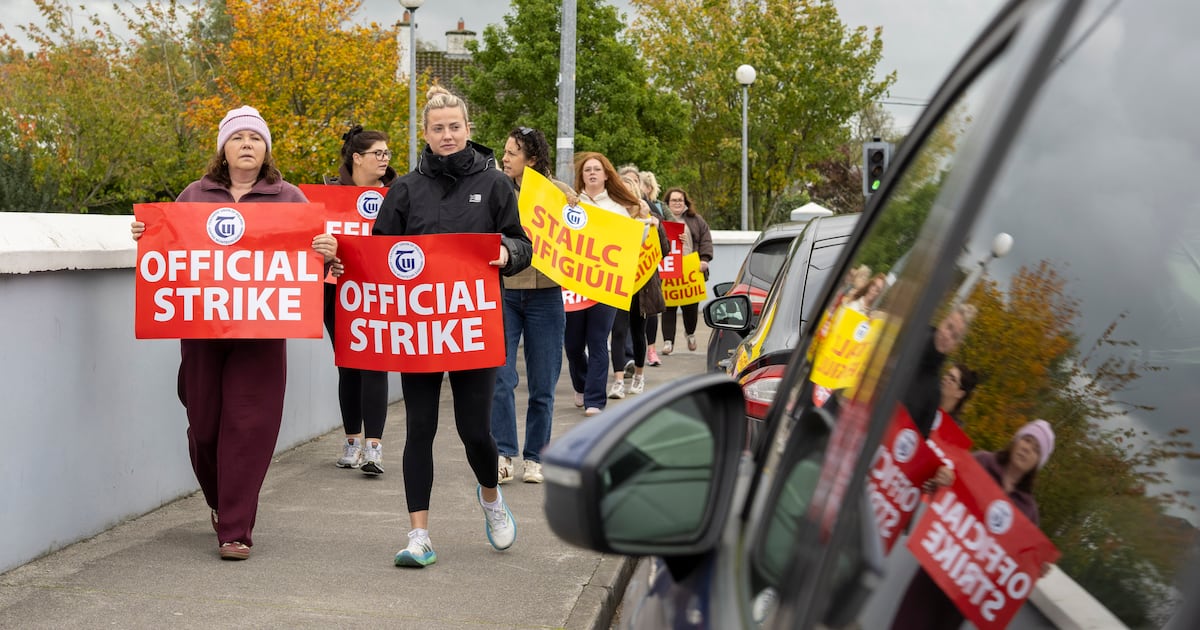
Perhaps nobody in Government had heard the old sales business adage: the first one to name a price always loses.But they might reflect now on how outlining a package aimed at public sector workers in last week’s budget ended up putting them on the back foot.Within the trade union movement, some believe Minister for Public Expenditure Jack Chambers was gambling that the Budget 2027 tax changes, along with the €1.2 billion set aside for public pay increases next year, would give the Government the upper hand going into talks. Instead, union leaders seized upon the sums as something to publicly scoff at as, on Wednesday, their members took to the streets and formed picket lines in a public sector strike. READ MOREChambers has been left to “scramble”, as one observer puts it, for several days, discounting all that has been offered so far as merely a starting point for the talks that will at some point follow this weekend’s preliminary engagement.Labour TD Ged Nash suggested on Thursday, as he proposed a private members’ motion on the issue, that the Government had “sleepwalked” into a first national public sector strike in 17 years. The sight of so many young workers who had never been on a picket line before outside their workplaces will have provided a wake-up call.From a public relations perspective, the Government could have done without the parade of workers highlighting what they regard as its failings in interviews with the media.Ciara Loftus, who works in the Mater’s emergency department, said she was still living at home at 25 and feels she has no chance of getting on the housing ladder. This was a recurring theme, along with childcare, among younger strikers. “I feel like I’m going to be forced to move country by the end of the year or next year,” she said. “It’s not sustainable.”Across Dublin, in Dún Laoghaire, Conor Carroll, a porter at St Michael’s hospital, with young children at home, talked about being stung by food inflation whenever he visits the supermarket. “You see the price of things,” he said, “even the stuff you need to eat. You’re just not earning enough these days.”Conor Carroll, a porter at St Michael’s Hospital in Dún Laoghaire, said Wednesday’s strike was all about wages and the increased cost of getting by. Photograph: Emmet Malone Maurice Sweeney, a lab worker at Trinity College Dublin, said he is supposed to be one of the lucky ones on what is considered a decent wage. The reality, he says, is different. “The weekly shop has you under pressure and we didn’t see much benefit from that budget there last week at all,” he said. Maurice Sweeney (right), a lab worker at Trinity College Dublin, standing with colleagues during Wednesday's strike outside the university. Photograph: Emmet Malone Many expressed frustration to find themselves in this position when politicians keep telling them the country is booming.During the last strikes, the situation was very different. Back in 2009, following the banking crisis and economic crash, workers walked out over the scale of the cuts made by a Government with no money and little scope for negotiation with unions.A decade’s worth of talks and deals that followed, from 2010 to 2020, are characterised as “defensive” by one senior trade union leader.Now, though, he suggests this week’s industrial unrest might have taken place six years ago, when the public sector pay deal entitled Building Momentum was negotiated, had it not been for the Covid pandemic and the huge uncertainty surrounding almost every aspect of work and the economy at the time. Relations were strained then by what the unions regarded as the continued efforts by Department of Public Expenditure (DPER) officials to approach pay talks as though the country was still broke. The situation has only been exacerbated by what they see as DPER’s vetoing, or delaying of, spending that unions thought they were entitled to. These frustrations extend to deals they say were already agreed, such as the local bargaining aspect of the last national pay agreement.What made the situation significantly worse over the past year, contributing to the loss of trust for the unions, was the VAT cut to hospitality. This, they felt, was given based on arguments that would not stand up to the scrutiny their own spending proposals are subjected to. Then there was the Government caving to the demands of fuel protesters.“What you had there,” says one observer on the union side, “was people who went, parked their tractors and trucks and said, ‘right, we have the country by the balls’.”Another person with a vested interest points to “unelected people suddenly having access to the highest levels of Government and being able to force changes that in some cases had been agreed with elected representatives or people with a respect for democratic structures”.“Say what you want,” says the first observer, “but unions are regulated, there are rules they have to observe and they do because of the potential consequences.”Most workers – many in modestly paid jobs and feeling the pinch of rising grocery, fuel and accommodation costs – were more put out by the expiry of the last pay deal in June. It came at a time when prices were on an upward trajectory but the Government had not indicated when they might get around to ensuring their wages were raised accordingly.Predictably, there is now something of a blame game as to why talks on a new agreement were delayed beyond the expiry of the last deal in June. What is undisputed is that a couple of exploratory meetings in June went poorly. By the time Chambers wrote an opinion article in The Irish Times on July 1st, he was suggesting “all issues of importance to both sides can and should be discussed as part of any engagement”. He also warned that “setting preconditions or barriers to engagement does not assist the process of building consensus and agreement”.The unions indicated early on that they wanted to change what was regarded as the normal running order in previous negotiations and have pay addressed up front. Fórsa’s Kevin Callinan and John Boyle of the Irish National Teachers’ Organisation have since said they believed pay increases had fallen between 5 and 7 per cent behind inflation over the previous four years. They wanted an agreed plan to close that gap over the lifetime of any new pay deal.One of those familiar with the process on the Government side suggests the unions wanted a final outcome on the pay issue before anything else could be discussed.This, they argue, would have left the negotiators on the employer side with no leverage at all as they sought improved productivity through changes to work practice around artificial intelligence (AI), hybrid working or anything else. There seems to have been surprise among officials that the unions subsequently disengaged, as they viewed it, and proceeded to balloting on industrial action relatively quickly.The unions express exasperation that Chambers did not intervene directly, pick up the phone or arrange to meet them.Those with experience of previous pay-agreement negotiations suggest there would traditionally have been more going on by way of back channels. Callinan’s repeated calls this week for Taoiseach Micheál Martin to get involved are likely rooted in this, it is suggested by veterans of the pre-crash system of engagement during the “social partnership” from 1987 to 2009. Martin, they observe, is the only survivor on the Government side of how that worked and they would like to see his department reassert the control it used to exert over the negotiations. Senior union figures want Taoiseach Micheál Martin to play a bigger role in talks around a new public sector pay deal. Photograph: Cillian Sherlock/PA Wire Martin taking over might not look good for Chambers. However, Callinan made it clear on Friday that the shape of the preliminary talks process was hammed over a call with the Taoiseach.The unions believe they are in a good position as the process gets under way, given how well Wednesday’s strike went.Michael Doherty, a professor of law at Maynooth University and a prominent figure in the industrial relations landscape, suggests “the Government may have got a shock by the number of young, enthusiastic people getting a first taste of industrial action on the pickets and anxious to be heard”.Having energised this young and important constituency, he says the unions need to ensure they do not leave disappointed and disillusioned.“They are going to have to be very careful because there is the possibility they won’t want to accept some sort of fudge, that they’ll feel, ‘Hold on, you marched us up the hill here’.”At this juncture, the unions might have felt it was better to threaten a second strike date than carry through with another stoppage – especially on what is forecast to be a cold and rainy day next Wednesday.Preventing the second strike should help Chambers and the Government to regain some control over the situation.To get this far, he has repeatedly said that pay can be talked about at the outset, while the unions have stuck to their position: “Nothing is agreed until everything is agreed.”Negotiating a deal that is good for the Government will still be a challenge, though.Both sides point to different time periods, framing the relationship between pay and inflation in recent deals in a way that suits their purposes.The unions do not want the sacrifices forced upon them in the wake of that strike 17 years ago to be written out of the equation.Union leaders now talk about insuring their members against future spikes in inflation such as those caused by the wars in Ukraine and Iran. However, such a mechanism would severely undermine the big prize from the negotiations for the Government: budgetary certainty for the coming few years.The answer, some observers suggest, could be a short-term deal to get over the current impasse and allow everyone to come back when the tensions have eased. An alternative would be an agreement with a robust review clause for pay.Both sides will likely agree on one thing if there is to be a short-term agreement: they will want to avoid being back in this current stalemate any sooner than they have to be.
Strike success leaves unions in position of strength and Jack Chambers ‘scrambling’
Full Article
Original Source
Read the full article at Irishtimes →KhanList aggregates and links to publicly available news content. We do not host full articles from third-party sources. Always verify important information with original sources.