
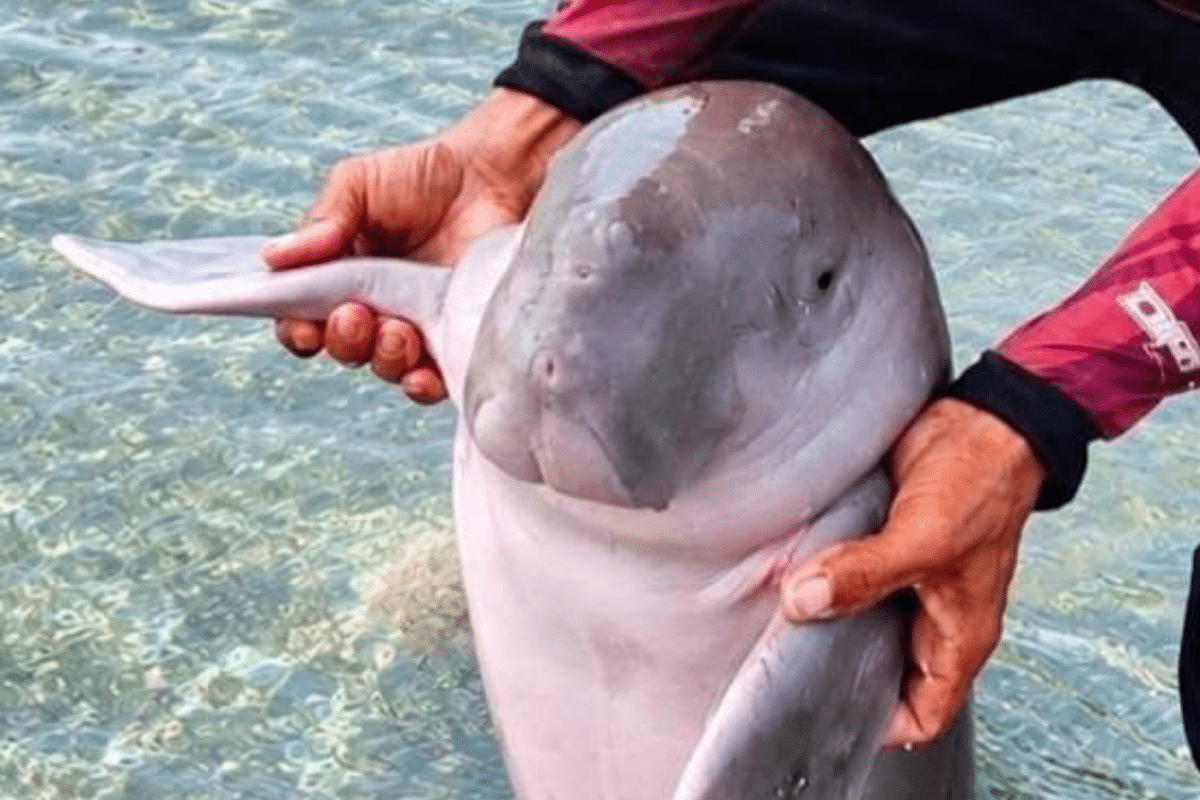
A resident assists a juvenile dugong (Dugong dugon) that became stranded during low tide on Liwagao Island in Barangay Sibolo, Caluya, Antique, on Sept. 6, 2026. Residents helped the marine mammal return to the sea. The dugong is classified as Critically Endangered in the Philippines but is listed globally as Vulnerable on the International Union for Conservation of Nature Red List. (Photo courtesy of Jelly Agustin) ILOILO CITY — Residents rescued a juvenile dugong that became stranded during low tide on Liwagao Island in Barangay Sibolo, Caluya town, Antique province, on Sunday. The dugong, or sea cow (Dugong dugon), was found in shallow water during low tide. Concerned residents helped the dugong and eventually returned it to the sea. Research showed that dugongs, once widely distributed across the Philippine archipelago, are now found in fragmented seagrass habitats, including areas in Palawan, Romblon, Guimaras, Negros, Fuga and Tawi-Tawi islands and parts of Mindanao. Article continues after this advertisement READ: Endangered dugong found dead in Magsaysay, Occidental Mindoro Studies also estimated that the dugong’s distribution in the Philippines had declined by about 63 percent from its former range. It identified hunting, accidental capture or bycatch, dynamite fishing, and the destruction of seagrass habitats from coastal development and reclamation among the threats to the species. The Department of Environment and Natural Resources has also acknowledged gaps in information about the country’s dugongs, including their population, distribution, and breeding areas. While the dugong is classified as Critically Endangered under the Philippines’ national conservation assessment, its global classification is different. The International Union for Conservation of Nature (IUCN) lists Dugong dugon as Vulnerable on its Red List of Threatened Species, meaning the species faces a high risk of extinction in the wild. Scientists note that populations across much of the dugong’s range are fragmented and the status of individual populations can be more precarious than the global classification suggests. Article continues after this advertisement Dugongs depend primarily on seagrass meadows for food, making them closely tied to the condition of shallow coastal ecosystems. READ: Mother, calf dugongs seen; pregnant dugong found dead in Sarangani Bay Article continues after this advertisement Residents and visitors in Antique were reminded to avoid disturbing or approaching stranded dugongs and other marine wildlife and to report sightings to the proper authorities. The juvenile dugong rescued in Caluya was successfully returned to the sea./coa Your subscription could not be saved. Please try again. Your subscription has been successful.
Stranded baby dugong in Antique gets help returning to sea
Full Article
Original Source
Read the full article at Newsinfo →KhanList aggregates and links to publicly available news content. We do not host full articles from third-party sources. Always verify important information with original sources.