
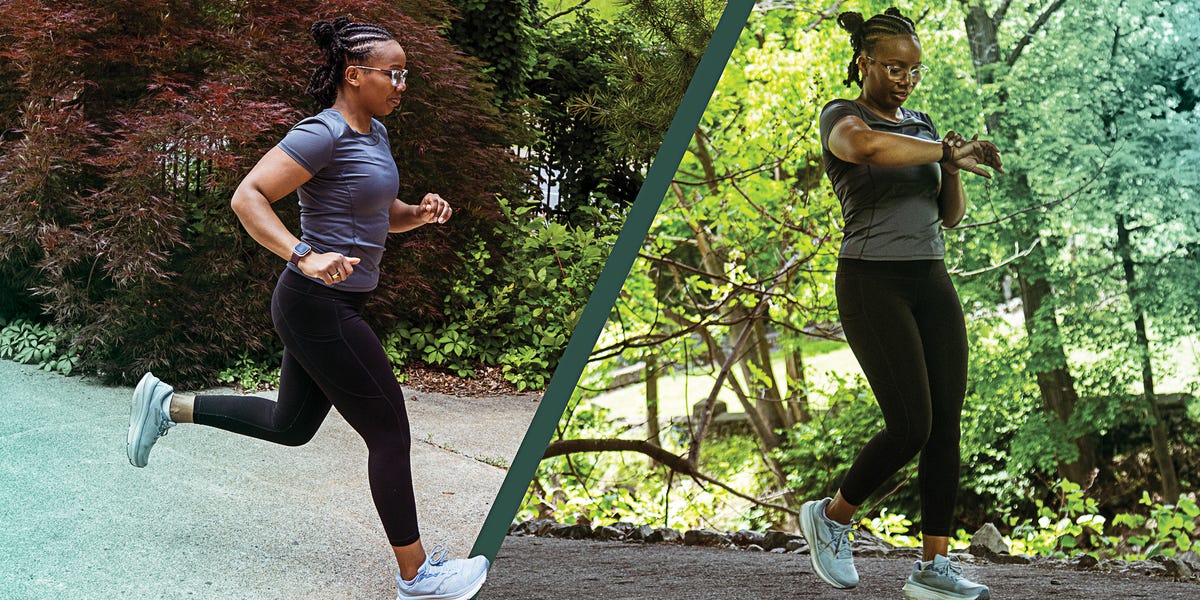
One Thursday afternoon, as I was preparing for a workout on the Delaware & Lehigh Trail near Runner’s World headquarters, I spotted a flock of Canada geese squatting near the trailhead. I like to keep my distance from them as I’ve heard of times when they’ve gotten aggressive with people. Too afraid to walk past them alone, I was glad another runner warming up nearby helped me scare them off.I assumed our conversation would end there, but once we realized we were running in the same direction, we decided to stick together. I told him I walk during the run, but he insisted we run together.He told me about all the marathons he ran when he was younger, and how he’s more focused on shorter distances now; I told him I was training for my third half marathon in a year and wanted to break 2:30.I only stopped for walks when I absolutely felt like I needed a break, although I usually take a minute to walk every three minutes. When I walked, he stayed by my side, slowing his pace to match my stride. He didn’t seem bothered by my breaks, but then he said I could probably hit a faster time if I didn’t walk; completing two half marathons proves I have the strength to cover the distance. We only ran together for a little over a mile and a half before parting ways, but the conversation stuck with me.This interaction wasn’t a one-off. As a run/walker, I feel frequently overlooked or not taken seriously by the running community. Walking is often seen as a beginner tool or a stepping stone toward running consistently, but rarely a legit strategy. I'm reminded of this every so often when someone tries to encourage me to run during my walk break midrace, or when I have to adapt a training plan to meet my run/walking needs and goals. Sure, Jeff Galloway’s Run-Walk-Run, Runner’s World, and a few others provide some resources for run/walkers, but it is a fragment in comparison to what’s available for runners who move continuously. While there are generic training plans available to help run/walkers improve their times, they have limitations and are harder to choose from. I might find a plan with some speed workouts, but those might not match my interval ratios, so if I follow it or tweak it, I risk leaving gains on the table or, worse, overtraining. All that makes me feel like walking breaks are only acceptable if it’s a temporary strategy.The run/walk method is much more than that. Yes, it makes the sport more accessible to newcomers, but it helps experienced runners achieve their goals, too. Let’s not forget, Galloway ran/walked 2:16:35 at the Houston Marathon in 1980. Eight-time Boston qualifier and RW contributor Liv Paxton also used walk breaks to run a sub-3 marathon. Runner’s World has a number of runners on staff who swear by the method. The strategy allows for quicker recovery, supports injury prevention, brings a mental benefit by breaking any distance into manageable chunks, helps better control heart rate—and science backs it up. A study on recreational runners published in the Journal of Science and Medicine in Sport stated that run/walkers reported significantly less muscle pain and fatigue after finishing a marathon.My walk breaks are moments that allow me to focus on getting my breathing under control, take gels, or sip water if I need to. They make me feel stronger, just as much as running does. Every time I start my intervals, I have confidence that I can show up, trust the process, and start over again. I’m stronger as a runner and a person because of them, and that’s not something I want to do away with anytime soon.In less than a year, I got faster thanks to the run/walk method. I improved my half marathon finishing time from 3:01 to 2:38, so I know my goal of breaking 2:30 is within reach—and I don’t need to stop taking walking breaks to achieve it.Monique LeBrun is a health and fitness editor who is based in Easton, Pennsylvania. She covers a wide range of health and wellness topics, with a primary focus on running performance and nutrition. Monique is passionate about creating content that empowers runners to become the best versions of themselves. As an avid runner and parent, she loves spending time outdoors with her daughter, who often accompanies her on weekend runs as her personal mini run coach.
Stop Treating Me Like a Beginner Because I Run/Walk—It’s an Effective Training and Race Strategy, Not a Stepping Stone
Full Article
Original Source
Read the full article at Runnersworld →KhanList aggregates and links to publicly available news content. We do not host full articles from third-party sources. Always verify important information with original sources.