
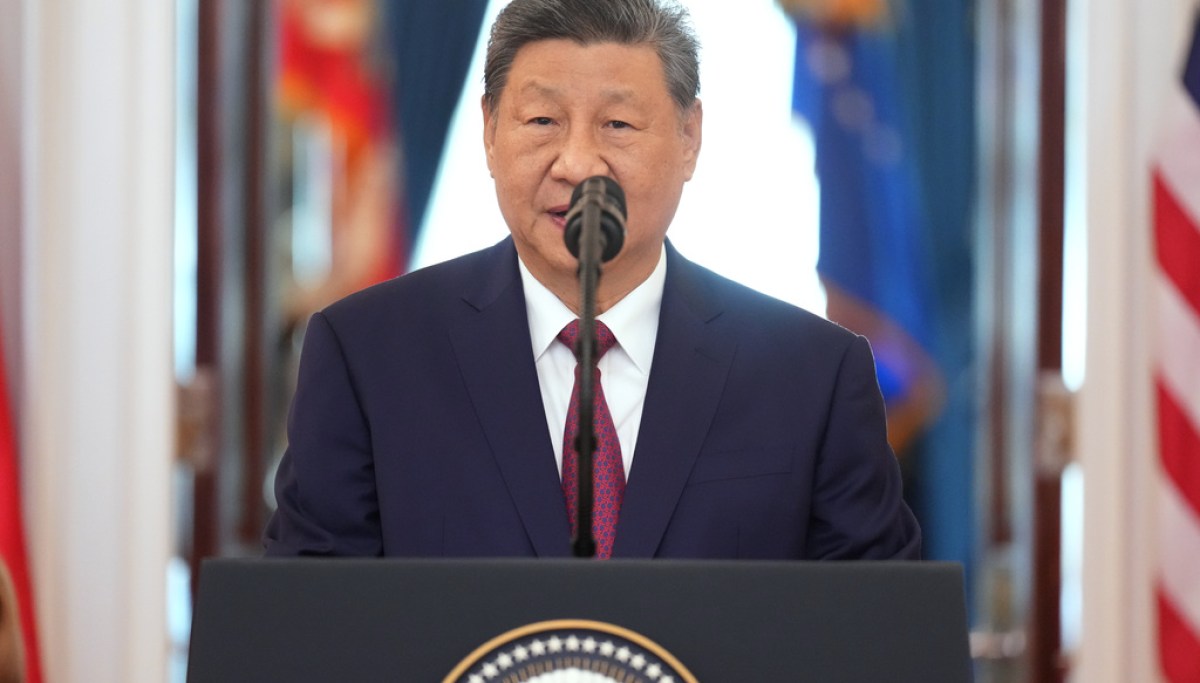
Thursday night’s White House state dinner for Chinese President Xi Jinping brought together some of America’s most powerful corporate leaders. Their presence reflected an enduring wager: that access to China’s enormous market remains a prize worth courting Beijing to obtain.During President Donald Trump’s May visit to Beijing, Xi declared that China’s door would “only open wider.” Despite the hype and commercial fanfare, the summit produced narrow, state-directed results: selective tariff relief, new government-to-government mechanisms and a Chinese pledge to buy American coal. These are real gains, but they leave unanswered the deeper question for U.S. businesses: not whether Beijing opens the door, but how much consumer demand exists behind it.The deeper problem is not simply whether Beijing opens the door, but how much demand exists behind it. China’s weak household consumption reflects a political system that concentrates resources and control in the state, while Xi’s centralization has made that imbalance harder to reverse. Washington and corporate America should face the emerging reality: China retains formidable power over critical supply chains, but under Xi’s current trajectory, its consumer market is unlikely to regain the strength American companies and investors still expect. A global imbalance rooted at home In 2025, China’s goods trade surplus reached $1.189 trillion — just over 1% of global GDP and the largest annual merchandise trade surplus ever recorded by a single country. In the first eight months of 2026, China recorded a further surplus of $805.5 billion, putting it on course to challenge that record. These figures are startling on their own. Set against China’s domestic data, however, they reveal a deeper imbalance: In August, industrial output expanded by 5.2% year-on-year, while retail sales grew by only 0.4%.China’s industrial output is expanding far faster than retail sales, showing the continuing weakness of household demand. When domestic demand cannot absorb expanding industrial capacity, producers must rely more heavily on foreign markets. Economists and governments now fear a second China shock — this time driven less by low-cost labor than by highly competitive electric vehicles, batteries, machinery, solar equipment, and other advanced technologies.This pressure extends far beyond the United States. Europe has already imposed trade defenses and is considering stronger measures. Emerging economies fear the erosion of their own manufacturing bases. Even governments committed to open trade are imposing tariffs and anti-dumping measures. China’s internal imbalance is now straining the international economic order that enabled its own rise.The savings reservoir mirage The prescription offered by the International Monetary Fund, foreign governments, and many prominent Chinese economists is familiar: Beijing must redirect resources from industry and investment toward households. They call for stronger pensions, higher household incomes, a more reliable social safety net, and, in some cases, direct transfers. Economically, the logic is sound.But the obstacle is not simply deciding how to spend the state budget. A one-off payment can be made by administrative order. Permanent support on the scale needed to rebalance the economy would change the relationship between Chinese citizens and the state. In Western welfare systems, pensions, healthcare, and other benefits are rights that citizens expect and can claim. In China, support is generally granted from above to serve goals chosen by the state, including social stability and national development. The party-state readily accepts the idea of “enriching the people,” fumin, and will provide targeted, conditional help for specific problems. It is far more reluctant to give households a lasting claim on public money.This difference helps explain why China’s headline economic data can hide household distress. During the pandemic, while the U.S. made broad nationwide payments to households, China relied much more heavily on targeted relief, existing social-protection programs, support to firms, and public investment. By the end of 2025, Chinese household deposits had reached roughly $25 trillion. Chinese policy discussions often portray this vast pool of savings as spending power waiting to be unlocked when “consumer confidence” returns.But those savings are distributed very unevenly. China Merchants Bank’s 2024 audited report shows that just 2.5% of its roughly 210 million retail customers held about 81.9% of its retail assets under management. The remaining 97.5% held an average of roughly $2,000 each, compared with about $350,000 among higher-asset customers. Calling weak spending mainly a confidence problem draws attention away from this deep gap in household resources. It also avoids the measures Beijing has resisted at sufficient scale: broad transfers that put money directly into households’ hands and lasting social protections that families can rely on. Stabilizing property developers and offering trade-in subsidies is not the same as restoring household wealth already lost through falling property values.Why the Deng era cannot be repeated To understand why Beijing puts state control ahead of household wealth, it helps to examine the history that shaped China’s political system. The closest precedent for a transformation in private wealth creation is Deng Xiaoping’s reform and opening up.Deng’s reforms, however, worked through a fundamentally different mechanism. They loosened planning controls and gave farmers, businesses, and entrepreneurs greater freedom to make their own economic decisions. By giving people more economic room, the state helped unleash extraordinary growth without relying mainly on large, recurring payments to households.Today’s consumption crisis cannot be overcome through economic freedom alone. A durable recovery requires greater household income security — and therefore a shift of resources toward households that the system has historically resisted. A political decree can force a sprawling metropolis into lockdown overnight — it cannot compel financially weakened households to spend.Deng’s reforms changed what Chinese citizens could do: create and retain private wealth. Today’s challenge is different. Households must be able to receive and retain a greater share of the national income China already produces.Why Xi makes the trap harder to escape Xi inherited a strong and rapidly growing China built through the reforms begun by Deng and broadly continued under Jiang Zemin and Hu Jintao. Those reforms loosened economic controls and allowed citizens and businesses greater freedom to create wealth. Xi moved in the opposite direction, concentrating political and economic authority at the center.China’s top-down system always carried the risk that too much wealth and too many resources would remain in state hands. Strong growth, rising incomes, and optimism had delayed the consequences. Xi’s centralization has now made the imbalance more severe — and made the political change needed to correct it far less likely.A Chinese political solution remains possible in principle. But a leadership that treats tighter party control as the answer to economic vulnerability is unlikely to shift resources in ways it believes would weaken state control.What Washington and corporate America should expect China’s consumption crisis has no purely economic solution. The prescription is clear — the obstacle is political. Western welfare systems cannot simply be imposed on China. Beijing needs a new political arrangement created within its own system — one that gives households greater financial security without appearing to surrender state power. Xi’s centralization makes such a compromise increasingly unlikely.AMERICA’S AI GUARDRAILS ARE SO BROKEN THEY’RE DRIVING US STRAIGHT TO CHINAFor the U.S., this political deadlock affects both sides of the economic ledger. Beijing’s failure to shift more resources toward households pushes excess industrial output into foreign markets, intensifying pressure on American manufacturers. At the same time, the Chinese consumer base American companies are courting lacks the broad purchasing power needed to absorb their goods on the scale many still expect.Unless the party-state changes the relationship between state resources and household security, China will remain a production superpower dependent on buyers abroad, while its promised consumer market continues to underdeliver.Jane Li is an independent China political economy adviser and has been quoted by Reuters, the Financial Times, South China Morning Post, and other international media on China-related business and political issues.
Stop chasing China’s middle class: It’s broke, and Xi likes it that way
Full Article
Original Source
Read the full article at Washingtonexaminer →KhanList aggregates and links to publicly available news content. We do not host full articles from third-party sources. Always verify important information with original sources.