
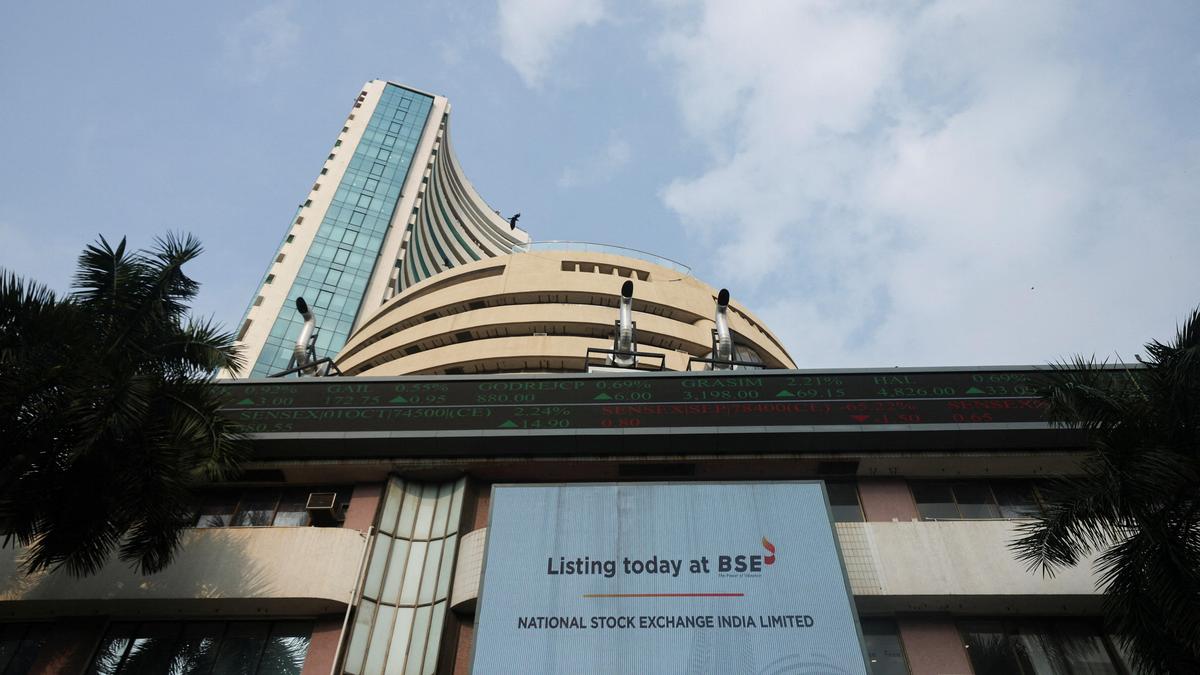
A view of the Bombay Stock Exchange in Mumbai. File | Photo Credit: Reuters Benchmark indices Sensex and Nifty drifted lower in early trade on Thursday (October 8, 2026) as growing prospect of tighter domestic and global monetary conditions persisting for longer, surging crude oil prices and foreign fund outflows dented sentiment.The 30-share BSE Sensex declined 264.97 points to 72,408.15 in early trade. The 50-share NSE Nifty was down 87.50 points to 22,507.65.Among the 30 Sensex firms, ITC, Adani Ports, Bharat Electronics, Bajaj Finance, Bajaj Finserv and InterGlobe Aviation were among the major laggards.Tata Consultancy Services, HCL Tech, Tech Mahindra and Infosys were among the winners.Brent crude, the global oil benchmark, traded 2.02% higher at $102.2 per barrel.Foreign Institutional Investors (FIIs) offloaded equities worth ₹6,121.37 crore on Wednesday (October 7, 2026), according to exchange data."The outlook for Indian equities remains cautious after the RBI raised its repo rate to 5.50%, tightening domestic financial conditions at a time when global markets are already contending with elevated Treasury yields and geopolitical uncertainty. Tighter domestic financial conditions and a fragile global risk backdrop could keep investors defensive," Ponmudi R, CEO of Enrich Money, an online trading and wealth-tech firm, said.The Reserve Bank of India raised its benchmark repo rate by 25 basis points to 5.50% on Wednesday (October 7, 2026), its first hike in nearly four years, while signalling that rate cuts are off the table in the near term and that further hikes could follow amid rising inflation, a weak rupee and high crude oil prices.The six-member Monetary Policy Committee (MPC) of the RBI voted unanimously to raise the repo rate, and sprang a surprise with a shift in policy stance to "calibrated tightening" from "neutral".In Asian markets, South Korea's Kospi, Japan's Nikkei 225 index, Shanghai's SSE Composite index and Hang Seng index quoted lower.U.S. markets ended lower on Wednesday."The key overhang is no longer the RBI’s rate increase alone, but the growing prospect of tighter domestic and global monetary conditions persisting for longer, potentially keeping pressure on risk appetite and foreign flows. The RBI’s shift to calibrated tightening, followed by Federal Reserve minutes indicating another U.S. rate increase may be required this year, could limit risk appetite," Hariselvan Radhakrishnan, Founder & CEO of HST Wealth, a research analyst firm, said. Published - October 08, 2026 10:17 am IST
Stock markets decline in early trade as RBI signals more tightening
Full Article
Original Source
Read the full article at Thehindu →KhanList aggregates and links to publicly available news content. We do not host full articles from third-party sources. Always verify important information with original sources.