
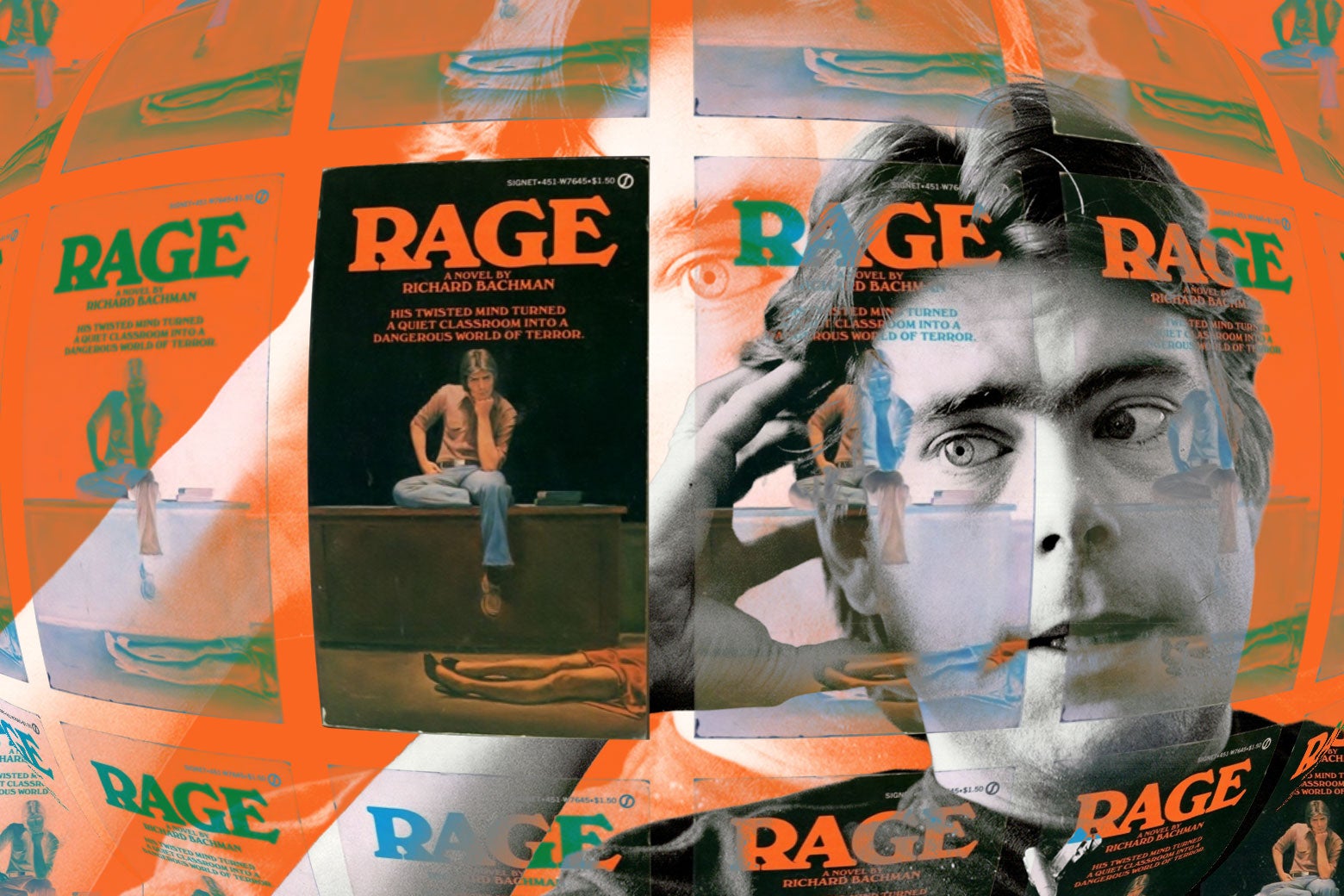
Wide Angle The one book so controversial that even the King of Horror pulled it from publication. Photo illustration by Slate. Photos by Boris Spremo/Toronto Star via Getty Images and Wikipedia. Sign up for the Slatest to get the most insightful analysis, criticism, and advice out there, delivered to your inbox daily. About a decade before he delivered us the most notorious senior prom in all of literature—the blood-soaked climax of his 1974 debut novel Carrie—Stephen King wrote another book about an act of shocking violence at a high school. That novel, Rage, wouldn’t be published until 1977, three years after Carrie had made King a star and after its pair of follow-ups, ’Salem’s Lot and The Shining, had made him the most famous horror writer in America. It was partly due to this renown that King decided to publish Rage under a different name, Richard Bachman, the first of five novels that he would publish under that moniker. “I think I did it to turn the heat down a little bit; to do something as someone other than Stephen King,” wrote King in 1985, after his pseudonymity had blown up and “Bachman’s” publisher, New American Library, decided to collect four of the five works, including Rage, into a volume entitled The Bachman Books, with King’s name now blared across its cover. (The fifth, Thinner, had been published in 1984 and was ultimately the source of King’s outing, when an enterprising bookstore clerk and King fan named Steve Brown went to the Library of Congress and tracked down King’s name on the book’s copyright paperwork.) Sometime in the late 1990s, King quietly made the decision to let the original Bachman Books collection fall out of print. Three of the collected novels—Roadwork, The Running Man, and The Long Walk—are still available, both in a revised version of The Bachman Books and in individual form, but Rage is not. Rage is, in the most basic terms, a book about a school shooting, a phenomenon that, by the time King pulled it from circulation, had become sickeningly more commonplace than it had been in 1977, to say nothing of the mid-1960s, when he’d actually written it. In January 2013, a month after the Sandy Hook massacre, King published an essay entitled “Guns,” which elaborated on his decision to remove Rage from publication, including an unsettling acknowledgment that in the ’80s and ’90s, at least four school shooters possessed copies of the book and were presumed to have been influenced by it. (All of King’s profits from “Guns” were donated to the Brady Campaign to Prevent Gun Violence.) Rage was originally titled Getting It On, and King began writing it in high school. (I assume the title was changed to avoid accusations of, shall we say, false advertising.) When Carrie became a sensation in the mid-1970s, first as a book and then as a hit Brian De Palma movie, it was easy to view King as an overnight sensation, but the reality was more like the opposite. By his own account, King had already completed five novels before Carrie, none of which had drawn the interest of publishers. (Rage and The Long Walk were two of them.) He’d spent years shopping his short stories to small regional journals and smutty “men’s magazines,” and Carrie’s initial hardcover sales were pedestrian; it wasn’t until the novel was released in paperback that it took off. With the exception of Thinner, none of the novels that King published as Bachman really qualify as “horror” fiction, unless you’re employing the most capacious definition of the term. Rage is an unsettling book, but it’s not a very scary one. It’s quite short: In the weathered copy of The Bachman Books that currently sits on my desk, it clocks in at 131 pages. It’s also not very good. It reads like the work of a precocious high schooler. The characters are undercooked, the ideas underdeveloped, the dialogue a little too fantastical. Most centrally, writing a story from the point of view of someone suffering from severe mental illness is very hard to do well, and King just doesn’t pull it off convincingly. King fans will surely find tropes and flourishes that he’d revisit more effectively in later work—at one point the main character addresses the principal as “Mr. Man,” a phrase that instantly evokes Annie Wilkes, the superfan antagonist of King’s wonderful 1987 self-satire Misery. But mostly Rage feels like a very early draft of something that a more mature and practiced writer might have done something better with (which, in a way, he did with Carrie). Rage’s reputation as a “school shooting” book is both correct and a bit misleading, particularly in the present context. While it’s set in a school, and people do get shot, the plot doesn’t much resemble the wanton massacres that have come to define our understanding of that phrase post-Columbine. Rage is really a hostage story. The book’s protagonist is a young man named Charlie Decker, a socially ostracized high school senior who commandeers a classroom full of schoolmates at gunpoint, but not before fatally shooting a teacher, then later another. These are the only two deaths in the book, and they happen early in the narrative. The bulk of the book concerns Charlie’s interactions with his classmates, many of whom grow increasingly swayed to their captor’s side as their ordeal endures, while also undergoing a Lord of the Flies–esque devolution of traditional teenage social mores. Interspersed are frequent flashbacks to Charlie’s troubled home life, particularly his relationship with his violent and abusive father. Rage’s most ambitious, and most admirable, undertaking is its attempt to turn a young man who’s committed a completely indefensible act into a sympathetic character, and on this count it mostly succeeds. If many of King’s best-known works often feature superficially “normal” people who are driven to monstrosity for some reason or another—The Shining, for instance, and of course Carrie itself—Rage gives us something like the opposite trajectory, a young man who begins the story committing a monstrous act and yet by its end has become, if definitely not a hero, at least a full human being. It’s this aspect of Rage that has certainly stuck with King. Writing this piece prompted me to reread “Guns” for the first time since it was published, and it’s a terrific essay, written with a disarming matter-of-factness that underscores the severity of its subject matter. One of its most moving sections is when King provides brief biographical sketches of each of the four young men who’d committed appalling acts of violence under the influence of his writing. The details are, unsurprisingly, heartbreaking. It’s a reminder that people aren’t monsters, even those who do unspeakably terrible things; rather, they are products of the hands they’ve been dealt, of injuries and afflictions, of things that have been done to them that they did not deserve. For a writer whose career has been largely devoted to terrifying his readers, King has always had a deep and unmistakable humanistic streak to his work. It’s what connects Rage to “Guns,” and to everything else. Books Horror Stephen King Mass Shootings
Stephen King Wrote a Book About a School Shooter. Then It Allegedly Inspired Several School Shootings.
Full Article
Original Source
Read the full article at Slate →KhanList aggregates and links to publicly available news content. We do not host full articles from third-party sources. Always verify important information with original sources.