
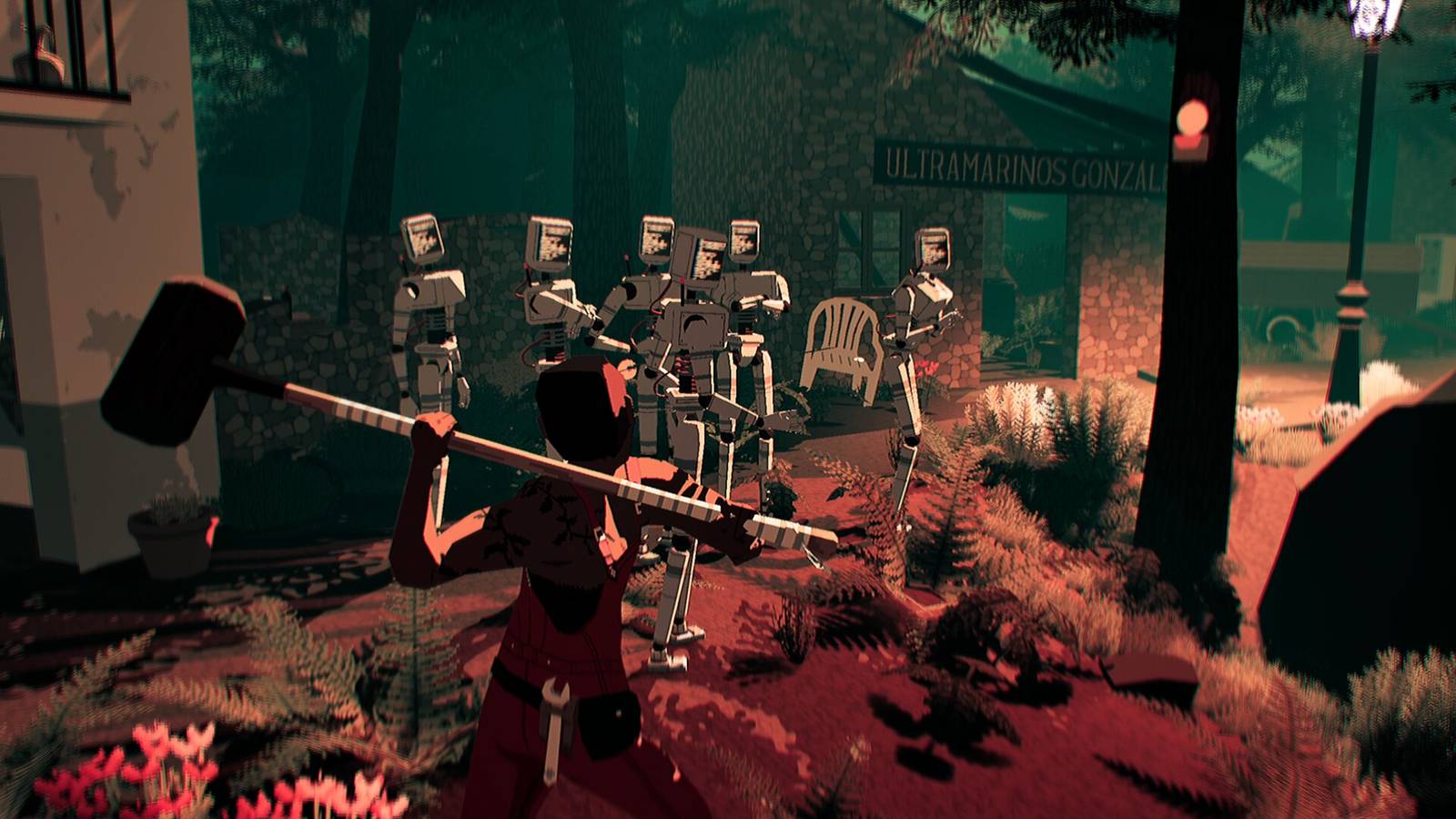
Published Nov 13, 2026, 8:00 AM EST Virtue and a Sledgehammer rages against AI and finds peace in grief Virtue and a Sledgehammer rages against AI and finds peace in grief Image: Deconstructeam/Selkie Harbour, Devolver Digital There are plenty of good reasons to have an adversarial relationship with generative AI. You could go to war over the tech’s environmental impact, its catastrophic impact on labor, the way it has driven up the cost of RAM, or the fact that it’s an empire built on mass theft. But there’s also the existential horror of it all. Imagine what a world where human beings forfeit all of their brainpower to machines would look like. Where nobody can be bothered to write so much as an email to one another. Where photos are replaced with digital approximations of cherished moments. Where art is no longer created by people who have something to express, but by those who only see it as a space-filling product. The greater threat of an unchecked AI industry is that it will siphon the soul out of humanity. And what are we without that? It’s a question that haunts Pratelle, the tortured star of Deconstructeam and Selkie Harbour’s rage-filled Virtue and a Sledgehammer. Grief crosses paths with cultural frustration as Pratelle sets out on a quest to smash a town full of bots. Generative AI is a clear target in this vital and timely story about resisting harmful technology before it's too late, but that’s only one piece of the game’s more thoughtful meditation on what makes a person human, and why we must accept our limitations as a species. That even means finding peace with death. Reeling from the loss of her mother, Pratelle returns to her hometown — with a sledgehammer in tow — to discover that everyone’s consciousness has been transferred into walking machines. Scattered flashbacks gradually reveal that her sister, Nina, is behind the town’s transformation into a robotic paradise. Unable to process the impending death of her mother, Nina becomes obsessed with the idea of saving her mom by letting her thoughts live on in a machine body. Pratelle detests the idea, and eventually returns home with the intention of destroying her sister’s work. Pratelle’s rage manifests in a simple but effective mechanic: she can smash every bot and building in sight with a sledgehammer. Tapping the button simply lets her shove bots away. Holding the button down allows her to swing it. And holding it as long as she can results in a Hulk-like smash that can level an entire house. It’s a one-note bit of gameplay, but it’s as much as the three-hour story calls for. There’s an undeniable power that comes from pounding a bot into oblivion. Visceral sound design emphasizes the impact of each swing as walls crumble in an ear-splitting stone downpour. Virtue and Sledgehammer’s stance on AI isn’t subtle, nor is it trying to be. It’s an aggressive rejection of the tech built for anyone who has ever said what they wish they could do to a data center, out of earshot of a cellphone microphone. It sees an impending dystopia and wishes one person could have the power to cut it off at the knees. The entire premise of the game even evokes Ridley Scott’s iconic 1984-referencing Apple commercial, where a runner dressed in red throws a sledgehammer through a screen as Big Brother speaks to the brainwashed masses. (It’s a reclamation of the image in some way, given that an Apple is now a very major player in the tech climate that Virtue and a Sledgehammer is so ready to topple.) Virtue and a Sledgehammer frames the idea of letting go as the kindest thing you can do for a person. But catharsis is only a temporary bliss; Virtue and Sledgehammer is much more about the problems that can’t be solved with destruction. The real heart of the story comes from Pratelle and Nina’s divergent responses to an inevitable death. Pratelle faces reality in a coldly blunt manner. Death is death. Once her mother’s brain stops functioning, she will no longer exist. Nina refuses to accept that, and it’s what leads her to believe that a person could live forever if they give themself over to a tech singularity. A body is just a body, in her mind; it’s your thoughts that make you who you are. And if you could transplant those thoughts into a bot and simulate consciousness, isn’t that the same thing as being alive? Virtue and Sledgehammer wades into similar territory explored by Yorgos Lanthimos’ Alps. The Greek film centers around a service that helps people get over a recent death in their life by sending them an actor who impersonates the deceased. The idea is that it could allow people to wean themselves into acceptance by giving them a substitute to fill that sudden void in their life. Is that ethical, or a manipulative business practice that causes more harm than good? It’s a Lanthimos movie, so you can probably guess the answer if you’re familiar with the pitch-black filmmaker. But Virtue and a Sledgehammer approaches similar questions, tied up in an AI premise that’s beginning to feel less sci-fi by the day, with a genuine philosophical curiosity. While destroying everything in a blind rage, Pratelle is challenged by the horrifying idea that Nina could be right. After all, the robots she’s crushing house the thoughts and feelings of real people she once knew. Her empathy is repeatedly tested by cowering robots who beg not to be killed, as is yours when you’re left deciding whether to hear their pleas or treat them as the cold ramblings of a machine. It would all be easier for everyone involved if you could accept the comforting idea that immortality is possible. Image: Deconstructeam/Selkie Harbour, Devolver Digital But it’s not. One of the great pains of living is knowing that everyone you’ve ever met will someday die. You can skip the funerals to avoid staring at that cold truth lying in an open casket, but that doesn’t reverse a loss. It’s not a scientific problem to be solved. Virtue and a Sledgehammer isn’t trying to bum players out with a bleak reality. Instead, it embraces the fact that this cycle of life, death, grief, and acceptance is an inseparable piece of our humanity. What makes humans special is that we aren’t machines that operate with 100% efficiency. We are flawed creatures with bodies and minds that are built to break down. The fact that we know that and still continue on, trying to forge legacies and leave the world a better place than we found it, is remarkable. And it’s remarkable because we know how fragile and impermanent we are, not in spite of it. Virtue and a Sledgehammer frames the idea of letting go as the kindest thing you can do for a person. It’s an acknowledgment of an irreplaceable humanity that can only come from an imperfectly designed being. The absence is an invisible monument to their life; it is not a void to be filled with a substitution. That’s something that a tech industry so overeager to push humanity past its natural limits fails to grasp. Let us fail, let us grow, and let us die. Otherwise, what’s the point of living? Virtue and a Sledgehammer is out now on Windows PC. The game was reviewed on Windows PC using a prerelease download code provided by Devolver Digital. You can find additional information about Polygon’s ethics policy here. Free sign-up Get Polygon’s Wishlister newsletter A weekly cheat sheet to what you’ll eventually love to play. No buying, no commitment — just saving for later. Sign up free Free. Unsubscribe anytime.
Steam’s Angriest New Game Is the Perfect Place to Channel Your AI Hate
Full Article
Original Source
Read the full article at Polygon →KhanList aggregates and links to publicly available news content. We do not host full articles from third-party sources. Always verify important information with original sources.