
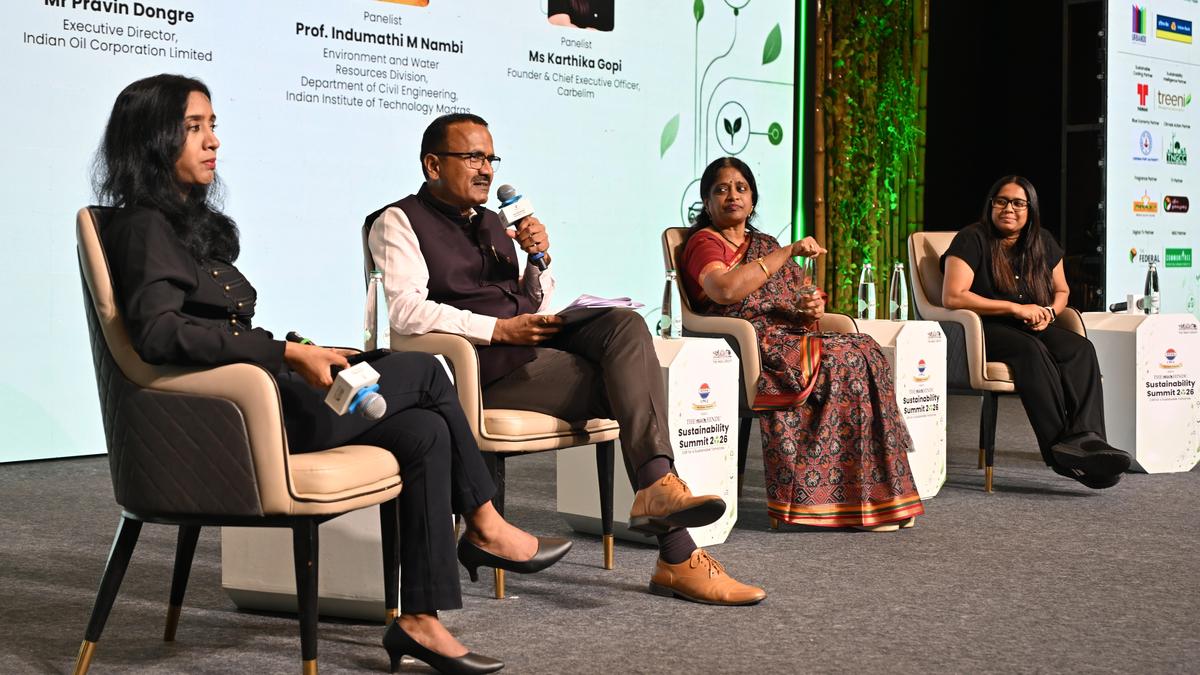
Ideas to Impact: Startups Accelerating the Energy Transition: Pravin Dongre, Executive Director, IOC, Prof. Indumathi M. Nambi, Environment and Water Resources Division, IIT, Madras, Karthika Gopi, Founder and CEO Carbelim, Moderated by Sangeetha Kandavel, Senior Assistant Editor, The Hindu at the The Hindu Sustainability Summit 2026 in Chennai on September 23, 2026. | Photo Credit: M. Srinath Start-ups working on sustainability solutions need to be supported from the ideation stage to help innovative ideas translate into viable technologies, panellists said at The Hindu Sustainability Summit 2026 held in Chennai on Wednesday (September 23, 2026).At a session on ‘Ideas to Impact: Start-ups accelerating the energy transition’, speakers discussed about the current status of start-ups, challenges they face and the support needed to scale their innovations.Elaborating on the importance of incubation and entrepreneurial activities, Indumathi M. Nambi, Environment and Water Resources Division, Department of Civil Engineering, IIT Madras, said not many incubators supported students at ideation stage and many students too did not register with incubators. This indicated a gap in the existing incubation eco system. There was a need to create pre-incubators that could help students develop and test their ideas.At IIT Madras, gaps had been identified after the piloting stage and corporates and industries must step in to bridge them. Highlighting that funding was not an issue for deep tech start-ups, she said a major roadblock was the trust about new ideas.Doctoral programmeShe also suggested introducing a doctoral programme in entrepreneurship to help students demonstrate scaled-up products and receive mentorship support for commercialisation.Speakers called for greater collaboration between industries, academic institutions and start-ups. They also stressed the need to introduce entrepreneurship as a subject at the school level to help students pursue careers aligning with their interests.Pravin Dongre, Executive Director, Indian Oil Corporation Limited spoke about IOCL’s journey in encouraging the start-up ecosystem. Various start-ups across the value chain, including those working on clean and green energy and water, had received funding with support extended for 18 to 36 months. Some had reached proof of concept stage and some of them, including projects such as eco toilets and nano fillers for oil pipelines had been commercialised, Mr. Dongre said.He stressed the need for start-ups to have clarity on long-term development. Incubation mechanisms could benefit both start-ups and industries. More support mechanisms were needed to take innovations from modular solutions to commercial scale, he said.Speakers also emphasised on the need for collaborations to address critical environmental challenges such as air pollution and water issues.Pointing out various challenges faced by start-ups, Karthika Gopi, Founder and Chief Executive Officer, Carbelim, said achieving net-zero goals did not have a one-stop solution but required an umbrella of solutions. Testing technologies in real world conditions was often challenging, while protecting intellectual property and achieving commercial scale-up were other hurdles.Start-ups, particularly deep tech start-ups, needed consortium-based support as investors had to be patient during gestation period. Start-ups must also explore international support and generate early evidence to validate their technologies, she said.Such consortium-based support from industries and the government would pull out ideas from the lab and facilitate the emergence of new technologies, she added.The session was moderated by Sangeetha Kandavel, Senior Assistant Editor, The Hindu. Published - September 23, 2026 11:25 pm IST
Start-ups need support from ideation stage to drive energy transition: panellists
Full Article
Original Source
Read the full article at Thehindu →KhanList aggregates and links to publicly available news content. We do not host full articles from third-party sources. Always verify important information with original sources.