
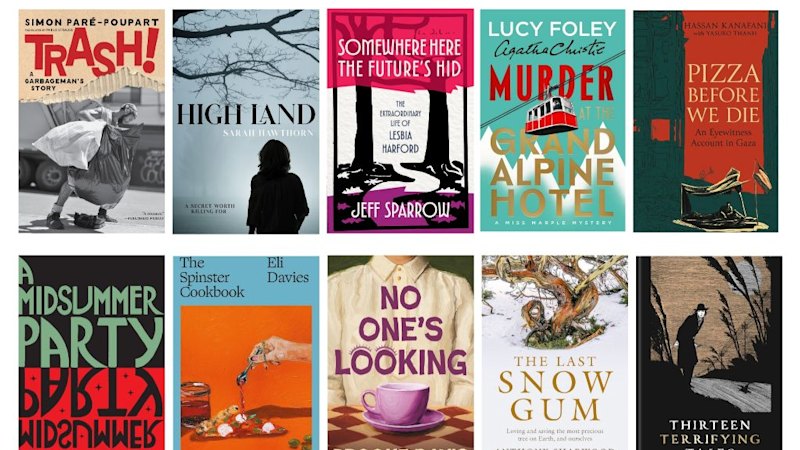
This week’s fiction features murder and mystery aplenty, relationship dynamics and vintage horror, while our non-fiction reviews range across everything from nature, the war in Gaza and waste management. Something, surely, for every reader.Fiction Thirteen Terrifying Tales, edited by Kirsty Logan (Bodleian Library, $35)These 13 tales were written in the late 19th and early 20th centuries, during, as editor Kirsty Logan points out in the foreword, a period of great upheaval with the advent of industrialisation and medical advancements. But before we put distance between these stories and our own, Logan reminds us that the “same vast expansions and rapid progress that thrilled them also terrified them – just as our technologies do now.” Whatever the case, a good story is not bound by time, and the majority of these tales are indeed scary. There are submissions from big names – Bram Stoker, H.P. Lovecraft and Ambrose Bierce, who you’d expect to excel in all matters dark and creepy, but there’s also a surprise or two: who’d wager Edith Wharton would make the cut? There are a number of ghost and haunted house stories in the mix, as well as superstitions and folklore, but equally effective are tales that draw on psychological terror, of being beholden to “the claws of peril and dread” of one’s own conscience after wrongdoing. A solid collection to prepare for Halloween. High Land by Sarah Hawthorn (Transit Lounge, $35)Annie survives a tandem skydive when her parachute fails, while her unlucky instructor dies by taking the brunt of her fall on impact. The accident sets off a chain reaction of remarkable events. Not surprisingly, Annie is discombobulated upon regaining consciousness, with strange and inexplicable flashes of memory disturbing her recovery. To aid her convalescence, her parents keep her in a heavily fortified remote property in the Southern Highlands, ostensibly to avoid further media attention. But why are they so nervous and paranoid? Sarah Hawthorn’s latest book has all the requisite ingredients of a thriller: a couple of suspicious deaths and a European hunt to find the truth, as well as a narrative that includes kidnapping, blackmail, extortion, and an elaborate revenge plot. No one seems to be who they claim; no one should be trusted, and the narrator is not reliable either. It’s a fun, wild ride, and you forgive some of the outlandish, unbelievable happenings because just when you think you have High Land figured out in terms of whodunnit and whydunnit, the novel suddenly changes direction again. No One’s Looking by Brooke Davis (Hachette, $35)No One’s Looking is Brooke Davis’ second novel, after her highly acclaimed debut Lost & Found, and explores the ennui, expectations and comfort of long-term marriages, sibling relationships, and gender dynamics. Set over a month in the blistering summer, the book surveys the lives of two 40-something sisters as they navigate various stressful flashpoints. Susan is meek and quiet; her younger Vicki is feisty and opinionated. Both are uncertain of what to do when their hard-won equilibrium is disrupted: Susan’s husband wants an open marriage, and Vicki’s teenage daughter, Gretel, is testing boundaries with her boyfriend. The book is all about women’s bodies, the pervasiveness of the male gaze, patriarchal demands in the domestic sphere, and the reclamation of one’s own sexuality and identity. These are all well-trodden topics, but still worth another appraisal. There’s a metaphorical poignancy when Susan admits that she’s never been able to ride a merry-go-round because she feels the horses “were trapped on this spinning wheel for nothing but the pleasure of others”.Murder at the Grand Alpine Hotel by Lucy Foley (HarperCollins, $35) This novel is Lucy Foley’s tribute to her favourite Agatha Christie character, Miss Marple, “the very picture of a slightly dithery village spinster”, as those who don’t know her very well tend to dismiss her. But as detective fans know, her harmless little old lady persona acts as a foil for her keen intellect and intuition. Foley sets her drama in 1950 in a luxurious hotel in the Swiss Alps, and populates it with a motley crew of guests, including an oily and pompous politician and his elegant wife, a Hollywood starlet, a paid companion to an elderly widow, and, of course, Miss Marple. There’s a death, and then a couple more. Like many Christie stories, Foley keeps her suspects in one place. A convenient snowstorm and a blocked train tunnel prevent anyone from escaping, giving just enough time for Miss Marple to puzzle together the mystery. The snowy setting, the post-war intrigue, the fast-paced narrative, and the points of view of various suspects make this novel an enjoyable romp. A Midsummer Party by Antoni Jach (Transit Lounge, $35)This is not so much a novel that trades on a plot; rather, it’s a book about ideas and debate. Most of the action – if you can call it that – takes place at a party in Rome, where the unnamed narrator, a freelance journalist, artist, and micro-press publisher (not dissimilar to the author), interacts with a number of other guests much like, as he puts it, “one of those bush dances where you are in a large circle and you continually swap one partner for another.” The company is full of creatives and sophisticates, the type of people who quote Shakespeare and Wittgenstein earnestly and unironically. Apart from a heated discussion and engaging in “verbal pugilism” with a pompous art historian, the narrator mostly remains passive; he prefers to listen to the tales of others. A Midsummer Party is a talking heads book, full of mini-stories about travel, culture, and ambition. As in any party, there are some tiresome characters who divulge too much and whose self-obsession and rambling monologues feel as though they are orating to a spellbound audience.Non-fiction Somewhere Here the Future’s Hid by Jeff Sparrow (Monash University Press, $35)“My mission in the world/ Is to prolong/ Rapture by turning it/ Into a song./ A song of liberty,” wrote the Australian poet and activist Lesbia Harford in 1915. In this superb biography, she blazes from the page through her words and deeds, finally given her full due as a writer, radical, lover and visitor from “future’s door”. One of the first women to qualify as a lawyer, she chose instead to labour in a factory and advocate for the seamstresses she worked alongside. While she died at 36 of a congenital heart condition, she lived with an intensity, passion and commitment to love, art, sexual freedom and working people that could have fuelled many lifetimes. She didn’t want to lecture her readers, Harford said in one poem; she wanted to tear them apart. Her work languished in obscurity for decades until scholars finally brought it to light. As Jeff Sparrow observes, her concerns and her lyrics speak to our turbulent times with a yearning, freshness and immediacy that makes her more relevant than ever. Trash! by Simon Pare-Poupart (Pantera Press, $30)This slim volume has all the hallmarks of a cult classic. Its wry, streetwise voice draws us into a world widely disdained even though civilisation couldn’t function without it: that of the garbage collector, “the Sisyphus of our consumer society”. Quebecois Simon Pare-Poupart went into waste management because his stepfather wanted to make a man of him. He quickly developed a taste for its exceptional physical demands and the sense of solidarity it fostered with his fellow workers on the margins of society. Collecting garbage financed him through university and while he’s done other jobs, he returned to “throwing trash” because he regards it as a vocation and an art form. This is not just memoir and sociological analysis but a celebration of the athleticism and value of the work itself. While it goes unrecognised, the job yields its own paradoxical rewards: “a state of grace that frees you for a while from the burdens of existence”. Pizza Before We Die by Hassan Kanafani with Yasuko Thanh (Arsenal Pulp Press, $35)In a landscape reduced to crumbling debris, everywhere people are starving. Hassan Kanafani overhears two little girls talking. One says, “Expensive? What does that even mean? Let’s just fulfil our dream and eat pizza before we die ... no one knows.” As Gaza slips from the news headlines, here is a book to remind us of the horror endured and that still endures; a shattering plea to the world not to look away, not to forget. These incidents from daily life during the war and in the immediate aftermath were originally posted on Reddit. Kanafani clearly has the soul of a poet as he tells of life in threadbare tents buffeted by the wind, the rain and the cold, and of the acts of humanity amid an existence pervaded by “not the fear of death, but the fear of life”. He writes of a boy eating a biscuit who is shot dead by a sniper. Of a father taking the shrouded body of his child to the cemetery while the rest of his family lie buried under rubble. The Last Snow Gum by Anthony Sharwood & Anna Langford (Hachette Australia, $37)“They are sensual, erotic, ecstatic, orgiastic. If you’ve never seen sex writ large in a tree, it’s because you’ve never seen Australia’s snow gums.” While I’d have to contend that the smooth, muscular trunks and limbs of the lemon-scented gum offer stiff competition, this Dionysian challenge makes for a great opening gambit. But before you get too excited, Apolcalyptus Now is the real-time film playing out in the High Country, says Anthony Sharwood. Snow gums are facing a triple threat from a ring-barking beetle, global warming and fire. In alternating chapters, which later merge into an on-the-page conversation, Sharwood and environmental activist Anna Langford blend yarning with research and plenty of on-the-ground experience to bring the plight of the snow gum to the widest possible audience. With a light touch that never obscures the seriousness of the subject or their passion for it, the authors successfully garner our concern while showing, as Joan Baez put it, how action can be “the antidote to despair”. The Spinster Cookbook by Eli Davies (The Indigo Press, $40)There’s a growing list of words that have been reclaimed by those they once stigmatised – slut, bitch, queer, crip and wog, to name a few. But this is my first encounter with the use of “spinster” as a badge of honour. Part of Eli Davies’ motivation was her feeling that being “uncoupled” doesn’t make you a solitary unit. She is also drawn to the way the spinster traditionally occupied a space outside the mainstream household. In this candid, thought-provoking memoir, she reflects on how food creates a sense of home and community, the portrayal of the spinster in literature and film, and – despite her love of cooking – her ambivalence about how it has been treated as part and parcel of a woman’s role as carer. Slowly, after the break-up of her relationship with her domestic partner, Davies discovered the joys of pleasing herself (such as having a vodka and toast for dinner), the freedom of rejecting conventional mealtimes and the pleasures of the “spinster dinner party”.What else is happening in the book world?Pulitzer Prizewinner Barbara Kingsolver on her new novel and Appalachian prideThis novel is the raw, moving reality check Australian fiction needsBlood, lies and cartels: Five new crime books to read this month“Landmark achievement” wins $80,000 literature prizeA giant Mao looms over Hong Kong. Welcome to 2030
Spooky vintage tales to set the Halloween mood and nine other new books
Full Article
Original Source
Read the full article at Smh →KhanList aggregates and links to publicly available news content. We do not host full articles from third-party sources. Always verify important information with original sources.