
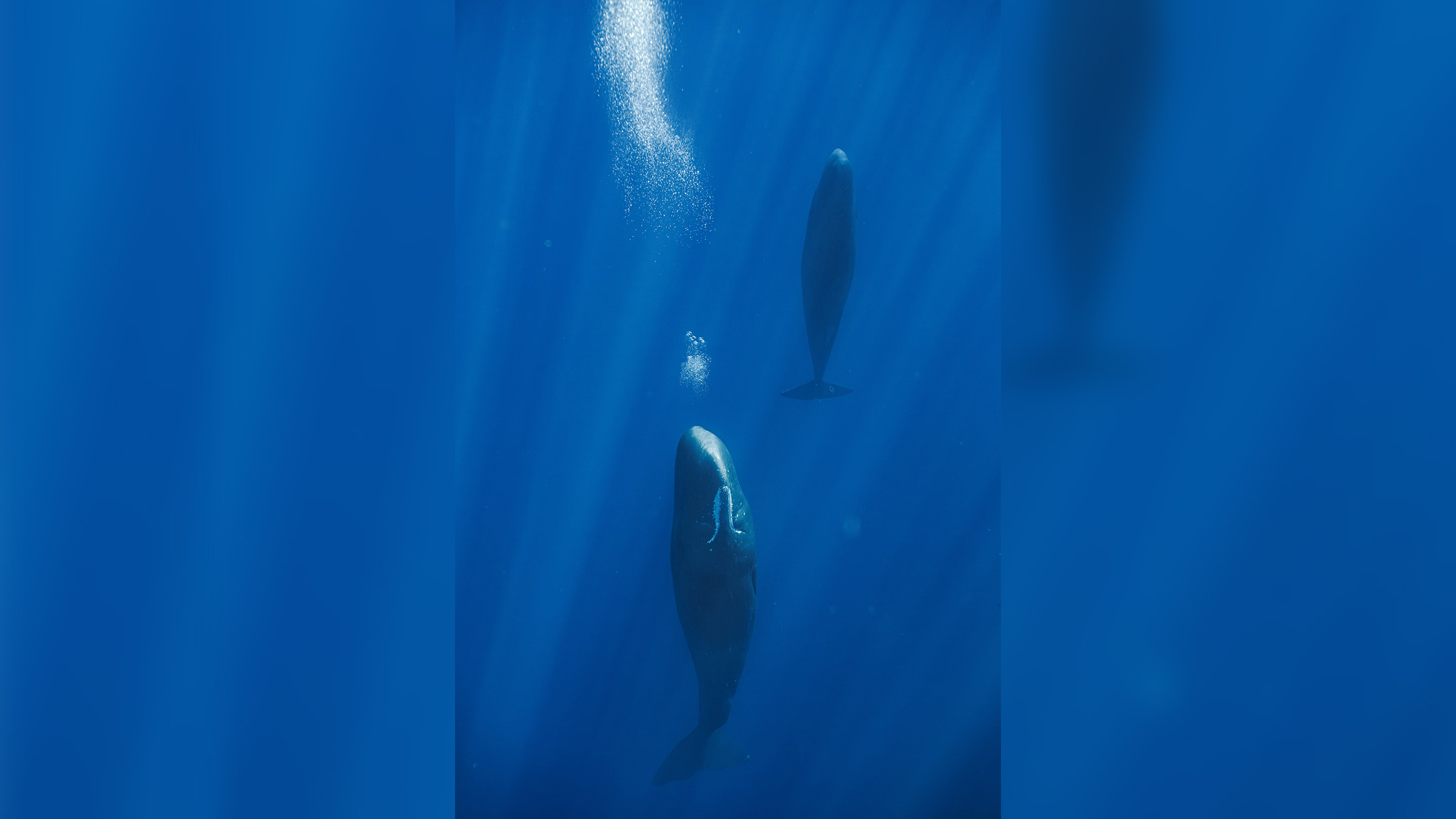
Sperm whales are the only whales known to rest vertically, floating steadily just below the ocean’s surface. Scientists have hypothesized that the whales release air bubbles to help them stay neutrally buoyant but the mechanism for how they do so has not previously been demonstrated — until now. “We already knew that sperm whales rest in a stereotypical vertical position and that they had been observed releasing bubbles during these resting periods,” lead author of a new study Noémie Freymond, a researcher at the Université de Neuchâtel in Switzerland, told Mongabay by email. “It had been hypothesized that the release of bubbles was related to buoyancy regulation, but this had not been demonstrated experimentally or systematically recorded.” Sperm whales (Physeter macrocephalus) are buoyant largely thanks to a massive oil-filled organ, called the spermaceti organ, located in their heads. Waxy spermaceti oil is lighter than water, making the whales buoyant. It was once used as a fuel for lamps and candles and the reason the whales were targeted by hunters. The whales’ lungs, respiratory tract and spermaceti organ are all low-density organs positioned near the head and help the whales stay vertical. As the whales drift up, lower pressure allows air in the lungs to expand, pushing the whales toward the surface. Releasing bubbles counteracts that upwards push and allows the whales to stay submerged instead of bobbing to the surface. The study’s research team used data from 42 sperm whales that had been tagged with suction cups near Norway’s Lofoten Islands. The data, collected between 2005 and 2019, contained recordings that enabled the research team to identify when bubbles were released. Seventeen of the 42 whales were recorded in this resting position, which lasted from just a few minutes up to three hours. Scientists refer to this behavior as resting rather than sleep because they haven’t yet conducted EEG tests to record their brains activity, which is difficult to do in the wild, Freymond said. Sperm whales aren’t the only marine mammals to use bubbles in some way. Humpback whales (Megaptera novaeangliae) release bubbles during foraging, creating bubble nets that make it easier for them to capture prey. Dolphins produce bubbles during play and social interactions. Gray whales (Eschrichtius robustus) and bowhead whales (Balaena mysticetus) have been observed using bubbles to control their buoyancy, both during dives and resting, she added. For sperm whales, the researchers found that the volume of air that whales breathed in during resting dives was different than for other activities, such as foraging dives. “The behavior suggests that sperm whales are able to respond to changes in their environment or physiological state during resting dives,” Freymond said. “Improving our understanding of their sleep and awareness during these periods could have important implications for understanding their vulnerability to anthropogenic threats, such as ship strikes.” Banner image: A sperm whale resting and releasing bubbles. Image courtesy of the University of St Andrews. Credits Topics
Sperm whales blow bubbles to stay afloat while resting, research shows
Full Article
Original Source
Read the full article at News →KhanList aggregates and links to publicly available news content. We do not host full articles from third-party sources. Always verify important information with original sources.