
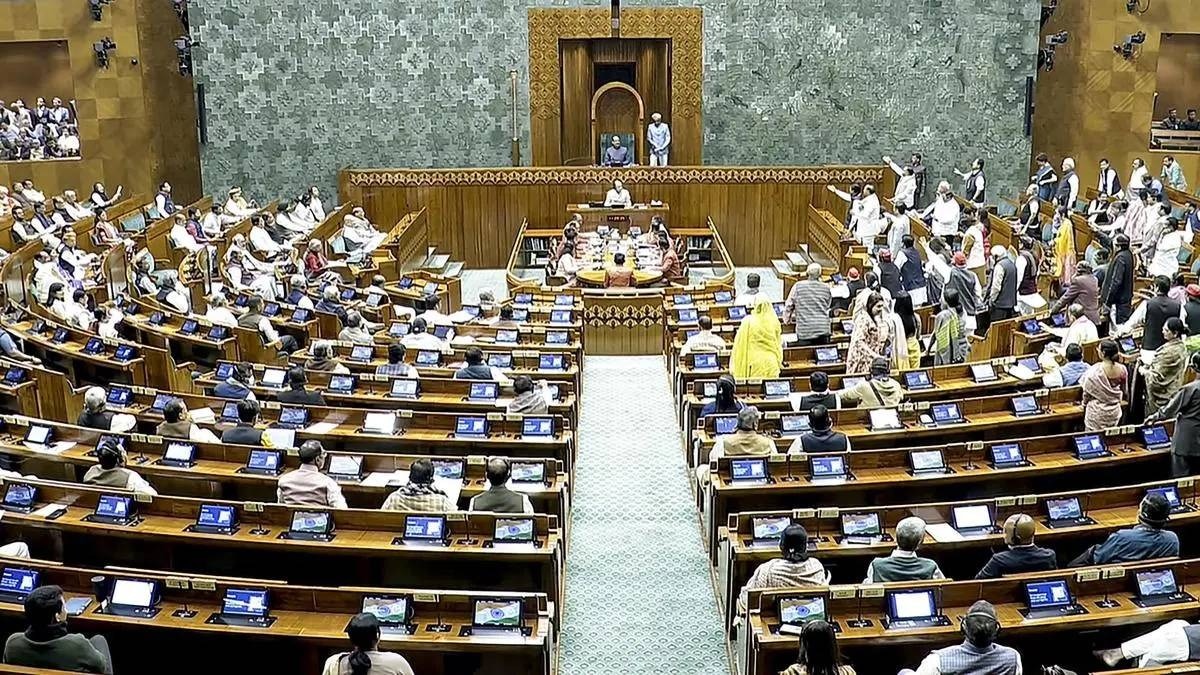
Political discussions have gathered pace over the government's plans to revive the contentious Delimitation Bill and Women's Reservation Bill, with the focus firmly on the numbers required to secure their passage in Parliament. The Lok Sabha Speaker and the Rajya Sabha Chairman okayed the proposal as the government asked them to reconvene the Lower House on November 30 and the Upper House on December 2 for special sittings, which may conclude on December 3.The move has triggered fresh political calculations over whether the BJP-led NDA can muster the two-thirds majority needed to pass the proposed constitutional amendment, even as Opposition parties have criticised the timing and the government's legislative approach.NDA EXPLORES SUPPORT BEYOND ALLIESThe government faces the challenge of securing the constitutionally mandated majority in both Houses.Under Article 368, a Constitution amendment requires a majority of the total membership of each House and the support of at least two-thirds of members present and voting. In the Lok Sabha, which has a sanctioned strength of 543, three seats are vacant.The NDA currently has around 298 MPs, including 240 from the BJP, 16 from the Telugu Desam Party, 13 from the Eknath Shinde-led Shiv Sena and 12 from the Janata Dal (United). The government's potential tally could rise to 319 with the support of 20 rebel Trinamool Congress MPs, who have broken away from the party and pledged support to the NDA, along with Shiromani Akali Dal MP Harsimrat Kaur Badal.The numbers could increase further if regional parties extend their support.The DMK has 22 MPs, the NCP (Sharadchandra Pawar) eight and the YSR Congress Party four.Their combined support could take the projected tally to 353. NCP (SP) leader Supriya Sule has indicated that her party could consider backing the legislation if it provides for a uniform 50 per cent increase in Lok Sabha seats for every state.With 353 votes, the government could meet the two-thirds requirement if 529 or fewer members vote.If all 539 MPs other than the Speaker participate, 360 votes would be required. Abstentions among Opposition members could therefore prove significant.WHY THE BILLS MATTERThe proposed constitutional amendment seeks to increase the maximum strength of the Lok Sabha from 543 to 850 through delimitation, paving the way for implementing 33 per cent reservation for women in the Lok Sabha and state legislative assemblies.Parliament passed the Women's Reservation Act in 2023, but its implementation was linked to a delimitation exercise following the publication of figures from the first Census conducted after the law came into force.The government is seeking to expedite the process so that the quota can be implemented before the 2029 Lok Sabha elections.However, the proposed expansion has raised concerns among southern states over the possibility of changes in their relative representation in Parliament.The government is understood to be considering a 50 per cent increase in seats for every state or retaining the existing proportion of representation based on the 1971 Census. No final decision has been announced.APRIL DEFEAT CASTS SHADOWThe government's renewed efforts come after the Constitution (131st Amendment) Bill, 2026, was defeated in the Lok Sabha on April 17.Of the 528 MPs who voted, 298 supported the Bill and 230 opposed it. The government needed 352 votes to secure the required two-thirds majority, falling short by 54 votes.Following the defeat, the government held back the related Delimitation Bill, 2026, and the Union Territories Laws (Amendment) Bill, 2026.The political arithmetic has since changed, with 26 MPs moving out of the Opposition camp, strengthening the government's position.OPPOSITION QUESTIONS SPECIAL SITTINGThe announcement of the special sittings has drawn sharp criticism from Opposition parties, which have questioned the decision to reconvene Parliament for a brief period instead of holding a regular Winter Session.Congress general secretary Jairam Ramesh accused the government of seeking a "super-tainted" two-thirds majority after what he described as "105 days of Operation Lotus".He called the move an "insult to and assault on the Constitution".Congress MP Manish Tewari said the government's request "mocks the institution of Parliament", arguing that a special sitting should not become a substitute for a regular Winter Session.CPI(M) MP John Brittas alleged that political manoeuvres were being used to manufacture a majority for delimitation, warning that "Women's empowerment must never become a smokescreen for electoral engineering."Congress MP Renuka Chowdhury also questioned the short-notice announcement, saying Parliament must provide adequate opportunities for legislative scrutiny, Question Hour, Zero Hour and discussions on matters of public importance.CABINET MEET, OPPOSITION HUDDLE IN FOCUSThe Union Cabinet is scheduled to meet on Friday and is likely to discuss the proposed legislation.The Congress Parliamentary Strategy Group, chaired by Sonia Gandhi, is also scheduled to meet to formulate the party's response ahead of the special sittings.The government has maintained its push for women's reservation, with Prime Minister Narendra Modi blaming the Opposition for the earlier defeat of the constitutional amendment.With the proposed sittings approaching, attention will now centre on the final provisions of the Bills, the positions taken by regional parties and the government's ability to secure the required numbers in both Houses.The coming days are expected to see further political consultations as the Centre attempts to revive legislation that failed to clear Parliament earlier this year.- EndsWith PTI inputs
Special Parliament sitting revives buzz over delimitation, women's quota bills
Full Article
Original Source
Read the full article at Indiatoday →KhanList aggregates and links to publicly available news content. We do not host full articles from third-party sources. Always verify important information with original sources.