
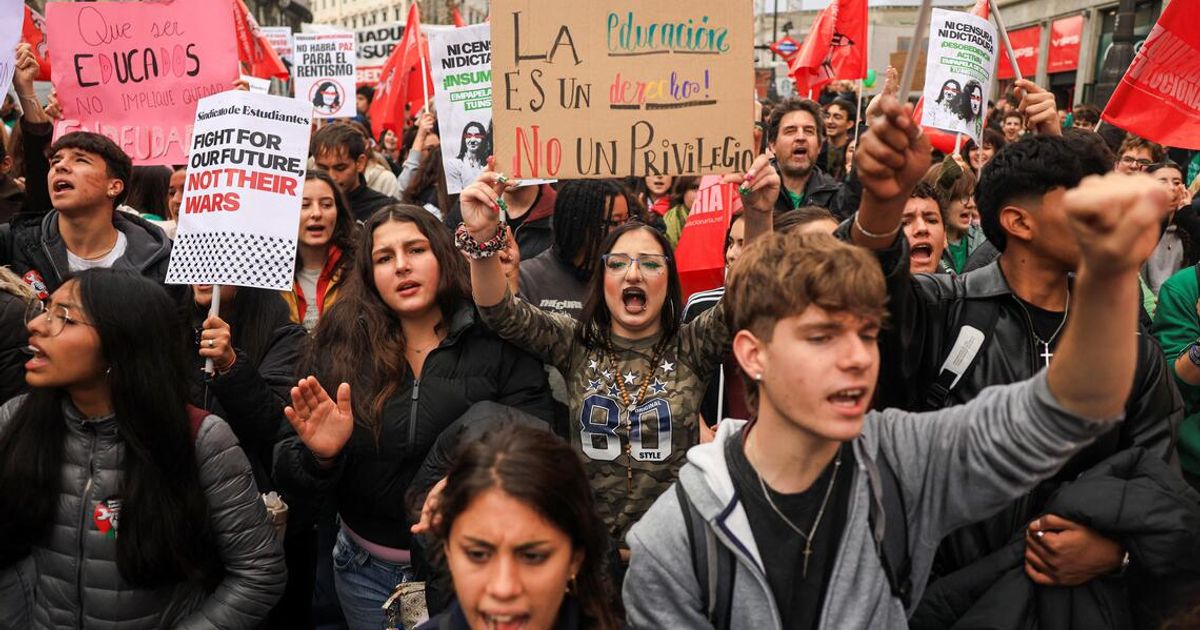
MADRID – A giant banner featuring Prime Minister Pedro Sanchez’s smiling face hangs over the main entrance to Madrid’s central Sol station.A few weeks earlier, it was the epicentre of some of the biggest protests the country has seen in a generation.Above ground, demonstrators railed against politicians and their failure to deal with a housing crisis, which has become a symbol for broader anger about the cost of living and inequality.Below, many commuters shared the frustration, enduring delays on trains taking them to jobs that barely pay enough to cover rent.The protest camp is gone now, removed by police.But the outrage that drove people there in the first place remains.And Spanish voters will have their say on Nov 29 after Sanchez called a snap election.The mood among large swathes of the population is at odds with the image of Spain on paper.It looks like a model economy, expanding more than twice as fast as the eurozone, cutting its budget deficit and reducing unemployment.In November, ING called it the “comeback kid.”The numbers, however stellar, don’t capture reality for many Spaniards, especially the younger generation, whose life is dominated by worries about money, job security and what the future holds.Housing looms large. Property prices have risen about twice as fast as wages for young workers.Two thirds of adults under the age of 34 still live with their parents.As if the daily grind wasn’t enough, the country has been traumatised by a series of catastrophes, from tragic rail crashes that killed more than 100 people to summer wildfires, climate-fuelled storms and flash floods that destroyed homes and businesses.“They were supposed to defend us and they took us for granted, they just defended their own interests, and those of people who have money,” Salomé Iglesias, a 21-year-old international relations student, said while waiting for a friend near Sol station. “The government has messed up time and again.”Iglesias, who works part time doing odd jobs, lives with her parents in central Madrid.She can’t afford to move out, and says the system is broken. She doesn’t plan to vote on Nov 29.Crisis fightingSanchez called the election after a failed attempt to pass emergency housing measures.His Socialist Party has trailed Alberto Núnez Feijoo’s centre-right People’s Party in most polls, though they’ve been narrowing the gap in recent days. Sanchez is under pressure from corruption cases involving allies and his family, as well as struggles to deal with a migration crisis after tens of thousands of people illegally crossed into the Spanish enclave of Ceuta in North Africa during the summer.Echoing trends elsewhere in Europe, he’s also fighting a rise in support for the far right. Vox, with its anti-immigration platform, has been able to exploit the Ceuta situation, and a surge of arrivals in the Canary Islands.The party has linked immigration with other issues, like healthcare, low wages and housing shortages.While Feijoo hasn’t said he would form a coalition with Vox, surveys show an alliance would give them a comfortable majority in Parliament, and control of the government.Eviction outrageFrustrations about the cost of living have led to multiple strikes by rail workers, doctors and teachers in 2026. In September, the anger escalated following the eviction of Maria del Carmen Abascal, an 87-year-old woman who couldn’t afford a rent increase.Abascal died a few days later.“Her case was so obvious that everyone was able to empathise – a retired, vulnerable woman who always paid her rent and whose life was second to a company’s profit,” said Valeria Racu, a spokeswoman for the Sindicato de Inquilinas, a tenants’ group that represented Abascal.The group called for the protests that led to the encampment at Sol square.It later pushed for a country-wide stoppage that was backed by labour unions and crystalised with the first general strike since 2012.Sanchez has repeatedly touted the country’s strong growth, calling Spain “one of the most prosperous economies in the West” in his 2025 review.It’s true the country is in a far better place compared with what happened after 2008, when a real-estate collapse gave way to bank bailouts, recessions and austerity.But many people say they have been left behind by the boom, a view exacerbated by housing issues. According to Fedea, a Madrid-based think tank, almost 2 million extra households fall below the poverty line once their rent is paid. “If you look at aggregate macro figures and growth, Spain is doing well,” said Pablo Muylle, an economist at ING in Belgium and co-author of the “Comeback Kid” research note. “Still, that does not necessarily mean an average person is really seeing the benefits.”Minimum wageThe government has taken steps to help the lower paid. The minimum wage increased by 54% between 2018 and 2024, and will rise again at the start of 2027.But median wages have increased far less, and workers don’t feel like living standards are improving.A lot of Spain’s growth has been immigration led, which has meant sharing the spoils among more people. Between 2021 and 2024, net inward migration amounted to more than 2 million people.Spanish households are only around 11% better off in real per-capita terms than two decades ago, half the average EU gain.“Spain doesn’t work anymore,” José María Figaredo, a Member of Parliament with Vox, said during a television debate in November. “Unaffordable housing, a broken education system and having a job or two doesn’t guarantee you’ll make ends meet.”One problem is that home building hasn’t kept pace with the economy or population growth.Construction slumped after 2008 and never recovered. Tourism, a huge part of the economy, exacerbates the shortage as more properties get turned into holiday homes.Spain’s main parties all have manifesto proposals to boost construction.But experts worry that election promises and short-termism will dominate, to the detriment of meaningful long-term solutions.That’s a common frustration, not just in housing. A liberalisation of the high-speed-train services brought in new companies and lower prices. But the infrastructure didn’t keep up with the increased traffic.The rise of renewable power has shielded Spain from high electricity prices, but a huge blackout in 2025 raised questions about operating practices and infrastructure.‘Nos quedamos’As the housing crisis has mounted, Sindicato de Inquilinas says membership has tripled in 2026. Earlier in November, it hosted an assembly at a cultural centre in Carabanchel, historically a working-class district of Madrid now buzzing with art galleries, design schools and music studios.Paloma Díaz, 57, told how she fought to keep her apartment using a strategy known as “Nos quedamos,” or “we’re staying,” when her building was sold and the new owners wanted everyone out. A dancer and choreographer from Seville, Díaz held on for almost two years paying her €750-a-month (S$1,057) rent.In February, she gave up and moved to a small studio in Carabanchel where she pays €1,000.“The government has been putting band-aids on the problem since the pandemic,” Diaz said. “You feel completely awful when millionaires and tourists kick you out of your home.” BLOOMBERG
Spain’s angry generation feels left behind in a booming economy
Full Article
Original Source
Read the full article at Straitstimes →KhanList aggregates and links to publicly available news content. We do not host full articles from third-party sources. Always verify important information with original sources.