
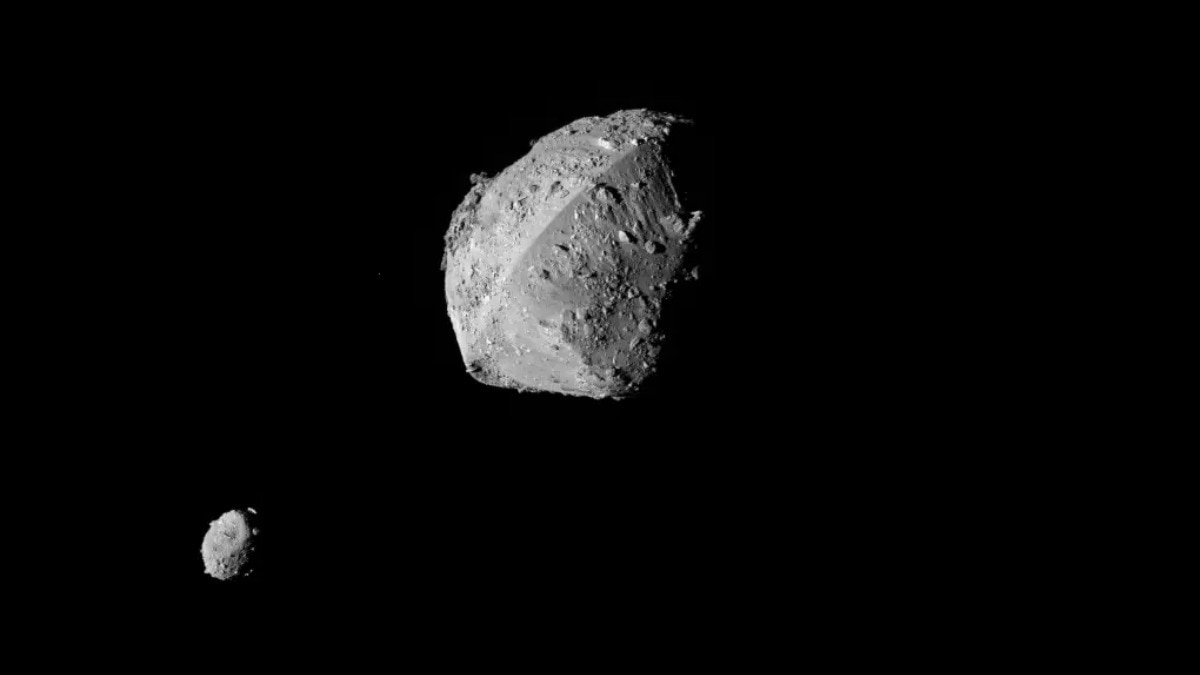
Hera has captured the first close-up views of Dimorphos after Nasa's DART collision. The findings could sharpen future asteroid-deflection calculations and planetary defence missions.This Hera Asteroid Framing Camera image shows Dimorphos in orbit around Didymos, with the crater caused by the 2022 DART impact clearly visible. (Photo: ESA)New Delhi,Nov 26, 2026 11:40 ISTHumanity's first planetary defence experiment has left behind a much bigger scar than scientists expected. Europe's Hera spacecraft has revealed that Nasa's deliberate collision with an asteroid in 2022 flattened an entire face of the space rock, creating a stadium-sized impact crater and sending it into a chaotic tumble.The findings come from Hera's first close-up observations of Dimorphos, a 151-metre-wide asteroid that orbits the larger, 730-metre-wide Didymos.The binary asteroid system is currently around 193.5 million kilometres from Earth. The observations offer the first detailed look at what happened to an asteroid after a spacecraft deliberately slammed into it, providing crucial information for future planetary defence missions.On September 26, 2022, Nasa's Double Asteroid Redirection Test (DART) spacecraft crashed into Dimorphos in a historic experiment to test whether humans could alter the trajectory of an asteroid. The impact shortened the asteroid's orbital period around Didymos by approximately 33 minutes, significantly more than initially predicted. However, scientists were uncertain about how the collision had physically affected the asteroid.Hera's observations have now revealed that the impact produced all three possible outcomes scientists had considered: a crater, a change in shape and significant changes to its motion."The face struck by DART has been flattened into an impact crater the size of a sports stadium, which extends across the asteroid's entire width," said Patrick Michel, Hera principal investigator and Director of Research at CNRS and Observatoire de la Cte d'Azur.Another surprising discovery is that Dimorphos is now tumbling chaotically in its orbit.Researchers have also identified hundreds of previously unknown boulders, each measuring a few metres across, surrounding the binary asteroid system. Scientists will investigate these objects more closely as Hera moves towards the asteroids.The European Space Agency's small-car-sized spacecraft is currently observing the asteroid pair from approximately 25-30 kilometres away. It is using three instruments, including an Asteroid Framing Camera, a multispectral imager called Hyperscout H and Japan's Thermal Infrared Imager (TIRI).Hera's investigation is far from over. In December, the spacecraft is scheduled to move closer, approaching approximately 13 kilometres from the asteroid pair to capture higher-resolution images. The dot trails correspond to hundreds of boulders of differing sizes in motion around the Didymos-Dimorphos system. (Photo: ESA) In January 2027, it plans to deploy two shoebox-sized CubeSats, Juventas and Milani. While Juventas will use low-frequency radar to probe the asteroid's interior, Milani will study its surface composition and surrounding dust.The findings could help scientists understand how asteroids respond to high-speed impacts and improve calculations for deflecting potentially dangerous space rocks.The mission is an important follow-up to Nasa's DART experiment, turning a successful collision into a detailed scientific investigation.ESA says the combined missions demonstrate how international collaboration can help develop reliable planetary defence capabilities and potentially protect Earth from future asteroid threats.- Ends
Spacecraft crash into asteroid created a stadium-sized crater. See pics
Full Article
Original Source
Read the full article at Indiatoday →KhanList aggregates and links to publicly available news content. We do not host full articles from third-party sources. Always verify important information with original sources.