
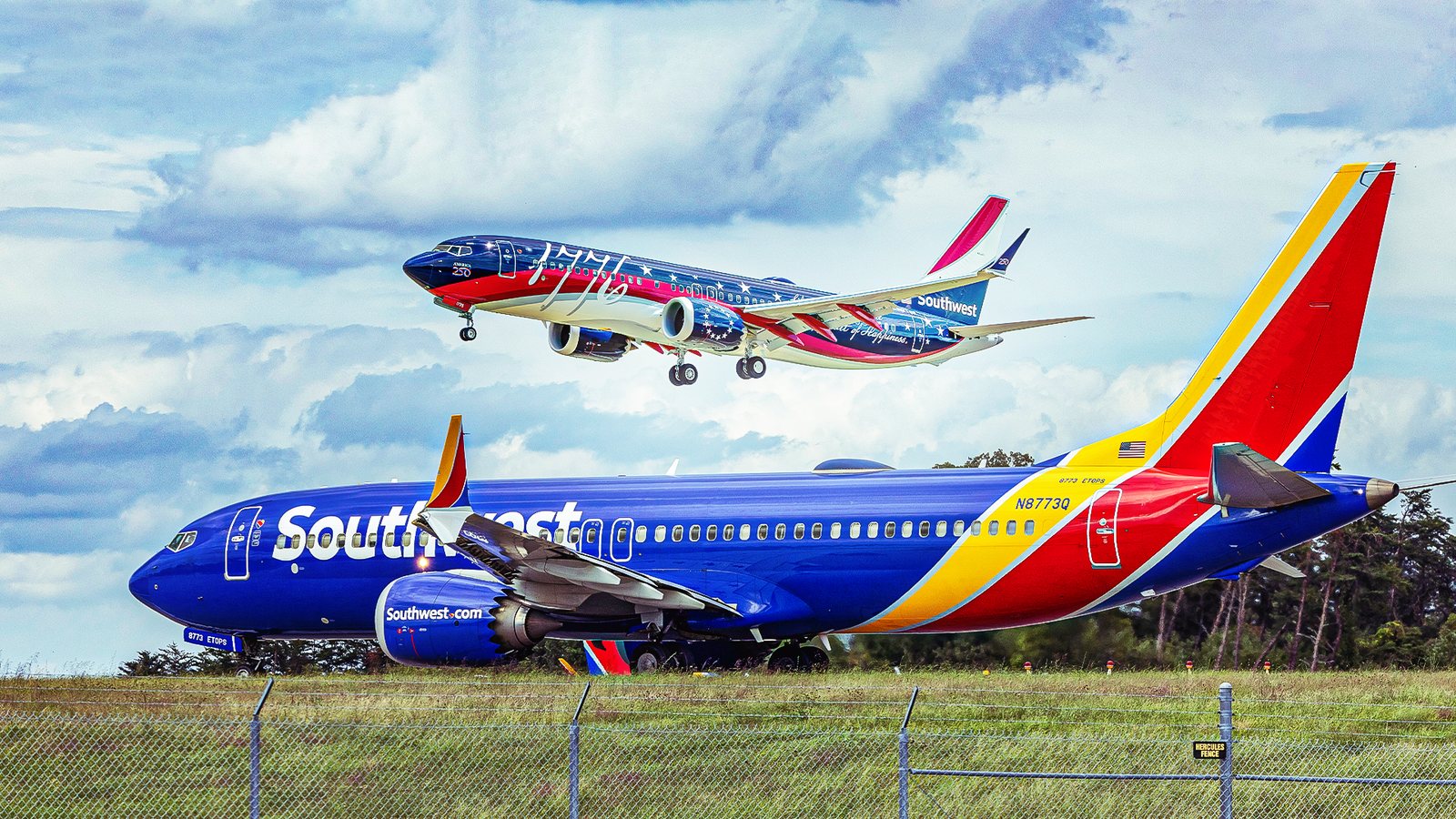
Published Nov 26, 2026, 1:00 PM EST Chris earned a Master’s degree in Defense and Strategic Studies (Highest Honors) from the University of Texas at El Paso. His graduate work concentrated on Global and National Security, Low-Intensity Conflict, Modern Warfare, and US grand strategy. He also undertook extensive regional studies, analyzing how key regions integrate into the broader US security architecture. This rigorous program provided him with a comprehensive understanding of U.S. military operations, global strategy, and weapons systems. Additionally, he gained a strong appreciation for great power competition.—an increasingly central force shaping international relations and conflict for the foreseeable future. Sign in to your Simple Flying account Southwest Airlines operates one of the largest domestic narrowbody networks in the US, connecting cities across the country with its extensive Boeing 737 fleet. Although the carrier is traditionally associated with short- and medium-haul services, several of its routes stretch nearly 2,700 miles across the continental United States, making them among its longest domestic nonstop journeys. Southwest's longest transcontinental routes in 2026 highlight the 737 variants deployed on these services and how the airline's evolving network strategy supports its longer-distance operations. The analysis also considers aircraft utilization, available seating capacity, and network changes supporting Southwest's nonstop services between markets across the country. What Are Southwest Airlines' Longest Transcontinental Routes? Southwest operates several long-distance transcontinental routes across the US, connecting major cities on the East and West Coasts. While the airline's 737 fleet primarily serves domestic short- and medium-haul markets, some of its longest services cover distances approaching 2,700 miles. According to Cirium data for 2026, the carrier's longest route connects Boston Logan International Airport (BOS) with San Francisco International Airport (SFO), covering an average distance of 2,704 miles. The second-longest route connects Rhode Island T.F. Green International Airport (PVD) with San Francisco, covering an average of 2,691 miles. Boston–San Jose International Airport (SJC) follows closely behind at 2,689 miles. The difference between these three routes is relatively small, with just 15 miles separating the longest and third-longest services. The company also serves the Providence-San Francisco market, with its official route information listing a comparable distance to that reported by Cirium. Providence–San Jose ranks fourth, covering an average of 2,675 miles, followed by Boston–San Diego International Airport (SAN), at 2,588 miles. Southwest's Providence-San Jose and Boston-San Diego route pages provide further information about these city pairs. The final two routes in the top seven both originate at Baltimore/Washington International Thurgood Marshall Airport (BWI), connecting with San Francisco and San Jose. These services cover average distances of 2,457 and 2,438 miles, respectively, according to Cirium. Which Boeing 737 Aircraft Does Southwest Use For Its Long-Haul Flights? While larger carriers generally use larger aircraft to connect destinations separated by considerable distances, this does not necessarily require an aircraft as large as the Boeing 747 or Airbus A380. Southwest instead relies on more modest narrowbody aircraft for its long-haul flights, including the Boeing 737-700, Boeing 737-800, and 737 MAX 8. This approach allows the airline to serve long-distance domestic markets while maintaining the flexibility of a single-family narrowbody fleet. Operating a common narrowbody fleet reduces the complexity of pilot training, maintenance, spare parts, and scheduling. Further, a long-distance route does not automatically require a 250- or 300-seat aircraft. Airlines match capacity to passenger demand, and operating several daily 737 flights can offer greater scheduling flexibility than deploying a single larger aircraft. Additionally, having numerous 737s allows Southwest to serve a wide range of domestic airports and routes while also operating international services, giving the airline considerable flexibility in fleet deployment. The primary passenger aircraft that Southwest used on its longest routes in 2026 was the MAX 8. This makes considerable sense given that the aircraft has a seating capacity of 175 passengers, while its widest seats measure 17.8 inches (45.21 centimeters), according to Southwest. Cirium states that the aircraft operated 1,310 flights across the long-distance routes examined, offering a combined 229,250 available seats over the year. These figures reflect the available passenger capacity rather than the number of tickets sold or passengers carried. The 737-800 came in second, with 813 flights and 142,275 available seats across the same routes. Interestingly, the 737-800 and MAX 8 share the same passenger capacity in the company's fleet, with both aircraft configured to accommodate up to 175 passengers. This means the difference in their overall available seat capacity across the routes is largely attributable to the number of flights operated by each variant. Meanwhile, the 737-700, with a smaller passenger capacity of 137, operated 209 flights and offered 28,770 available seats, making it a lower-capacity option among the three aircraft. Despite these differences, all three variants allow the carrier to maintain its narrowbody approach to long-distance domestic services. Southwest's Shift Toward Extended Range Routes Southwest has embraced a point-to-point service strategy rather than the traditional hub-and-spoke model used by most major US airlines. point-to-point enables the company to connect passengers directly to their destinations without requiring them to disembark and transfer at a connecting airport, as is often the case with the hub-and-spoke system. This approach allows the airline to offer more nonstop services between cities while giving passengers greater flexibility when planning their journeys. The route structure operated by the company has allowed the carrier to offer more direct nonstop flights as opposed to hub-and-spoke operations. Southwest stated that in order to "provide greater connectivity and support operational reliability and recoverability, in recent years the Company has increasingly focused on designing its network around core stations." The latter are strategically important airports in the carrier's network where the airline concentrates flights to facilitate passenger connections, improve scheduling, and maintain operational reliability. Simply put, these stations function somewhat like smaller connecting hubs, allowing passengers to transfer between flights without requiring the airline to adopt a traditional hub-and-spoke model. This unique route network has also enabled Southwest to provide its markets with frequent, conveniently timed flights and competitive fares. The airline complements its high-frequency short-haul services with an expanding selection of mid-range and long-haul nonstop routes. According to the airline, these include services connecting Hawaii with California, Las Vegas, and Phoenix, as well as mainland routes such as Las Vegas–Washington Reagan, Los Angeles–Nashville, New York LaGuardia–Houston, Los Angeles–Baltimore, Oakland–Houston, and San Diego–Baltimore. These services show how the carrier balances its traditional short-haul network with longer-distance connections, allowing it to serve markets across the continental US while maintaining its emphasis on nonstop operations. Adding to its success and convenience, in 2025 the airline added 24-hour operating capabilities by introducing red-eye flights to key markets to maximize fleet utilization. Southwest "now offers over 50 peak-day redeye flights during peak periods and includes flights across the continental United States and from Hawaii to the US mainland." Further, to expand its customer base, the company has enacted a strategy to reach travelers where they are performing travel searches. The airline also stated that it has expanded its operations onto such platforms as "Expedia, Priceline, Google Flights, Kayak, and Skyscanner to broaden its customer base and begin to engage them in its loyalty program." Plan Ahead For Warm Weather With Southwest's Summer 2027 Schedule With winter rapidly approaching, warm your thoughts and start looking ahead to summer 2027. The carrier is providing you with every reason to do so with its summer schedule. The company has already planned "4,498 trips on peak days during Summer 2027 are the most Southwest has ever offered in its summer schedule. Effective June 3, 2027, through August 2, 2027, the schedule is comprised of five unique schedules – Monday, Thursday, Friday; Tuesday/Wednesday; Saturday; and Sunday." Some of the biggest destinations are Austin, Texas; Nashville, Tennessee; San Diego, California; and Orlando, Florida. For Austin, Southwest will offer up to 143 departures, with frequency additions on existing routes and seven seasonal routes, including five that the company has not previously offered. "Weekend service through June and July connecting Austin to Liberia, Costa Rica, Nassau, Bahamas, and Punta Cana, Dominican Republic, complementing existing international service to Cancun, Mexico, Los Cabos, Mexico, Puerto Vallarta, Mexico, and San Jose, Costa Rica." San Diego will offer up to 150 departures during the summer, with new seasonal service connecting the city with Oklahoma City and the return of seasonal service between San Diego and Bozeman, Montana; Columbus, Ohio; Milwaukee; and Pittsburgh. The carrier will also offer up to 278 daily departures to Las Vegas, while Orlando will see an increase to 173 daily departures this summer. Further, seasonal daily operations between Las Vegas and Anchorage are set to return in June 2027, in addition to seasonal service connecting Bozeman, Montana, to Chicago (Midway) and Dallas. Southwest's Longest Routes Showcase Its Boeing 737 Fleet & Evolving Network Strategy Southwest's longest transcontinental routes demonstrate how the airline uses its 737 fleet to connect distant markets without relying on larger widebody aircraft. The MAX 8, 737-800, and 737-700 all contribute to these operations, although the MAX 8 accounts for the largest share of available seating capacity across the routes examined. This fleet strategy allows the airline to balance passenger capacity with operational flexibility while maintaining its focus on efficient nonstop domestic services. As the company continues developing its network, introducing overnight operations, and expanding its schedule into summer 2027, its longer-distance services remain an increasingly important part of its evolving domestic strategy. These developments also demonstrate how the airline is adapting its traditional point-to-point network to serve longer-distance markets while maintaining frequent nonstop connections across the United States.
Southwest Airlines’ Longest Transcontinental Boeing 737 Routes In 2026
Full Article
Original Source
Read the full article at Simpleflying →KhanList aggregates and links to publicly available news content. We do not host full articles from third-party sources. Always verify important information with original sources.