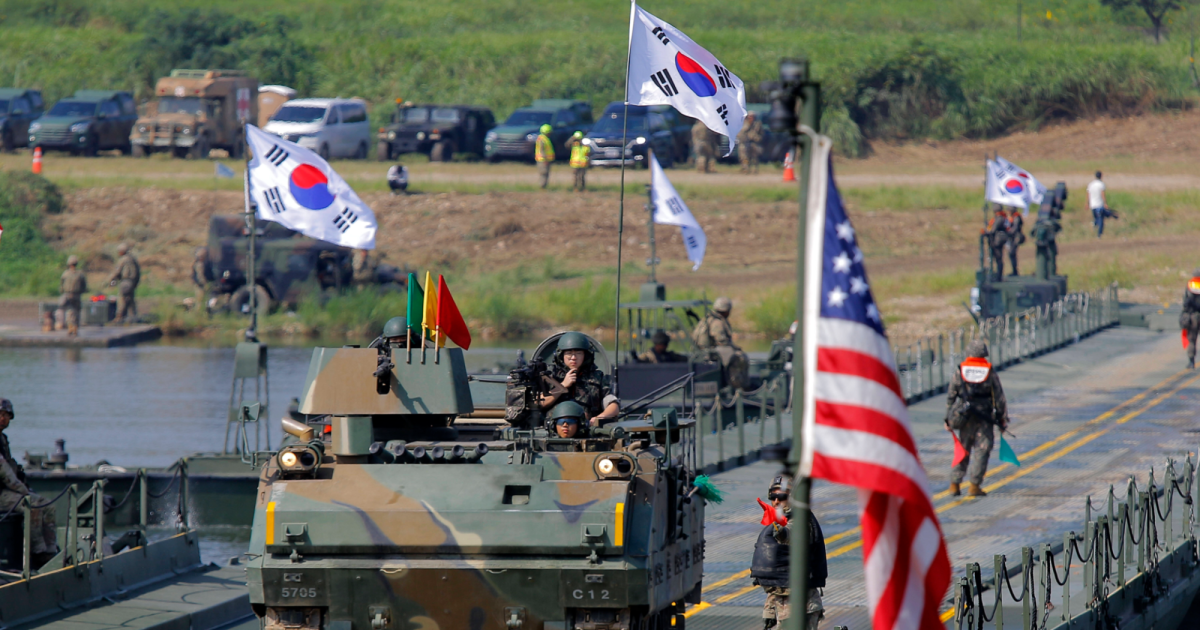
In Yeoju, South Korea, on August 27, 2025, ROK Army 7th Corps Engineer Brigade and U.S. Army 11th Engineer Battalion of the 2nd Infantry Division soldiers take part in a joint bridging drill.Seung-il Ryu/NurPhoto/AP Get your news from a source that’s not owned and controlled by oligarchs. Sign up for the free Mother Jones Daily. On Tuesday, South Korean President Lee Jae Myung reiterated his calls for the country to retake full control of its military operations from the US following Donald Trump’s order to cut back on annual joint training drills in preparation for North Korean threats two days prior. “A strong alliance makes the foundation of security stronger, and strengthening our own capabilities increases our value and necessity as an ally,” Lee said, framing the US-South Korea alliance and independent military control as mutually beneficial. Trump told reporters at the Oval Office on Monday that his decision to scale back military training with South Korea was due in part to Lee’s refusal to support the US war effort in Iran: “We can’t go around and protect all of these countries, especially when they’re not there to help us.” And in that announcement reducing the joint training, Trump wrote on Truth Social that his move was also “based on my very good relationship with Kim Jong Un,” North Korea’s dictator and, oddly referring to himself in the third person, the drills with South Korea “send a signal that is totally inappropriate and hostile, to a Country that, as long as Donald J. Trump has been President, has been unthreatening and respectful.” Lee said in response on Tuesday that Seoul should immediately plan a transfer of control over the Combined Forces Command, which consists of both South Korean and US forces. According to the Korea Times, regaining wartime operational control, which takes effect during major conflict, is a key goal of Lee’s administration. South Korea ceded full control of its military during the Korean War in the 1950s, but has been trying to regain complete command for over two decades. The same Korea Times report said that South Korea’s joint training drills with the US are “essential for assessing Seoul’s readiness to lead the combined forces” in the near future and are symbolic of the country’s national sovereignty. Lee also signaled rearmament, which may increase tensions and threaten further military action from North Korea. He pushed for Seoul to accelerate building nuclear-powered submarines, signaling rearmament. Several NATO members have also ramped up spending on military development following Trump’s multiple threats to withdraw from the alliance. Trump approved Seoul’s nuclear submarines last year, and Hegseth has praised South Korea for taking on more of its own defense. But burden-sharing was supposed to mean allies paying more for an arrangement Washington still runs. Lee is proposing something else: an ally that no longer needs to ask.
South Korea Wants Its Military Back
Full Article
Original Source
Read the full article at Motherjones →KhanList aggregates and links to publicly available news content. We do not host full articles from third-party sources. Always verify important information with original sources.