
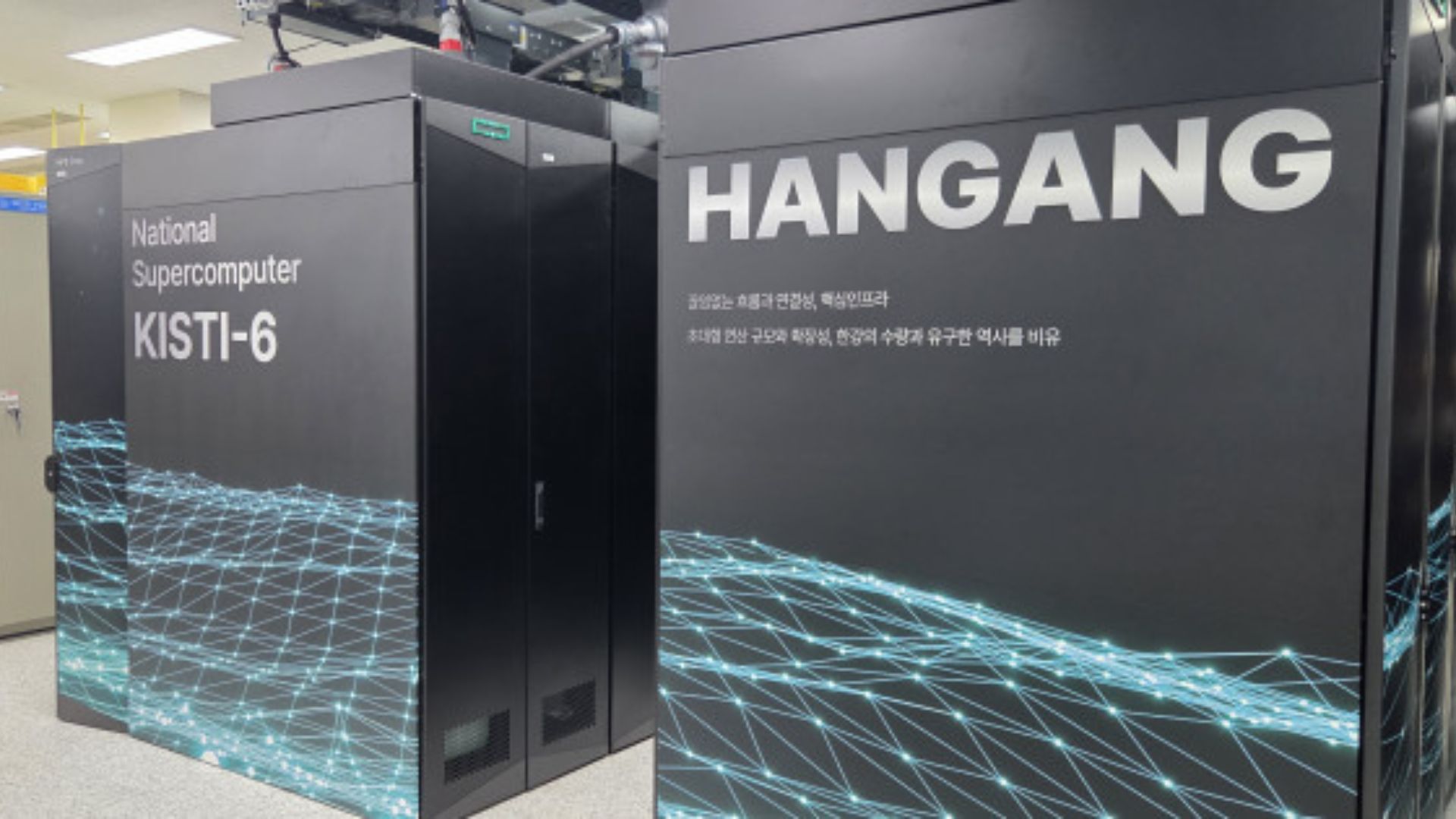
The Korea Institute of Science and Technology Information (KISTI) launched ‘Hangang’, the nation’s sixth supercomputer at a ceremony attended by over 200 members from academia, research institutes and industry at its headquarters in Daejeon. With a computing performance of 614.7 petaflops, the supercomputer is expected to break into the top 10 of the 500 supercomputers in the world when the list is updated this month. The Hangang supercomputer succeeds Nurion, which was launched in 2018 and has a stellar track record. In the past eight years of operation, South Korea’s fifth supercomputer was involved in 1,730 research projects which culminated in over 1,520 publications across a wide spectrum of subject areas ranging from next-generation battery materials to building AI systems for chemical analysis using large language models (LLMs). Hangang’s arrival has been delayed by surges in GPU prices during the recent artificial intelligence (AI) boom. The project passed a feasibility study in 2022, but tenders failed as demand for GPUs skyrocketed. The team had to redraw plans to meet changing research needs and possibilities, and after four years, Korea’s supercomputer no. 6 will soon be available for users. Hangang is powered by 8,496 NVIDIA GH200 chips that integrate GPUs and CPUs, and it boasts 9,936 CPUs. The storage capacity of the supercomputer is 205 petabytes (PB) with transmission speeds of 400 gigabits per second (Gbps). Together, the supercomputer can perform 61.47 quadrillion calculations per second. Its measured performance in June was 342.6 petaflops (PF), when it ranked 12th on the TOP500 list. In September, KISTI began recruiting researchers for pilot services on the Hangang and slowly scaling up its utilization. When the system enters full service by the 16th of next month, its theoretical performance will reach 614.7 petaflops, which would be a 24x leap over Nurion. Hangang is expected to take on not only Nurion’s workload but also new GPU-powered research. KISTI has previously announced that the computing resources will be allocated for research and development (55 percent), national strategy (30 percent) and industrial innovation (15 percent), with the latter supporting small and mid-sized companies. The quantum connection In early 2027, KISTI will also look to connect Hangang with a quantum computer it plans to introduce, bringing hybrid research systems to South Korea. This will create a win-win situation where the superior simultaneous computing abilities of the quantum computer will be teamed up with the large-scale and accurate computational prowess of the supercomputers. A possible area of application would be drug discovery, where the quantum computer narrows down protein structures that can bind to an enzyme while the supercomputer computes their binding energies. While KISTI looks at innovative applications, the organization must also prepare to bring in a successor to the supercomputer that is still in its pilot stage. This is meant not only to avoid a repeat of last time’s failures but also to secure South Korea’s computing needs in a highly competitive market. In the future, South Korea will look to be more self-dependent in building such systems. However, in the short run, the country lacks an ecosystem to build its own supercomputer and must rely on GPUs sourced from foreign countries to keep costs down. Get the latest in engineering, tech, space & science - delivered daily to your inbox.Ameya is a science writer based in Hyderabad, India. A Molecular Biologist at heart, he traded the micropipette to write about science during the pandemic and does not want to go back. He likes to write about genetics, microbes, technology, and public policy.
South Korea unveils 614.7-petaflop supercomputer, powered by 8,500 Nvidia GPUs
Full Article
Original Source
Read the full article at Interestingengineering →KhanList aggregates and links to publicly available news content. We do not host full articles from third-party sources. Always verify important information with original sources.