
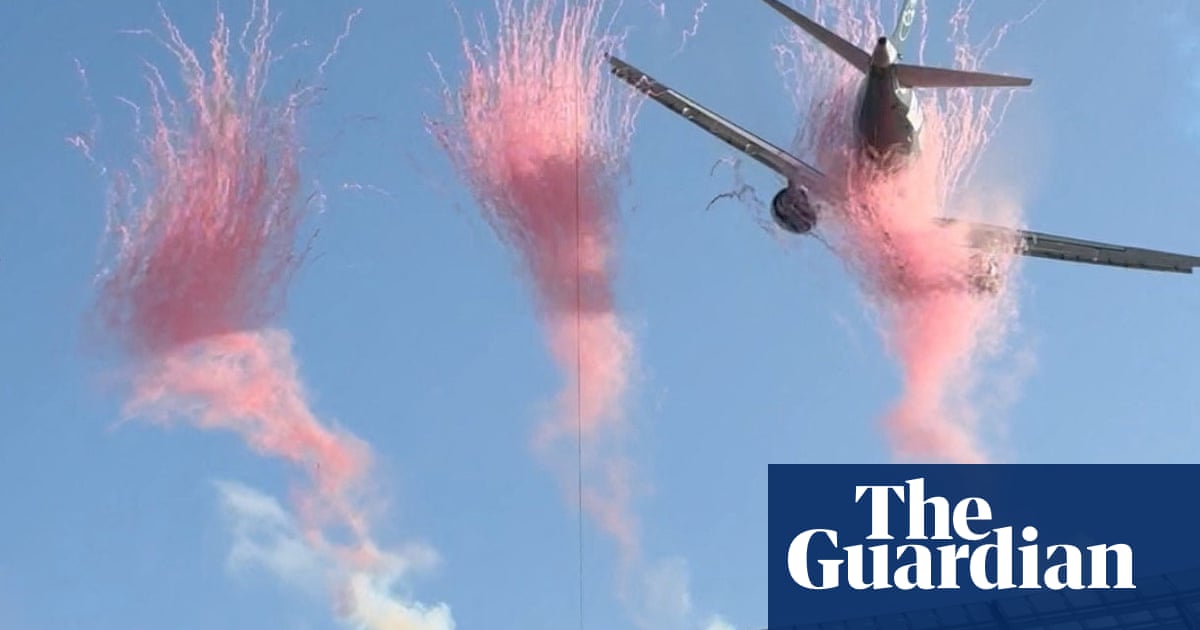
A pre-game stunt involving two passenger jets flying dramatically low over a stadium in South Africa drew huge cheers from the estimated crowd of around 56,000 people, but also sparked a major debate over safety risks.The flyby by two Embraer jets, operated by local airline Airlink, happened on Saturday before the second rugby union Test between South Africa and New Zealand in Cape Town.Flight tracking service Flightradar24 estimated that the lead jet passed just 41 to 46 feet (12 to 14 metres) above the roof of Cape Town Stadium, with the crowd and the world’s top-ranked rugby teams below. The second jet, which was very close behind, flew through a cloud of pink dust that shot up from the stadium roof as part of the show.Allow Instagram content?This article includes content provided by Instagram. We ask for your permission before anything is loaded, as they may be using cookies and other technologies. To view this content, click 'Allow and continue'.Airlink, a sponsor of the South African rugby union team, said that the flyby was conducted according to safety regulations. The airline said that it was carefully planned and rehearsed, with the aircraft traveling at around 150 knots (172 mph), when they went over the stadium. Each jet had three senior captains on board, Airlink said, operating in the roles of a commander, a co-pilot and a safety officer. The jets were not carrying any passengers.“Airlink notes the concerns expressed in various social media and online forums regarding yesterday’s formation flyby over Cape Town’s DHL Stadium,” Airlink said on Sunday. “The flight demanded careful planning and rehearsal, as it required navigating at low altitude, at around 150 knots. The South African Civil Aviation Authority and Air Traffic Navigation Services provided valuable guidance, approval and support to ensure a safe flyby.”The planes fly above the stadium before kick-off. Photograph: Gallo Images/Getty ImagesSouth African rugby union has a tradition of stadium flybys at big games, starting when a Boeing 747 flew over another stadium in Johannesburg before the 1995 World Cup final between the same teams, who are fierce rivals. But this weekend’s flyby was especially low and dramatic, generating global interest after it was shown as part of the pre-game broadcast, and sparking a flurry of videos shot by witnesses.Some aviation experts questioned whether the margin for error was too small. “Basically, that lead aircraft … was kind of like dodging over the roof and climbing over the one side and dipping below and then climbing over the other side. That was a little bit uncomfortable,” said Chris Martinus, president of Aircraft Owners and Pilots Association South Africa. “[If] something adverse happens, you just don’t have options at that kind of altitude.”skip past newsletter promotionafter newsletter promotionThe second jet flies through a cloud of pink dust that shot up from the stadium roof as part of the show. Photograph: APKeith Tonkin, an Australian aviation consultant and former military and commercial pilot, said on Monday that the Embraer passenger jets – which are small to medium jets designed for regional flights – were not designed or intended for that kind of low-level operation and warned against the precedent.“The bigger picture is that a benchmark has been established and others may expect to do something similar, and that’s not going to end well,” Tonkin said. He added that turbulence or a bird strike at such a low altitude could leave the pilots with too little room to maneuver without hitting the stadium.Airlink said that the flight data recorded by both aircraft confirmed that their flights were performed within civil aviation safety limits for speed and altitude.
South African airline defends dramatic low-level flyby before rugby union clash
Full Article
Original Source
Read the full article at Theguardian →KhanList aggregates and links to publicly available news content. We do not host full articles from third-party sources. Always verify important information with original sources.