
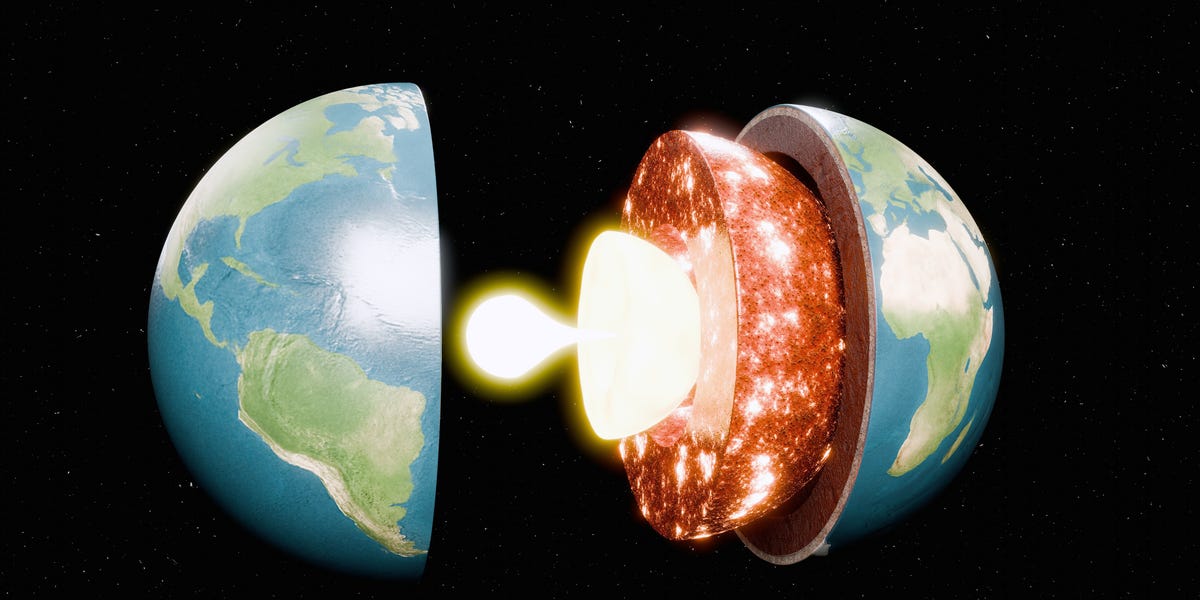
3 min readHere’s what you’ll learn when you read this story:When the rotation of Earth’s axis speeds up or slows down, which happens over decades, a day might end up being milliseconds longer or shorter than 24 hours.Surface forces like hurricane winds and rising seas don’t explain it all, so researchers looked deeper.The likely culprit is that the inner core spins at its own rate, clashing with the layers above.Though daylight hours shrink and stretch throughout the year, a day on Earth—the time it takes for the planet to fully rotate on its axis—is still 24 hours. But it isn’t always the exact same 24 hours. The true length of days can vary over time, give or take as little as a few milliseconds. While we barely realize that these shifts are happening, scientists are constantly trying to find out what’s causing them.Several forces can either lengthen or shorten Earth’s days by speeding up or slowing down the planet’s rotation. The most intense earthquakes redistribute mass by shifting entire landmasses, as do glaciers and continental ice that melt and raise ocean levels. Atmospheric influences such as hurricane winds can have an impact. Even the flow of ocean tides can exert a gravitational torque that tugs on Earth’s spin. But these influences aren’t limited to the surface. They reach far below, down to the hot, ever-flowing liquid metal of the outer core. When forces disturb the flow of that molten metal enough, the rate at which the planet rotates can change.What has remained a mystery about Earth’s inconsistent rotation is how the torque between the core and mantle contributes to these shifts. Viscous drag from core flows is too weak to exert much stress on the core-mantle boundary (CMB). But observations of how Earth’s axis shifts position suggest that the lowermost mantle can conduct electricity, which would let core flows exert electromagnetic stress on it, coupling the two layers. To gauge these forces’ effect on day length, geophysicists Huifeng Zhang and Mathieu Dumberry of the University of Alberta combined seismic estimates of the inner core’s rotation with models of outer-core flow, reconstructing changes from 1964 to 2019.“We have known for more than 30 years ... that the decadal changes in day length] are caused by core-mantle interactions,” the researchers said in a study recently published in Nature. “Yet we still lack a successful [length of day] prediction based on a modeling of the torque on the mantle.”Zhang and Dumberry realized that changes in the length of a day, however imperceptible, might actually be the result of angular momentum being exchanged between the inner core and the outer core (along with the bottom of the mantle). The inner core can also deform within just years and affect the layers above as it flattens one way or the other.When the flow of material at the CMB heads west, it causes a westward torque on the mantle that might also involve electromagnetic or topographic forces. Eastward and westward torques on the mantle fluctuate and compete. Because the inner core rotates slightly faster than the rest of the planet, it drifts east of the alignment that gravity would otherwise hold it in relative to the mantle. Gravity pulls to restore that alignment, exerting a persistent eastward torque on the mantle that opposes the westward torque at the CMB. Any imbalance between the two shows up as a change in day length.The models point to a small but persistent eastward misalignment of the inner core, sustained by its steady eastward drift relative to the mantle. Questions remain, though. The researchers could only predict rotation changes on timescales of two or three decades or longer, because seismic estimates of the inner core’s rotation aren’t precise enough to resolve shorter intervals. And while the electromagnetic and topographic torques at the CMB showed no significant decadal fluctuations, that may say less about Earth than about the models. The core-flow model’s resolution is limited, and some forces that shift day length may be missing from the calculations altogether.“As our study illustrates, better explaining the nature of the core–mantle torque driving the [length of day] contributes to sharpening our understanding of the structures, material properties and dynamics in the deep interior of Earth,” Dumberry and Zhang said.Meanwhile, processes happening miles beneath your feet are shifting our entire planet, but you’ll probably never notice.Elizabeth Rayne is a creature who writes. Her work has appeared in Popular Mechanics, Ars Technica, SYFY WIRE, Space.com, Live Science, Den of Geek, Forbidden Futures and Collective Tales. She lurks right outside New York City with her parrot, Lestat. When not writing, she can be found drawing, playing the piano or shapeshifting.
Something Deep Inside the Earth Is Messing With Time—and Making Days Longer Than 24 Hours
Full Article
Original Source
Read the full article at Popularmechanics →KhanList aggregates and links to publicly available news content. We do not host full articles from third-party sources. Always verify important information with original sources.