
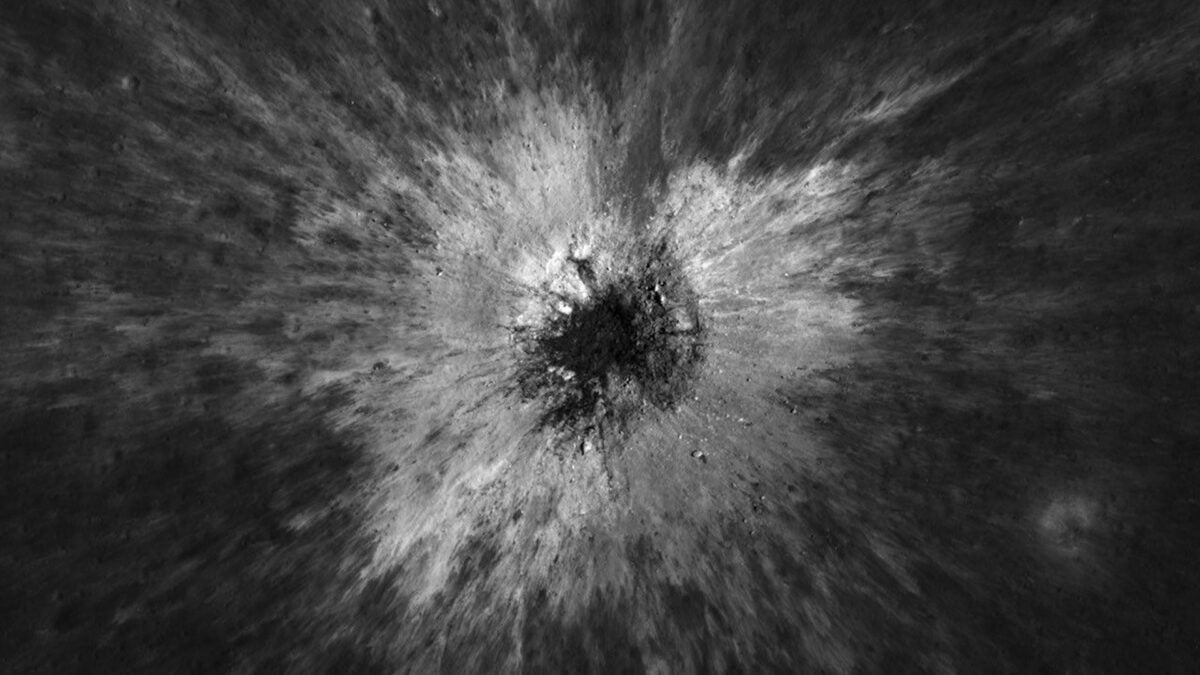
Two years ago, something about the size of a small apartment building, three- to six‑stories-tall, crashed into the Moon—and evidence of its impact went unnoticed for over a year. The object was probably a picayune space rock or an icy comet. (Although a boy can dream, can’t he?) Whatever it was, the object smashed a gigantic, “once in a century” crater into the lunar surface, according to NASA’s announcement of the new find. The new crater spans 728 feet (222 meters) in diameter, carved about 141 feet (43 meters) deep, which for context is a little more than 20 feet shy of the height of the Arc de Triomphe in Paris. Researcher Robert Wagner of Intuitive Machines made the discovery via NASA’s Lunar Reconnaissance Orbiter Camera (LROC), which the firm now manages on NASA’s behalf after the firm hired the space agency’s principal investigator for LROC, Mark Robinson. “It was by far the most obvious impact debris pattern I’ve ever seen in one of these images,” Wagner said in NASA’s announcement. “I just stopped, dropped everything, and started looking into what that spot was,” Wagner recalled of the moment he first noticed the crater on October 24, 2025. Once in a lifetime Working with the nonprofit Lunar and Planetary Institute (LPI) and NASA, Intuitive Machines’ team estimates that this still mysterious object collided with the Moon sometime between April 11 and May 22, 2024. The researchers, who published their analysis in the journal Science Advances on Wednesday, have named the crater McGetchin, after Apollo mission lunar field geologist Tom McGetchin. “Crater production models indicate that an impact of this magnitude is expected to occur only once every 132 years on the Moon,” The research team wrote in the new study. “As such, this event constitutes a statistically rare, effectively once-in-a-lifetime observation.” An oblique view of the new McGetchin crater. Credit: NASA / Intuitive Machines Wagner, an image-processing specialist at Intuitive Machines, made the find while stacking “before” and “after” images from LROC’s Wide-Angle Camera. The overlaying technique draws out changes to the lunar surface, rendering unchanging landscapes in muted grays, while highlighting geological changes in either bright whites or dark near-blacks. But the crater got even more interesting when the researchers looked at it via the Lunar Reconnaissance Orbiter’s other multispectral imaging hardware—which detected what researchers described as a “cold spot temperature anomaly” in a second paper on the find. Born under punches Animated data taken by NASA’s Lunar Reconnaissance Orbiter thermal instrument, Diviner, depicts the nighttime cold spot that surrounds McGetchin crater. Credit: NASA Goddard / UCLA / JHU APL Measurements taken by the orbiter’s Diviner Lunar Radiometer Experiment revealed a roughly 4.3 mile (7 kilometer) cold region surrounding the crater, with a nighttime temperature 14 to 16 degrees Fahrenheit (8 to 9 degrees Celsius) colder than the surrounding lunar surface. Scientists collaborating with the team from Johns Hopkins Applied Physics Laboratory, the University of California, Los Angeles (UCLA), and elsewhere suspect that loosened lunar dirt, or regolith, kicked up by the impact retains heat less readily than more densely packed moon rock. The researchers cross-compared every newly formed crater larger than 66 feet (20 meters) in diameter to test this hypothesis for their study, discovering a repeatable cooling effect in every new crater bigger than 98 feet (30 meters). And, tellingly, these lower temperature spots tracked with increased crater size—suggesting bigger, fluffier regions of dusty regolith does create these temperature drops. The researchers noted that this new crater research will likely help future lunar bases better prepare for any potential rocky projectiles launched by the myriad collisions that create craters on the Moon. But one of the second study’s coauthors, geophysicist and space physics researcher David Paige of UCLA’s SPACE Institute, also suggested that future lunar missions might want to create some craters of their own for research or resource extraction purposes. “We’re now thinking of impacts as a way to garden the regolith—churning the sediments and putting stuff above that’s usually below the surface,” Paige said in a statement.
Something Crashed Into the Moon in 2024, Leaving a Curiously Cold, ‘Once in a Century’ Crater
Full Article
Original Source
Read the full article at Gizmodo →KhanList aggregates and links to publicly available news content. We do not host full articles from third-party sources. Always verify important information with original sources.