
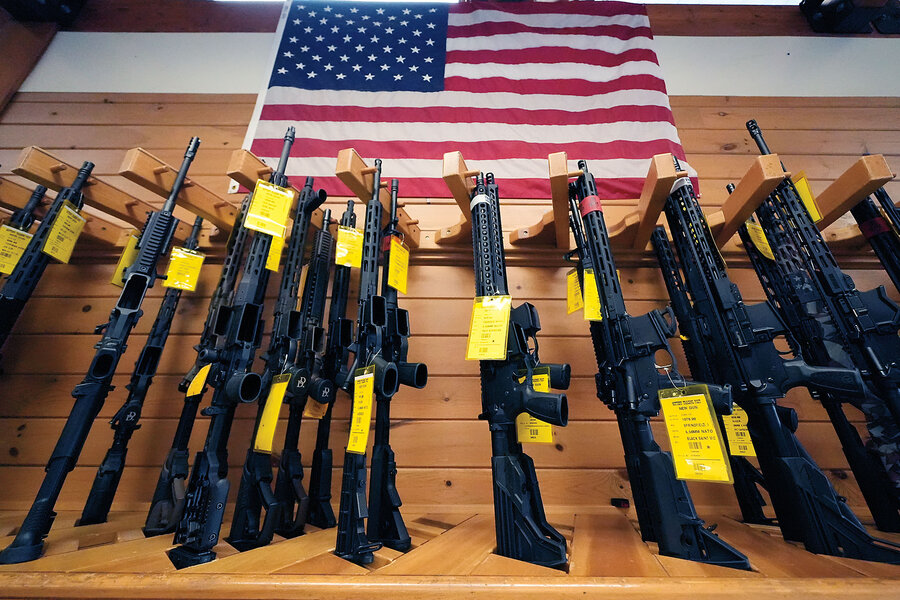
New Britain and Sandy Hook, Conn. | Nov. 29, 2026, 5:00 a.m. ET | 8 min read As the Supreme Court prepares to hear a potential landmark case over state bans on AR-15-style rifles – the most popular firearms in America – one group of Americans plans to tune in to the legal arguments from a “listening party” in rural Connecticut.After all, the case being heard is theirs.On a recent evening, about 60 members of the Connecticut Citizens Defense League gathered under fluorescent lights at a Veterans of Foreign Wars hall in New Britain. They munched pickle-studded kielbasa sandwiches, discussed protocol for what to do if a member is arrested for a gun crime, and planned pizza deliveries to listen to the court’s arguments on Dec. 2. The CCDL case, Grant v. Higgins, argues that the state’s assault weapons ban is unconstitutional. The ban was expanded in 2013 after the Dec. 14, 2012, mass shooting at Sandy Hook Elementary School, where a shooter fired 154 bullets from an AR-15-style rifle within about five minutes, killing 26 people, most of them children.The Supreme Court will hear this case next month alongside a similar challenge to Cook County, Illinois’ assault weapons ban, in a pair of cases that could reshape gun laws nationwide.CCDL President Holly Sullivan sees key questions for society behind the debate over whether states can ban military-style weapons. “At what point does public safety outweigh the constitutional rights of citizens? How much power does the state feel it has over you?” she asks.Why gun-law history mattersThe Supreme Court now requires new gun laws to be grounded in “historical analogue,” including America’s history and tradition of firearms regulations, making this case a potentially defining test of Second Amendment rights. Although most firearm crimes are committed using handguns, by industry estimates, there are as many as 30 million AR-15-style rifles that have been produced for the United States’ market since 1990.All that makes a ruling expected in June 2027 “a springboard that could take us in a cataclysmic direction,” says gun owner Dan Johnson, a communications specialist in Litchfield, Connecticut. “We just don’t know which direction that will be.”The ruling could be epochal or narrow, but likely not inconsequential. It will put down a marker for the degree to which states can keep weapons of war out of residents’ hands without infringing on their constitutional rights.“There’s an emotional quality to this because it’s a weapon that has been used in a small number of very sensational crimes,” says Robert Spitzer, author of “Guns Across America.” “And it enters into the regulatory territory because [these rifles] are the increasingly favored weapons of people who commit mass shootings; they are more likely to be used to kill law enforcement; and they are special favorites of extremist groups, political groups, and drug-gang types.”Rising use of semiautomatic weapons in mass shootingsEven as overall gun violence has declined, the use of assault-style weapons in mass public shootings has grown. A study published in September found that such weapons were used in 36% of mass public shootings in the 2010s and 60% so far this decade, up from roughly 20% in earlier decades.AR-15s and similar rifles are semiautomatic, firing one shot per trigger pull. Unlike machine guns, which fire multiple rounds with each pull and are heavily regulated, AR-15s are widely available in much of the country. These rifles can accept large-capacity magazines that allow shooters to fire dozens of rounds before reloading. Connecticut and several other states, plus Washington, D.C., have sought to restrict these weapons because of their potential to inflict mass casualties. Patrik Jonsson/The Christian Science MonitorSunlight shines on a memorial to those killed at Sandy Hook Elementary School, including Dylan Hockley, son of Nicole Hockley, the co-founder and CEO of Sandy Hook Promise, an antiviolence group, Nov. 11, 2026. A nationwide sales ban on newly manufactured AR-15 style weapons lasted for a decade until 2004. Such rifles have been used in at least 10 of the 17 deadliest mass shootings since 2012, including at Sandy Hook. But as Americans have endured that violence, states have faced a rising bar to pass gun control laws. One reason is a string of Supreme Court rulings in 2008, 2022, and earlier this year that have strengthened the Second Amendment while leaving lower courts and states confused as to what levels of regulation are permissible. High-profile events like the attempted assassination of then-candidate Donald Trump and the murder of conservative activist Charlie Kirk have jarred the nation. Yet U.S. gun violence has also declined, with homicide rates, for example, falling sharply since 2021, including a record 18% drop between 2024 and 2025. The downward trend has continued this year.Support ebbs for bans on assault weaponsMeanwhile, public support for banning assault-style rifles has softened in recent years, though a majority of Americans still favor restrictions. A November Gallup poll found 54% favor an assault-style rifle ban, down from 61% in 2019.“Firearms and rifles have always been part of the American psyche,” says Grant Reeher, a political scientist at Syracuse University’s Maxwell School of Citizenship and Public Affairs. “The AR-15 is the newest version of that.”The case will look through the lens of gun-law history to weigh whether these weapons should be viewed as common, or as unusually dangerous and therefore subject to potential state regulation.“The question is whether the bulk of Americans think that protecting their right to own a weapon is more important than protecting their own child,” says Nicole Hockley, whose son Dylan died at Sandy Hook, and who later co-founded Sandy Hook Promise, an anti-violence nonprofit. “We need to think about this from the human value and cost. This is not about taking away guns. It’s purely talking about weapons accessibility, meaningful regulation, and honoring states’ rights.”Gun rights advocates plan to argue that military-style weapons are part of the history of the Second Amendment, are the natural descendants of weapons technology forged in states like Connecticut, are in common use, and are in part “equalizers” that give citizens a fighting chance in case a tyrannical government turns on them. The court has to thread those competing views, legal experts say, with a relatively new standard that requires gun-safety laws to have historical analogues. Under the standard of the 2022 Bruen ruling, defending state-level bans presents a distinct legal challenge.Finding regulatory analogues from an era when single-shot muskets were the standard firearm remains a tall order. And a 2026 ruling rejected limits on gun ownership for marijuana users. But it’s also true that courts have upheld bans on other unusually dangerous weapons, including Bowie knives, which could serve as precedents for modern gun laws.“If we’re only looking at the laws in the 1700s and 1800s,” says Adam Winkler, a gun policy expert at UCLA School of Law, “it’s going to be hard to find an analogy.”Still, the case may not be a slam dunk for gun-rights advocates.“The court may also be looking for a middle ground,” says Dr. Spitzer, the author and an emeritus professor at the State University of New York at Cortland. “One remedy would be to let federalism be federalism. Let states that believe that these laws are important enact them,” he says.For a historical analogy, if states can restrict something as common as a knife, which many states do, he says, “it’s hard to make an argument that a gun can’t be similarly restricted.”One state’s firearms evolutionConnecticut may represent the competing viewpoints about as starkly as any state. A defining feature of the Hartford skyline is a blue dome, part of a historic district that includes an old Colt weapons factory. Smith & Wesson, Winchester, and Remington also had massive manufacturing plants in Connecticut or nearby Springfield, Massachusetts, contributing nearly half of the arms used by soldiers in some U.S. wars.On Dec. 13, 2012, then-Gov. Dannel Malloy celebrated the legacy of Hartford’s Colt firearms factory and local preservation efforts. “The West was won here. In Hartford,” he told a crowd.The next day, the governor faced grieving parents and a stunned country after the Dec. 14 Sandy Hook mass shooting. He vowed to work to make schools safer by setting higher standards for gun ownership, including a more comprehensive ban on the AR-15.“I’m a big believer in hunting rights, a big believer in supporting the Second Amendment,” he said later. “But there is a reality that this stuff has gone too far and is too easy to own.” Patrik Jonsson/The Christian Science MonitorMiles Lawrence, who was 13 years old in 2012 when the Sandy Hook shooting happened, says, “Guns are a big responsibility. ... We need to make them hard to get.” Today in Sandy Hook, a quaint New England village snuggled against a rocky stream, thick gates protect the new Sandy Hook Elementary School. The old one was demolished after the killings. Nearby, a memorial laid out around a tree, surrounded by a pool, has the names of each victim etched in stone.Twenty-something Miles Lawrence was 13 when the shooting happened. He remembers his mom’s stunned silence as she brought him home from school in nearby Bridgeport. For years afterward, she checked on him constantly at school.“Guns are a big responsibility,” he says. “Given that there are a lot of people who have a bit of crazy in them, we need to make them hard to get.” Donovan Herrera was 10 when the shooting happened. He remembers the ensuing lockdown at his school in nearby Danbury. His mom wept the whole way home.“Yes, it can be annoying to get a weapons permit in Connecticut,” says Mr. Herrera, a restaurant server in Sandy Hook. “But it should be annoying.”Not far away, in New Britain’s VFW hall, amid the scraping of metal chairs, some of the discussion turns to a tough election outcome. Several key allies in the state legislature lost their seats amid a nationwide wave for Democrats.CCDL Vice President Matthew Strasser said the losses suggest a tough future against what he called an “anti-gun supermajority” in a state legislature that doesn’t, at a fundamental level, understand gun owners.“We need to humanize gun rights,” he says. “We can’t just scream ‘gun rights!’”The group has support from the Trump administration. The Justice Department has backed the challenge, and a government lawyer will argue in support of the CCDL before the Supreme Court. For Ms. Sullivan, the group’s president, years of work on gun rights have led to this moment. “By some miracle, the Supreme Court chose us,” she says. “Now we are in the fight of our lives.”Henry Gass contributed to this story from Austin, Texas. Bring news welcomed in any home into your home45% off$110/year → $60/yearJournalism that gets above the fray and brings perspectives you won't get anywhere else.Already a subscriber? Sign in
Some states have banned AR-15-type rifles. Those laws face a test in court.
Full Article
Original Source
Read the full article at Csmonitor →KhanList aggregates and links to publicly available news content. We do not host full articles from third-party sources. Always verify important information with original sources.