
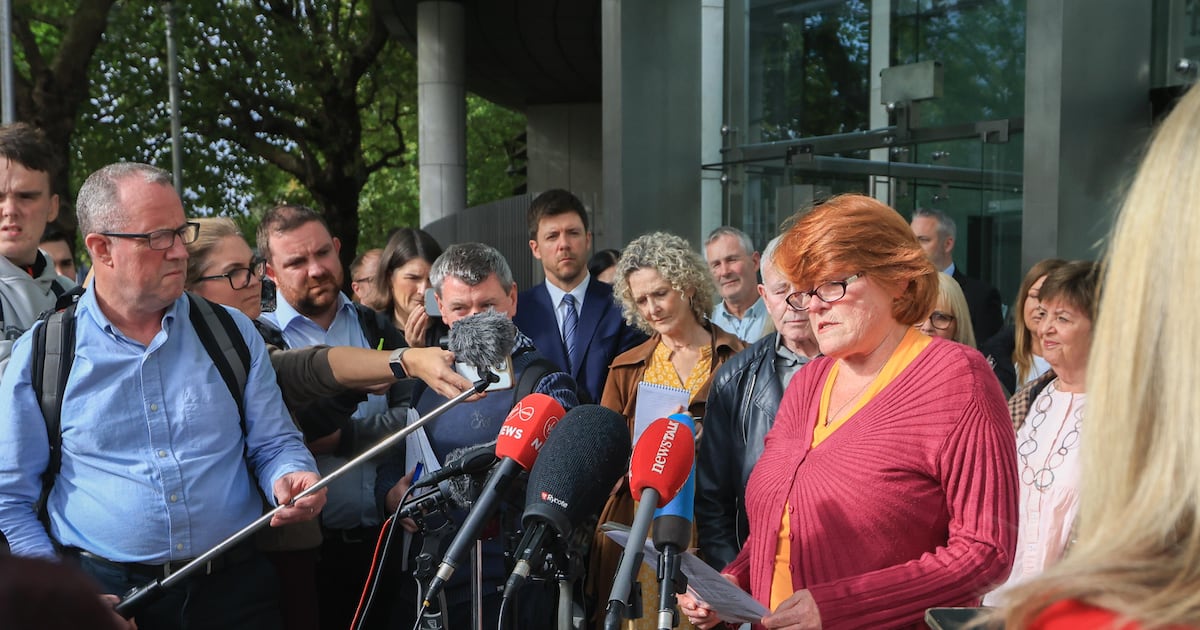
When justice finally came for the paedophile George Gibney, it arrived as a stark and lonely thing. Since his extradition from the United States, Gibney has had no prison visits, and during his trial he had no character references. The 78-year-old was sentenced on Monday for the sexual abuse of four girls in the 1970s and 1980s, and was wheeled out of the courtroom by a member of the Garda, taken by wheelchair to begin his 15½ years in prison. The scene on the steps outside the court was a vivid, bustling contrast. Complainant Orla Poole waived her anonymity and stood before the media wearing bright, optimistic clothes, her hair a brilliant auburn. She read a statement encouraging other victims to come forward, assuring them they are not alone. Nor was Orla Poole. Ber Carley, Tric Kearney and Chalkie White stood with her, more than 30 years after their case against Gibney foundered. Louise Kennedy, daughter of another victim, Lorraine Kennedy, stood there too. Close by were the journalists who did so much to expose the truth about Gibney earlier, Johnny Watterson and Justine McCarthy. Standing there too was the man who helped bring all of these people together: Mark Horgan. READ MOREHorgan presented and co-produced with Ciarán Cassidy the podcast series Where is George Gibney?, which revived national interest and kindled international attention to the story of Gibney, the celebrity swimming coach who disappeared in 1994 after he was granted a Supreme Court injunction preventing the DPP from prosecuting him for the alleged sexual abuse of children. [ ‘He needs to die in prison’: Survivor of George Gibney child sex abuse reacts to sentencingOpens in new window ]Few individual pieces of journalism in Irish history can match the podcast’s reach and impact. It is among the BBC’s most successful limited series ever, having been downloaded more than six million times, while Horgan and Cassidy successfully answered their titular question, finding Gibney living in Florida under an alias, John. Once the podcast was broadcast, however, more victims came forward, which led to a new Garda investigation into Gibney and culminated with Monday’s scene on the steps of Dublin’s Circuit Criminal Court. “To go all the way to where it has, to a woman that came forward on the basis of the podcast standing at the top of the steps of the court with the people we spoke with for the podcast, surrounded by the media, that’s out of this world,” says Horgan. Horgan is a co-founder and producer of the Second Captains podcast, and following their coverage of abuse cases involving football coach Barry Bennell in the UK and American gymnastics coach Larry Nassar, he turned his attention to the story of Gibney, believing it to be an Irish story with international resonance. His ambition was to revisit the story in-depth and produce a series that could stand along with any other podcast in the world. He recruited film-maker Cassidy, whose editing qualities, says Horgan, are as good as anyone he knows. Horgan also wanted to partner with an international broadcaster, and so he approached a BBC producer, Dylan Haskins, with the idea. Haskins was enthusiastic, and following a pitch, the commissioning editor of BBC Sounds, Jason Phipps, was fully on board. [ Where is George Gibney? - Mark Horgan on his quest to find outOpens in new window ]The first time Horgan and Cassidy pressed the record button was while sitting in a rental car in Florida, outside a house in which they believed Gibney to be living. Evin Daly, a US-based child welfare advocate who remained attuned to the Gibney story throughout the 2010s, tipped Horgan and Cassidy off to this location. Before landing in the US, Horgan and Cassidy phoned local police to tell them what they were doing, while they had looked at images on Google Maps to decide the best location from which to observe the house. They did all of this research at home, fearing that asking too many questions on the ground may alert Gibney, whom they believed to be a flight risk. Their first task was to confirm they had in fact tracked down Gibney. On their very first day a car emerged from the garage adjoining the house, which Horgan and Cassidy tracked on its way to a supermarket. They followed from a distance but noticed the set of rosary beads hanging from the rear-view mirror. They parked up, and when they saw Gibney emerge from the supermarket, Horgan got out of the rental car and walked in Gibney’s direction, holding his phone close to his face while furtively photographing Gibney as he walked by. George Gibney photographed in 2019 close to his home near Orlando in Florida. Photograph: Mark Horgan The photographs confirmed they were staking out the right man. From there Horgan and Cassidy hoped to establish Gibney’s daily routine, seeking to ascertain what he did and where he went, and whether he had access to children. Gibney, however, hardly left the house. The rental car was, meanwhile, drawing the attention of neighbours, who began approaching Horgan and Cassidy to ask questions. They changed their rental car and parked elsewhere, near the entrance to the housing estate, fearing the neighbours might alert Gibney to the stakeout and allow him to disappear again. Horgan needed to present Gibney with an interview request as a right of reply, but the BBC’s editorial guidance precluded him from knocking on the front door, given laws in Florida give strong weighting to privacy along with the right to bear arms. It was on their final day, with hopes fading and suitcases packed into the rental car, that Gibney emerged from the house. Horgan and Cassidy trailed Gibney to another supermarket, at which point Horgan caught his breath and made his move. With his microphone recording, Horgan calmly referred to him by his alias, John, and then explained what he had been doing, asking whether he wished to conduct an interview as a right of reply. Gibney, startled, said nothing.“We never wanted just a ‘gotcha’ moment,” says Horgan. “It was about finding him, which we did, but it wasn’t really about him. It was about everyone else who was connected to him. His silence was extremely telling and extremely powerful, when compared to the guy that talked for 20 years. I am glad we were able to capture that moment.” [ A shameless risk-taker and predator: How George Gibney groomed childrenOpens in new window ]The first time Horgan would hear Gibney’s voice was more than five years later, when Gibney faced a sample charge from each of the four complainants in an Irish court. Gibney said “Not guilty” four times with his hands joined in prayer, wrapped by rosary beads. (Gibney ultimately pleaded guilty to five counts of indecent assault, and was subsequently convicted of a further 39 counts of indecent assault and one count of attempted rape of children.)That Horgan ultimately heard Gibney’s voice at all is attributable to the impact of the podcast. Among the victims to contact him after its broadcast was Orla Poole. She and Horgan exchanged emails and then phone calls, usually at around 10pm Irish time, with Orla based on the west coast of the United States. Ber Carley (left) and Tric Kearney (right) embrace Orla Poole outside the Criminal Courts of Justice following the sentencing of George Gibney. Photograph: Dara Mac Dónaill/The Irish Times “It was the most upset I’ve ever heard anybody on any phone call I’ve ever had in my life,” says Horgan. “It was a mixture of extreme anger and fury, but also just tears. She later told me that some of what she told me, she never told anyone in her life.” They spoke for months, and eventually she agreed to speak on the record for a subsequent podcast episode, initially under a pseudonym. She also proceeded with a criminal complaint against Gibney. When asked why the podcast series was so successful in encouraging other victims to come forward, Horgan points to a coalition of factors. The testimonies of Ber Carley, Tric Kearney and Chalkie White were the most important, he says, and not only their bravery in detailing the horrors of their experience.“They were just incredible talkers, people found that highly affecting,” says Horgan. “They also have lives full of love, of success, whether that be from a family perspective or just from a professional perspective. They’ve come forward and they’re survivors, but he hasn’t ruined them or ruined their lives. I feel like there is a sense that ‘Okay, well, maybe it’s okay to be a survivor, I’m not going to be pitied or I’m not going to be put in a box, or feel like I’m damaged. I can still have some power in this moment.’” The podcast format was vital too, with no limit to the time and space available for the survivors’ stories to be told. The limited technological demands of a podcast without a visual element helped too – the microphones are less intrusive, and Horgan could conduct everything as a one-on-one conversation. Horgan, meanwhile, found himself drawn into the trial. While on holiday in Spain with his family earlier this year, he took a call from the Garda, explaining that Gibney’s defence had requested he hand over any and all emails, WhatsApp messages, call recordings, interviews, and notes that passed between him and the complainants in connection with the podcast. He said he wouldn’t do so, and subsequently sought legal advice before sending a confirmation letter, explaining that he is “fiercely protective of the obligations I owe to people who spoke to me as part of my investigation, and that it’s not something that I can give up voluntarily”. The judge subsequently rejected the defence counsel’s request for the communication, and it was not handed over. “The idea that those early conversations with Orla, or any notes that I’d taken in those conversations or the emails that we shared, that they’d have to be handed over, is such an astonishing invasion of privacy,” says Horgan. The complainants were requested to hand over notes from counselling sessions – the Government is currently working on reforms to restrict their use in future cases.“The idea that you don’t hand over medical notes but you’re forced to hand over something like counselling notes is beyond belief,” says Horgan, adding that it “shook confidence” as the complainants endured the challenges of going to trial. Horgan describes the experience for the complainants as like walking a tightrope. They could not, for instance, reference any other case or incident involving Gibney under cross-examination, lest it lead to the collapse of the trial. (After all of the evidence was presented, the judge told the jury that they were free to draw inferences from the consistency of the evidence presented by the four complainants if they believed them to be truthful and their evidence independent.) “Some of the exchanges were pretty extraordinary, and it was incredible how they were able to just keep their clarity under the sort of pressure that they were,” says Horgan. He reads from his notes and recounts a scene in which Orla Poole is being cross-examined by Gibney’s legal team, who said to her that there was never any “indecency or molestation” on their client’s part. “She snapped back, ‘You’re trying to say that I’m lying. Is that what you’re saying?’“There was a brief pause and the counsel said, ‘Yes.’“And Orla just stared at him and said, ‘Well I’m not.’”Horgan says one of the complainants found the trial process extremely difficult, especially the media coverage, which so starkly recorded the nature of her abuse.“The press have a duty to do that, because it’s really not sugarcoating the depth of the crimes, but it was really difficult for them to tell their stories and then also hear the tap-tap-tap of a laptop,” says Horgan. “I think there’s also a duty there to outline more specifically about what the media do on those days, how this is going to be covered, the reasons why it’s covered the way it is: those sorts of specifics, because it’s a difficult thing. It’s a really sensitive moment in their lives, and they deserve the most privacy to whatever level they can.” Orla Poole pictured following George Gibney's sentencing of more than 15 years. Photograph: Dara Mac Dónaill/The Irish Times Orla Poole turned to face Gibney directly as she read her victim impact statement, telling him “I’m free to leave today, and you will always be known as a convicted, serial paedophile”, and walked past him on the way out. Ber Carley and Tric Kearney, meanwhile, went to the pretrial hearings with Horgan and eyeballed Gibney. When he smiled back at them, Tric mouthed at him, “F**k you.” “That was important for them,” says Horgan, “to dress in bright colours and to eyeball him and say, ‘We’re still here.’” There is one other factor underpinning the podcast’s extraordinary impact: it was heard in 2020s Ireland. [ A shameless risk-taker and predator: How George Gibney groomed childrenOpens in new window ]“Gibney was completely exposed, facing people, sitting in the wheelchair,” says Horgan, recalling the trial. “He didn’t defend himself, he stayed silent. It was striking to see all that love and then on the other side, somebody who was just pathetic and alone and who knows that Ireland today doesn’t pay heed to rosary beads; doesn’t pay heed to clasped, praying hands. It was a younger jury, and I don’t think Ireland listens to that sort of stuff any more.” There are plans for a follow-up episode with the BBC to ensure all listeners everywhere are made aware of the answer to the question: where is George Gibney? He is where he has long, long deserved to be.
‘Some of what she told me, she never told anyone’: Finding George Gibney and the long pursuit of justice
Full Article
Original Source
Read the full article at Irishtimes →KhanList aggregates and links to publicly available news content. We do not host full articles from third-party sources. Always verify important information with original sources.