
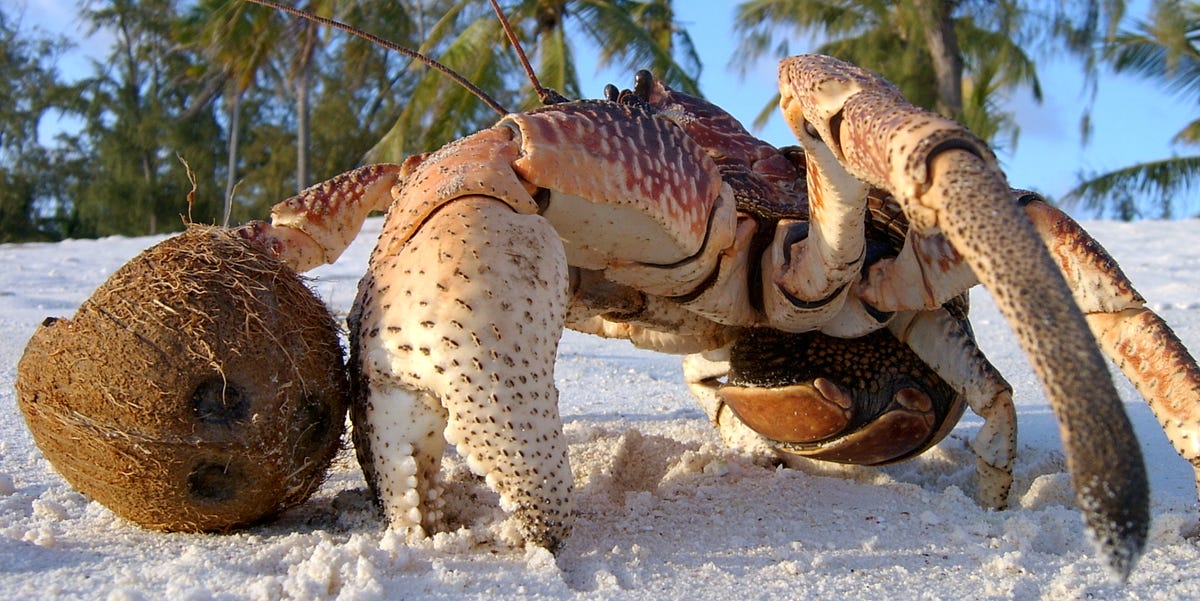
5 min readIf there’s one thing we love at Popular Mechanics, it’s a scientific hypothesis with enough meat on its bones to nourish a deeply-rooted psychological obsession. So it’s not surprising that one of our favorite stories focuses on the question of what might have happened if Amelia Earhart and her navigator, Fred Noonan, were marooned on Nikumaroro (then known as Gardner Island), following the disappearance of their plane over the Pacific Ocean in 1937.In particular, one prominent, longstanding theory posits that the famous aviator indeed was stranded on the island, and that she eventually perished there. But her body was never found because her remains were subsequently eaten—and her bones scattered—by the giant coconut crabs (Birgus latro) that live in great profusion on the atoll.But that raises a question. If you’re stranded on a remote Pacific island that’s jam-packed full of thousands of crabs, wouldn’t you try to eat them, instead of the other way around? Which brings us to another question.Can You Eat Coconut Crabs?Well, the answer to that one is pretty simple: oh yeah, absolutely! Coconut crabs are generally quite edible—in fact, they’re considered a highly prized delicacy in many Pacific island cultures. But eating them comes with significant safety warnings.NOAA Photo Library//Wikimedia CommonsBirgus latro is the world’s largest land crustacean‚ and it’s succulent. Photo: NOAASo if you’re considering eating a coconut crab, here’s what you need to know before going through with it.Are Coconut Crabs Safe to Eat?First, they’re protected by conservation laws in most places where they’re found, so don’t poach them! But the flavor is fantastic. The meat is famously sweet, and it’s often compared to a very dense, firm lobster. The fat sac (the hepatopancreas) in the crab’s abdomen is particularly prized: It’s often said to have a rich, nutty, coconut-like flavor. But that delicious coconut flavor isn’t a genetic trait—it comes from their diet. Coconut crabs are opportunistic scavengers, and the fat sac functions as a storage organ. If a wild crab has recently been surviving on a diet of, say, dead birds, rotting wood, and other crabs’ molted shells, its fat will still be rich, buttery, and oily, but it won’t taste like coconut.That’s one of the reasons why people typically capture these crabs alive, keep them penned up, and feed them an exclusive diet of coconuts for several weeks before cooking them up. This process infuses the fat sac with that highly prized, sweet coconut flavor everybody talks about.But even more importantly, deliberately feeding the crabs a special diet flushes out any toxins that might ordinarily have built up in their flesh. The poisonous sea mango tree (Cerbera manghas) grows in exactly the same places where you’re most likely to find coconut crabs.Both species share the same geographic distribution from the western Indian Ocean far into the South Pacific, including Kiribati, where Earhart was theoretically marooned. Coconut crabs spend most of their adult lives foraging in the same coastal scrub forests and beach thickets where sea mangoes grow. Because this ecological overlap is so common across thousands of miles of ocean, the cultural practice of penning and “purging” coconut crabs on a safe diet before eating them evolved independently across multiple different island nations. Eating a toxic crab can cause severe cardiac problems, and even death.Could Amelia Earhart Have Eaten Coconut Crabs on Nikumaroro?The answer is most definitely yes, because without sea mango trees, the main source of potential toxicity is eliminated. Nikumaroro is in a very remote area of Kiribati called the Phoenix Islands, a chain of coral atolls that often experience severe, multi-year droughts. It’s simply too dry there for the sea mango, which loves moisture, to survive. Instead, the crabs on Nikumaroro get their food from three sources: coconut palms, which were left over from failed British colonization and plantation attempts in the late 19th and early 20th centuries; Pisonia grandis (Buka) trees that can grow up to 50 feet tall, providing rotting wood and organic matter; and native coastal scrub plants like Cordia (kanawa trees), Scaevola, and Pandanus, which provide fleshy fruits for the crabs to eat.In short, the giant crabs on Nikumaroro enjoy a diet that undoubtedly makes them beautifully flavorful when eaten. So Nikumaroro’s giant crabs could certainly have provided an abundant, safe—and delicious—source of food for Earhart and Noonan.However, surviving on coconut crabs would have presented them with severe practical challenges. Here’s how their coconut crab situation probably would have played out.How Would Amelia Earhart Have Caught and Cooked Coconut Crabs?First, there’s the challenge of catching the crabs. Coconut crabs are enormous, heavily armored, and nocturnal. More importantly, their pincers have a crushing force comparable to the bite of a lion or a bear. Trying to catch, subdue, and kill a coconut crab without proper weapons or traps, especially while weakened by dehydration or starvation, would have been extremely difficult and dangerous. A pinch could easily break a finger or cause a severe, infection-prone laceration. Plus you really have to watch your back at night when you’re trying to sleep, so you’d probably be hunting them while very tired.Martin Harvey//Getty ImagesNighttime is the right time—for giant crabs.Second, you need to cook the crabs. Raw crab carries a high risk of bacterial infection and parasites, so the castaways would have been obliged to build fires to cook them. And as it turns out, there’s circumstantial evidence that they might have done just that. In the early 2000s, researchers from TIGHAR (The International Group for Historic Aircraft Recovery) performed excavations on Nikumaroro at a location called the “Seven Site.” They discovered the remains of small campfires there, and in the ashes, they found the cooked bones of birds, fish, and turtles. So there’s little doubt that someone did successfully cook local wildlife there at some point in time.The final issue is that the most famous association between Amelia Earhart and the Nikumaroro coconut crabs isn’t that she ate them, but that they likely ate her.Was Amelia Earhart Eaten by Coconut Crabs?TIGHAR's leading hypothesis for why Earhart's complete skeleton was never found is that after she died of starvation or exposure, the island’s massive population of coconut crabs scavenged her remains. The crabs are known to swarm dead bodies and carry bones deep into their underground burrows or into the coral rubble. The TIGHAR researchers argued that this aligns with the fact that only 13 human bones were discovered on the island in 1940, instead of a full skeleton. (The bones, alas, were subsequently lost).So while Nikumaroro’s giant crabs could unquestionably have provided safe, high-calorie meals for a castaway with a fire and a club or spear made from local wood, the crabs were ultimately much better equipped to survive the island than Earhart was. The most likely winner of a theoretical Earhart vs. coconut crabs survival competition was, with little doubt, the crabs.Shawn Gorman is Deputy Editor of News for Popular Mechanics. Before joining Pop Mech, he specialized in academic reading for educational testing. His diverse academic background also includes time spent as a lecturer and librarian at institutions such as the University of Kentucky, SUNY, and Harvard University. Shawn holds a Ph.D. in Modern Foreign Languages and Literatures from Boston University, an M.A. from The Ohio State University, and a B.A. in History from the University of Oregon. His favorite subjects to explore include computer science, physics, math, and biology. He lives on a medium-sized cat ranch in Easton, Pennsylvania, with his wife and two daughters.
Some Evidence Suggests Amelia Earhart Was Eaten by Crabs. The Twist: She Could Have Eaten Them to Survive.
Full Article
Original Source
Read the full article at Popularmechanics →KhanList aggregates and links to publicly available news content. We do not host full articles from third-party sources. Always verify important information with original sources.