
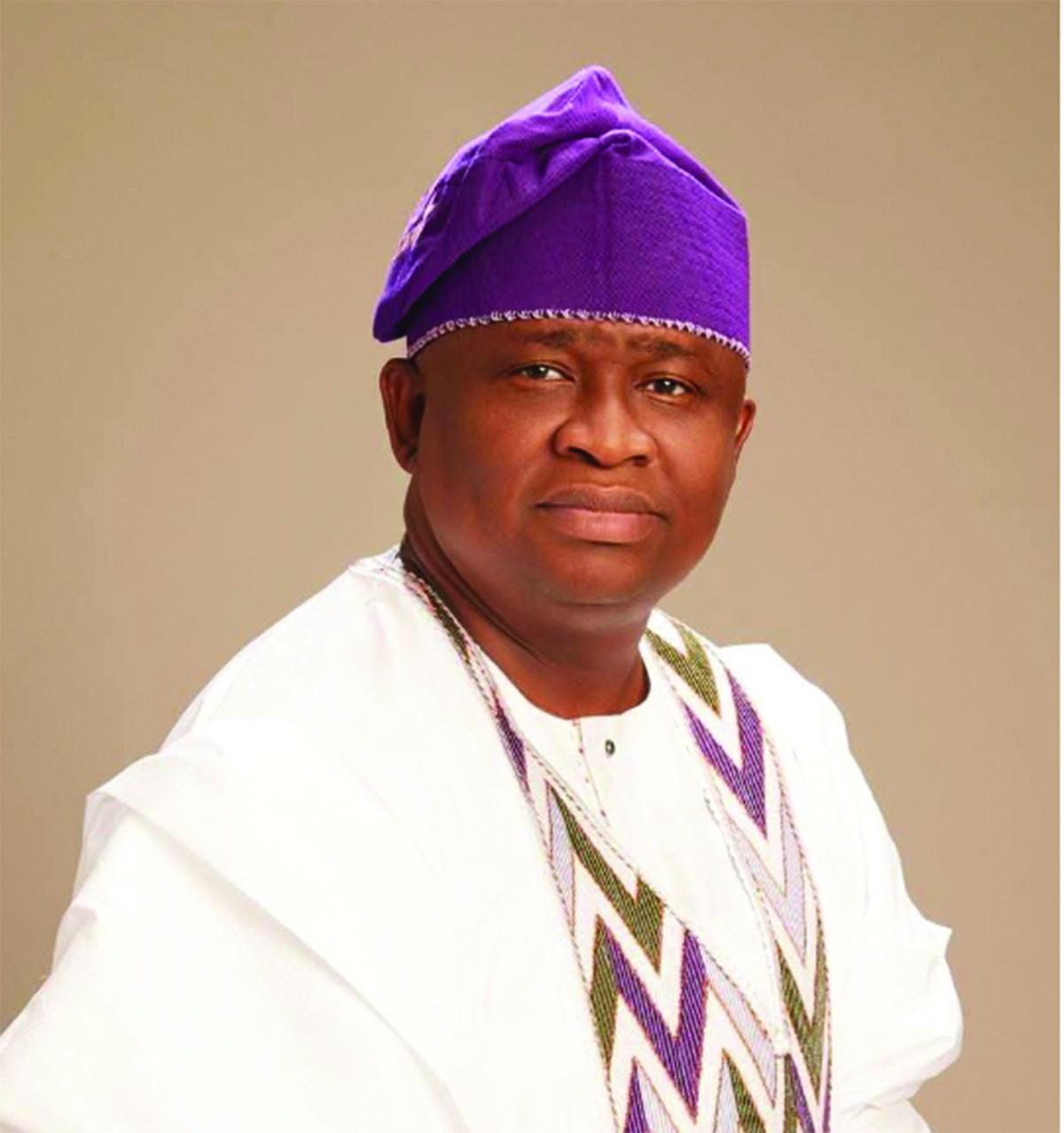
Senator Solomon Olamilekan Adeola, popularly known as Yayi, is the All Progressives Congress candidate for the 2027 Ogun State governorship election. Having served as senator representing Lagos West from 2015 to 2023 and Ogun West since 2023, Adeola brings more than two decades of legislative experience to the race. He outlines his vision for industrialisation, infrastructure, job creation and inclusive growth, arguing that Ogun must retain more economic value from businesses operating within its borders. He also responds to the controversy over his indigeneship and change of name. Wale Igbintade brings the excerpts: Amid the controversy over your indigeneship and the allegations surrounding your change of name, what verifiable documents or official records are you prepared to make available to establish your claim that you are an indigene of Ogun State?” Let me say this, I can’t be running for such an exalted office and I will not be confronted with these challenges. People who are doing this know they are doing it to discredit and destroy my person. There’s what is called investigative journalism. Where my father was buried is 30 minutes away from here (Ikeja), go and investigate. It is in Almosho, number 3, Ogunsola street, Alagutan, bus stop, in his house, that’s where he was buried. My mother was buried at Vaults and Gardens, Ikoyi, there. My grandmother, the mother of my mother, was buried at Ikeja, the burial ground is there. My great-grandfather was buried at Ishaga. So, how can I be running for a governor’s office, and I’ll be having such a big skeleton in my cupboard, and I’ll be comfortable? Having served The Guardian, and I resigned, I left, and somebody said, “He did change his name.” Yes, I did change of name, and I did it in The Guardian newspaper. I advertised it in The Guardian; I notified The Guardian newspaper of my change of name. They don’t understand, because they have nothing to fight with. So, they have to say something to discredit me, and I’m the candidate to beat. They can’t match me. I don’t want to join issues with them. They have nothing to offer. The know Yayi is from Ogun State. What they can do is to destroy Yayi, and those who are from Ogun State have responded, “Let him come from Afghanistan”. We will vote for him. Now, how did your political journey begin? My sojourn into politics has not been an easy road, but at least I managed to find my level. Because that was dated back to the June 12, 1993 struggle. Along the line, I lost my immediate younger brother to that riot, and that got me discouraged. I had to look for a way to step aside and make sure that I don’t get involved in politics again. I became very disheartened and decided to step aside and concentrate on my work. But God has a way of directing one’s path. It is something He destined you to do. In 2002, I found my way back into politics and contested for the position of member representing Alimosho Constituency in the Lagos State House of Assembly. I was there for eight years. Judging by my performance, I was encouraged to go to the Federal House of Representatives to represent Alimosho Federal Constituency, where I served for four years. Within those four years, I was able to convince my constituents and, by extension, the leadership of the state and the current President of the Federal Republic of Nigeria, my father, my leader and my mentor, that I was ripe enough to represent the Lagos West Senatorial District in the Senate. By God’s grace and with the support of my constituents, I represented Lagos West for eight years. Before then, I knew that originally I was not from Lagos; I am from Ogun State. That was evident in all my documents and forms that I filled. There was no cause for doubt. I attempted to return home for the first time, but I met some resistance. Since things were working for me in Lagos, it was easy to return and contest the Senate seat there, which I did successfully. For the second time, I attempted to return home to contest for the governorship of Ogun State. That was also met with some resistance, and again I returned to the Senate from Lagos West. I am giving you this history so that you will understand how I eventually found myself in Ogun State. What eventually brought you back to Ogun politics? For the third time, that was when God answered our prayer. When God opened the way and the political opportunity came, I was encouraged to return home. At a point, I was asked whether I would be interested in contesting for a Senate seat in Ogun State. I said yes. Initially, I did not want to run for the Senate again. My intention was to complete my two terms as a senator of the Federal Republic of Nigeria and then prepare myself for the governorship. But some people insisted that it was not possible to wait outside the political structure. They said I had to be in a position where I could remain politically relevant and then migrate from there to the governorship. It took me some time to deliberate on it. I never knew that it was the platform God wanted to use to elevate me to become governor of Ogun State. When I eventually decided to run for the Senate, I noticed that there was a lot of confusion and that several people were also showing interest. I did not realise initially that everybody was galvanising themselves around that platform as a possible route to the governorship in the future. I decided to throw my hat into the ring and, graciously, by the special grace of God, I got the ticket and won the election. By the end of that period, I had spent 12 years in the Senate of the Federal Republic of Nigeria and 24 years as an elected legislator, serving in both Lagos and Ogun states. What experience from your legislative career do you believe prepares you for the governorship? I have had the opportunity of getting to the zenith of the legislative body, which is the Senate. I also served in various capacities. In the Lagos State House of Assembly, I was Chairman of the Committee on Finance. In the House of Representatives, I was Chairman of the Committee on Public Accounts. That was while I was in the opposition party because, under the rules of the National Assembly, the opposition traditionally chairs the Public Accounts Committee. In the Senate, I was the pioneer Chairman of the Local Content Committee in the Ninth Senate. In the 10th Senate, I served as Chairman of the Finance Committee. With that experience, I believe I have what it takes to govern Ogun State and take it to the next level. Another important point is that my senatorial district has never produced a governor of Ogun State after 50 years of our existence. I believe that I have the experience and capacity required to provide leadership at this point in the state’s history. Today, I stand before you as the gubernatorial candidate of the APC in the February 6, 2027 governorship election. You have said your ambition is driven by a passion to serve. Why should Ogun people believe that? My quest to become governor of the state is not based on personal interest. It is not about enriching myself or occupying an exalted office simply to be called governor. It is driven by passion to serve. I want to serve the people for good. That is why I have chosen to engage the fourth estate of the realm and other opinion holders. There are a lot of issues in the political space. You read something about YAYI today, something about the opposition tomorrow, something about the governor the next day, and so on. But today, this gives you a first-hand, one-on-one interaction with the man called YAYI. I want you to hear directly from me what I intend to do for Ogun State. Your development agenda places considerable emphasis on continuity. What exactly do you mean by continuity? I want to work with someone whose experience has brought about some level of advancement to Ogun State. I strongly feel that the next person in line should come to consolidate on the gains we have made in the last seven and a half years as a state. I make bold to say that, under the administration of Governor Dapo Abiodun, Ogun State has done exceedingly well. I can testify to that. Of course, people will ask: if the government has done well, why are there complaints about certain things? I understand that. No government can completely address all the challenges confronting a state within a limited period in office. Governance is about the seen and the unseen. The seen are the physical structures we see—the roads, hospitals, rail transport and other infrastructure. The unseen are the policies, economic foundations and other things that, when put together and properly implemented, eventually give birth to the visible development. Under Governor Abiodun, we have been able to establish a strong economic foundation. For example, we have the proposed $7 billion deep seaport project in Ogun State, with groundbreaking expected in November. If that project becomes fully operational in the next few years, you can imagine the multiplier effect it will have on the state’s economy. There is also the dry port at Kajola and the proposed rail connection from Apapa to Kajola. The biggest dairy farm in Nigeria is also coming up in my local government area, starting with about 5,000 cattle and eventually increasing to a minimum of 15,000 cattle to produce dairy products from Ogun State. A major furniture manufacturing company is also coming up. As we speak, Ogun State is the most industrialised state in Nigeria. When Governor Abiodun came on board, our internally generated revenue was less than N100 billion annually. Today, we are talking about around N300 billion a year. There has also been oil exploration activity. We may, in the near future, be referred to as an oil-producing state. All these things are part of the foundation that has been laid. My responsibility, if elected, will be to consolidate on these gains and ensure that the multiplier effects are properly harnessed for the benefit of the people. Does continuity mean you intend to continue everything the present administration is doing? No. I don’t want anybody to misconstrue what I mean by continuity. Continuity does not mean that I want to take everything this administration has planned or implemented and say that I must continue with it. There are areas I need to continue; I will continue them. There are areas I need to improve upon; I will improve them. There are areas I need to change; I will change them. I will introduce new ideas and new initiatives that will put Ogun State on the path of growth. The essence of continuity is that whatever this administration has achieved and needs to be taken forward will not be abandoned simply because there is a change of government. Many of the projects are still works in progress. A responsible government coming on board will consolidate and ensure that these projects come to fruition. That is what “ITESIWAJU” is about. What does ITESIWAJU mean in practical terms? ITESIWAJU is the framework for the kind of government I want to run. The “I” stands for Infrastructure. The “T” stands for Tourism and Culture. The “E” stands for Education and Environment. The “S” stands for Security and Law Enforcement. The second “I” stands for Inclusive Growth and Well-being. The “W” stands for Women and Youth Development. The “A” stands for Agriculture. The “J” stands for Job Creation and Industrialisation. The “U” stands for Urban Physical Planning and Environment. All these nine pillars are critical to Ogun State. None of them can be treated in isolation. When you talk about tourism and culture, for instance, you cannot compare Ogun with Lagos because we are more of a rural setting and our culture is well appreciated. There are many activities and festivals that take place in Ogun every year. The question is: Are we deriving the maximum economic benefit from them for the state and its people? That is an area we want to focus on. We want to turn our cultural and tourism assets into economic opportunities. Let us take infrastructure, which is the first pillar. What would be your priority? Infrastructure includes roads, rail, housing and transportation. On transport connectivity, we want to deal first and foremost with interstate connectivity, and subsequently intra-state connectivity. I want a situation where I can conveniently stay in a corner of my house in Ilaro, get to the bus terminal and take a vehicle straight to Abeokuta. From Abeokuta, I should be able to take another vehicle to Sagamu, from Sagamu to Ijebu and then back to other parts of the state. When you look at the geographical location of Ogun State, you will understand the challenge. Lagos is different. In Lagos, you can move from one part of the state to another within a relatively short period. In Ogun, you can spend two hours travelling to the next town. You can travel for one hour and 40 minutes to get to certain parts of the state. If you are coming from Ilaro, you can spend several hours getting to another part of Ogun. That is how dispersed Ogun State is geographically. So, we need to have an effective transport system that connects all these areas within the shortest possible time. The road network is one area in which a lot of people residing in Ogun are challenged. I don’t want to embark on any road project that will not lead us anywhere. Yes, there are roads that need to be fixed along the way, but we want to focus on roads that will unlock economic opportunities. For instance, from Ijoko in Ota, we can put in place a road that will lead straight to the Lagos-Ibadan Expressway, with three bridges and about one kilometre of road. You can imagine what that means to us as a state. Not only will we open up that corridor, but economic activities will spring up around it. You will not believe the impact that a single intervention of that nature can have. There are many other examples like that. What is your plan for Ogun’s border towns, particularly those adjoining Lagos? The border towns are another area of interest. Presently, Lagos has an upper hand in many of the border town areas. When you look at the Ojodu axis and some of the surrounding areas, you will see that there is a lot of development on the Lagos side. But on our own side of the divide, we are not competing effectively. If I intend to increase the value of the state and work on the economy of the state, I must work on the border towns. That is why I refer to urban development, physical planning and the environment. I can create a new Magodo in those border towns that belong to Ogun. The land is there. What is required is the development. It is possible. I intend to give attention to the border towns and ensure that Ogun gives Lagos a run for its money in terms of development. You can imagine travelling from the Lagos side towards Ogun. Once you approach the border and get to certain points, the standard of infrastructure changes. That has to change, and it has to change immediately. You have used the condition of the Lagos-Ogun border to illustrate your environmental concerns. What would you do differently? If you are coming from the mainland in Lagos and travelling towards Ogun, you see a certain level of environmental cleanliness and organisation. You get to the Ogun side and, in some places, the picture changes. You see trailers parked along the road, people trading where they should not, and activities taking place that affect the environment and traffic. Under my watch, that will change. If there are businesses that need to operate there, they must do so in an organised manner. You cannot have trailers simply taking over the road. If there is a designated facility where a trailer can park and the operator is required to pay, then that is where the trailer should go. We must bring order to the environment. When the environment is clean, you are happy and more relaxed. When I was serving in Lagos, I could go to a hotel and relax. You could move around and feel comfortable. That is what we need to achieve in Ogun. If Lagos can maintain that level of cleanliness on its side of the same road, why can’t Ogun do the same? Some of us are committed to making sure that our state is clean, organised and better. I will declare a state of emergency on waste management and collection. I will also declare a state of emergency on environmental protection. The relevant agencies will have to sit up. For instance, as far as I know, we do not have an incinerator in Ogun State. We need to look at waste management comprehensively. Every government comes with its own area of focus. Governor Abiodun has done excellently well in laying a solid economic foundation for the state. My responsibility will be to consolidate on that foundation while focusing on other sectors that need attention. I want to reposition Ogun State not merely as a dumping ground for industries, but as a place where people want to invest and live. You describe Ogun as the most industrialised state, but you have also raised concerns about how much revenue the state derives from that industrial base. What is the problem? Ogun is the most industrialised state, no doubt about it. But does that automatically translate into revenue for Ogun? The answer is no. The industries are here, but many of the companies have their headquarters or regional offices in Lagos. That means the executives and other workers are based in Lagos. Their salaries are paid in Lagos, and the taxes associated with those salaries are paid in Lagos. So, what is the benefit to Ogun? How do I intend to address it? Very simple: I am not asking for more. Bring the regional offices to Ogun State. If you want to operate a major industry in Ogun, bring your regional office here. By that singular action, you bring middle-level and senior workers to the state. They live here, spend money here and pay taxes here. I intend to create a central business district for industries that are willing to invest in Ogun, where the government can facilitate land for regional offices. If somebody approaches me and says he wants to invest in Ogun State, I will embrace that investment. But if the investment is substantial and the company is going to make its money in Ogun, I will encourage it to establish its headquarters or significant regional operations in the state. Ogun should not simply be a place where you make money and then spend it in Lagos. I believe a portion of that economic value belongs in Ogun, and we should devise legitimate ways of retaining it. The intention is to ensure that when you come and invest in Ogun, you also work here and live here. That is why I have put forward strategies to address the environment and housing. You have made a bold projection about Ogun’s economic potential. What is the basis for your optimism? In terms of GDP, Ogun State is already running an economy comparable to that of some countries. Our GDP is about $12 billion. We are ranked among the leading state economies in Nigeria, ahead of countries such as Togo and Sierra Leone in terms of the size of their economies. With the right kind of leadership, a focused government and determination, Ogun can move from about $12 billion to $20 billion and beyond. Imagine what that means for the people. All these things—industrialisation, the seaport, agriculture, mining, oil and gas exploration and other investments—can contribute to the expansion of the economy. That is why I believe that, with the right leadership, you can imagine what Ogun State will look like in the next eight years. Let us turn to job creation. How do you intend to ensure that Ogun’s expanding economy creates jobs for its people? A lot of graduates are coming out of Ogun State without jobs. We must address that. I am not promising that government will employ everybody. But government can create an environment where jobs are created and can also recruit qualified people where there are genuine needs. If, for example, we recruit 50,000 people through a transparent and merit-based process, that alone would make a significant difference. Those who qualify should go through tests and the necessary processes. We also have to look at the number of industries coming into the state every day. People complain that Chinese and other foreign investors are taking over Ogun. I ask: what is the logic? The logic is that we need to ensure that our people participate in the opportunities created by those investments. Agriculture is another major component of your agenda. What is your vision for Ogun’s agricultural sector? Ogun is an agricultural state. We feed other states. What I want to do is transform agriculture from basic production into agricultural transformation and food security. You will begin to see high-level mechanised farming. We have already seen tractors, planters and other agricultural equipment being provided to farmers. As governor, I will not call myself a farmer, but I will make sure that I run an all-round government that addresses every sector of the Ogun economy. We need to work with the private sector and create commodity exchanges. We need to become the off-taker from farmers. We need to establish processing zones. Let me give you an example from my town in Ilaro. There is a farmer who buys cocoa from many cocoa farmers. He has acquired a significant portion of the produce in the area. If one individual can identify the opportunity, imagine what the government can do with the right policy. We can connect with other cocoa-producing states and establish processing facilities. There can be what I would call a cocoa mall or processing centre where cocoa can be processed, preserved and prepared for the market. Once you preserve and process the product, you find a customer for it. We need to move beyond producing raw materials and selling them cheaply. We need to produce, process and market. We need to encourage our youths and people generally to go into agriculture. Government will not be the farmer. Government’s responsibility is to create the enabling environment. We need to encourage young farmers, provide quality loans and empower them. If somebody is encouraged to become a farmer and knows that, at harvest, government or an organised market is ready to buy the produce and pay promptly, that person will be willing to farm. It is not enough to tell people to go into agriculture. They need access to land, finance, equipment, processing and markets. That is the complete value chain. Security is another pillar of your agenda. What is your approach? I believe security is everybody’s responsibility. We need to bring industries and captains of industry into the security conversation. When I was serving as a member of the Lagos State House of Assembly, there was a move to establish a security trust fund. How do we fund it? You bring together the industries and captains of industry and say: come, this is a security trust fund. You are going to be represented in its management because we want you to see exactly what we are doing. We are not necessarily asking you for cash. We can ask industries what equipment they can provide to support security—communication gadgets, security equipment, vehicles and other necessary items. There should be transparency and accountability in the process. You also mentioned using revenue from gaming and lottery. How would that work? There is a gaming and lottery industry that generates significant economic activity. In Lagos, for instance, the state established a framework for regulating the industry. Everybody involved in gaming and betting should register with the state. Once you regulate the sector properly, part of the revenue can be directed into the security trust fund. If thousands of people participate in betting, the industry generates significant revenue. The state can legitimately collect the appropriate taxes and levies and channel part of the proceeds towards public safety. That is one of the ways I intend to support security. You have also expressed support for state police. Why? I am in support of state police. Nobody understands the environment better than the people who live there. Local security management requires knowledge of the terrain, the communities and the people. That is why I support state police. I am also happy that the President is in full support of state police and that the constitutional process for establishing it is being considered. Once state police is established, it will give the state greater control over security management. For me, that is part of true federalism. What about the welfare and motivation of security personnel? We must encourage our law enforcement personnel. It is not easy. They work under difficult circumstances and put their lives at risk. We must ensure that they have the equipment, communication systems, welfare and support required to perform their duties. Security is not just about giving orders. It is about giving personnel the tools and motivation to do the job. Your ITESIWAJU framework also speaks about inclusive growth and well-being. What does that mean to you? Development must ultimately improve the lives of the people. It is not enough to say that Ogun is industrialised or that GDP is growing. The question is: what is the benefit to the ordinary citizen? If the economy grows, people should have jobs. If industries come, local businesses should benefit. If infrastructure is developed, people should have better access to markets and services. That is what inclusive growth means to me. We must ensure that economic development reaches ordinary citizens and is not concentrated in the hands of a few. How do women and young people fit into your development agenda? Women and youths are critical to the development of Ogun State. We need to create opportunities for them to acquire skills, start businesses, enter agriculture, participate in industry and benefit from the digital and creative economy. The government should create vocational training centres and other platforms where young people can acquire practical skills. We should not have a situation where a young person finishes school without any employable skill. If someone is trained in catering, machine operations, technology, agriculture or another vocational area, the government should create opportunities for that person to practice and earn a living. Government programmes and events should also patronise people who have been trained through such programmes. That is how empowerment becomes sustainable. Finally, what kind of government should Ogun people expect if you are elected? They should expect a government that is focused, inclusive and determined to move the state forward. I have said repeatedly that I will continue what needs to be continued, improve what needs to be improved, change what needs to be changed and introduce new ideas where necessary. I do not want a government that sits in an office and is surrounded by sycophants. I want to remain connected to the people. I want to be on the road and understand what is happening in the communities. At the end of every day, there must be an opportunity to review what has happened, what has been achieved and what needs attention. Leadership is about constant assessment. Ogun has enormous potential. We have the land, the industrial base, the agricultural capacity, the human resources and the strategic location. What we need is focused leadership that can bring all these advantages together. My ambition is not simply to become governor. It is to use the opportunity to build on what is working, correct what is not working and create new opportunities for the people. That is the meaning of ITESIWAJU. Ogun must move forward.
Solomon Adeola:Ogun Should Not Be State Where You Make Money and Spend It in Lagos
Full Article
Original Source
Read the full article at Thisdaylive →KhanList aggregates and links to publicly available news content. We do not host full articles from third-party sources. Always verify important information with original sources.