
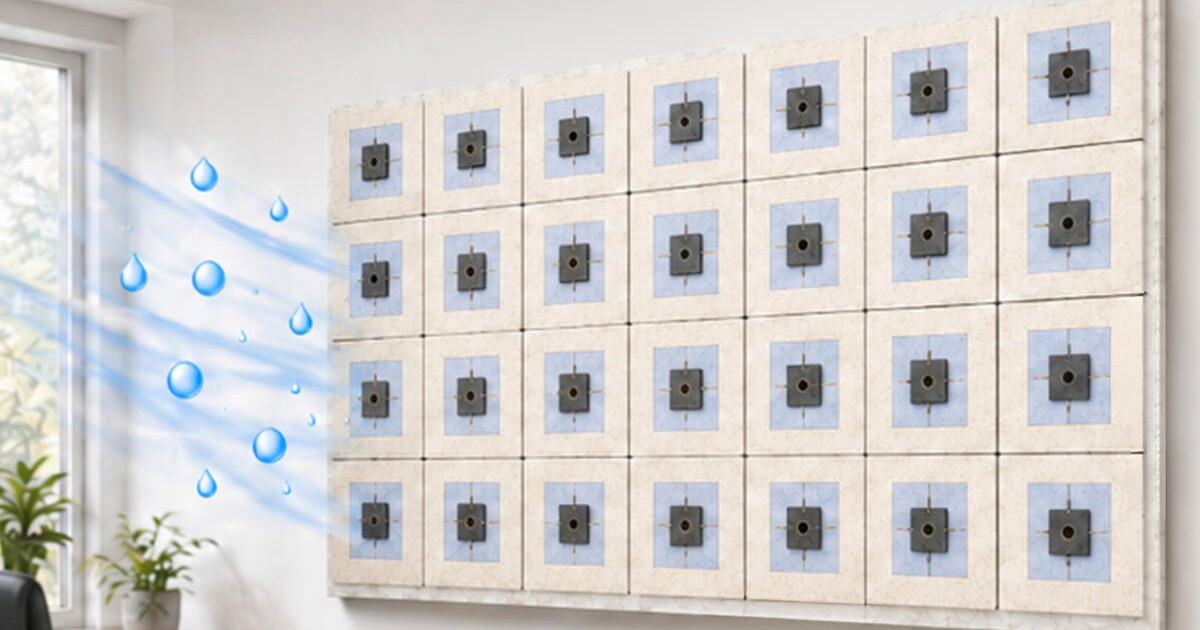
Rooftop solar panels power millions of homes around the world. But a team of researchers at Binghamton University is asking what happens if some of that electricity came from inside the house. Their answer is a study, described in Advanced Energy Materials, that turns indoor humidity into a small electric current.Drawing power from the air inside a home sounds almost impossible, but moist-electric generators do just that. These devices convert ambient humidity into electricity, and until now they've been aimed at the great outdoors, where they yield only microwatts (millionths of a watt) per square centimeter.Outdoors is also a rough place to work, since humidity, temperature, and wind swing unpredictably. "The problem is that it generates such small amounts of power, and the outdoor environment is not stable because of extreme sunlight or weather," says Seokheun Choi, who leads the team. "The good thing about an indoor environment is that it maintains a very constant humidity between 30 and 60 percent, and the occupants’ activities like respiration, cooking, and bathing generate additional moisture."The Binghamton team used lab-grade Whatman 3 MM paper, 340 µm (0.013 in) thick, rather than commercial wallpaper. To hide the wiring, connections run along the back. Laser-drilled holes 1 mm (0.04 in) wide, filled with silver paint, link the two faces. The process mixes wax printing, airbrushing, screen printing, and laser work, with no cleanroom needed. The team wants everything to be printable for mass production. How the paper moves moisture to make power and manage humiditySean Choi - Binghamton University The wallpaper is made up of 2 x 2-cm (0.8 x 0.8-in) squares of paper, each with three zones. The edge carries glycerol, a syrupy liquid that grabs water vapor from the air and turns it into liquid water inside the paper. The middle zone holds polyvinylpyrrolidone (PVP), a plastic-like material made of long-chain molecules. It holds water more tightly and has smaller pores, so capillary action (the effect that makes a paper towel soak up a spill) draws the liquid inward.The center is treated with wax. Think of a breathable rain jacket. The wax repels liquid water but keeps tiny pores, so vapor can still escape. Water therefore keeps flowing in at the edge and out through the center as vapor, and that steady flow is what generates the current.Chemical groups on the glycerol, cellulose, and PVP help water release protons (hydrogen ions). There are more at the edge than at the center, and this imbalance drives a current that graphite electrodes collect.For now, the output is modest. A single tile produced about 0.34 V at 80% humidity, and 10 in a row reached about 2.9 V. A 35-tile array ran a humidity sensor for about 15 minutes, and the biggest array, with 1,596 tiles, delivered 3.5 V at roughly 38% humidity. That was enough to run a wireless keyboard, with help from a capacitor, a small component that stores charge and releases it in bursts, although the study gives no total power figure for this wall version. A keyboard in the lab runs on power from the paper wallSean Choi - Binghamton University This paper also works as a humidity buffer, soaking up moisture and giving it back. In a sealed chamber measuring 30 x 30 x 15 cm (11.8 x 11.8 x 5.9 in), 28 tiles cut humidity from 75 to 50 percent in about four minutes. Once loaded with water, the paper raised dry air from 15 to 20 percent in about 16 minutes. In a room, the large array lowered humidity from 38 to 32 percent in 15 minutes, though that is only an early result, not proof of lasting capacity."We put a lot of energy into HVAC [heating, ventilation, and air conditioning] systems to remove moisture from the air, but if we use this concept, we could reduce or control moisture levels while also generating electricity," Choi says.The researchers acknowledge that this is still a proof of concept. The realistic goal, they say, is powering environmental sensors, wireless modules, and internet-of-things gadgets, not replacing the grid or solar panels. If durability holds up, a wall could become a self-powered sensor that also looks after the air in the room.Source: Binghamton University
Smart wallpaper turns your wall into a small indoor powerplant
Full Article
Original Source
Read the full article at Newatlas →KhanList aggregates and links to publicly available news content. We do not host full articles from third-party sources. Always verify important information with original sources.