
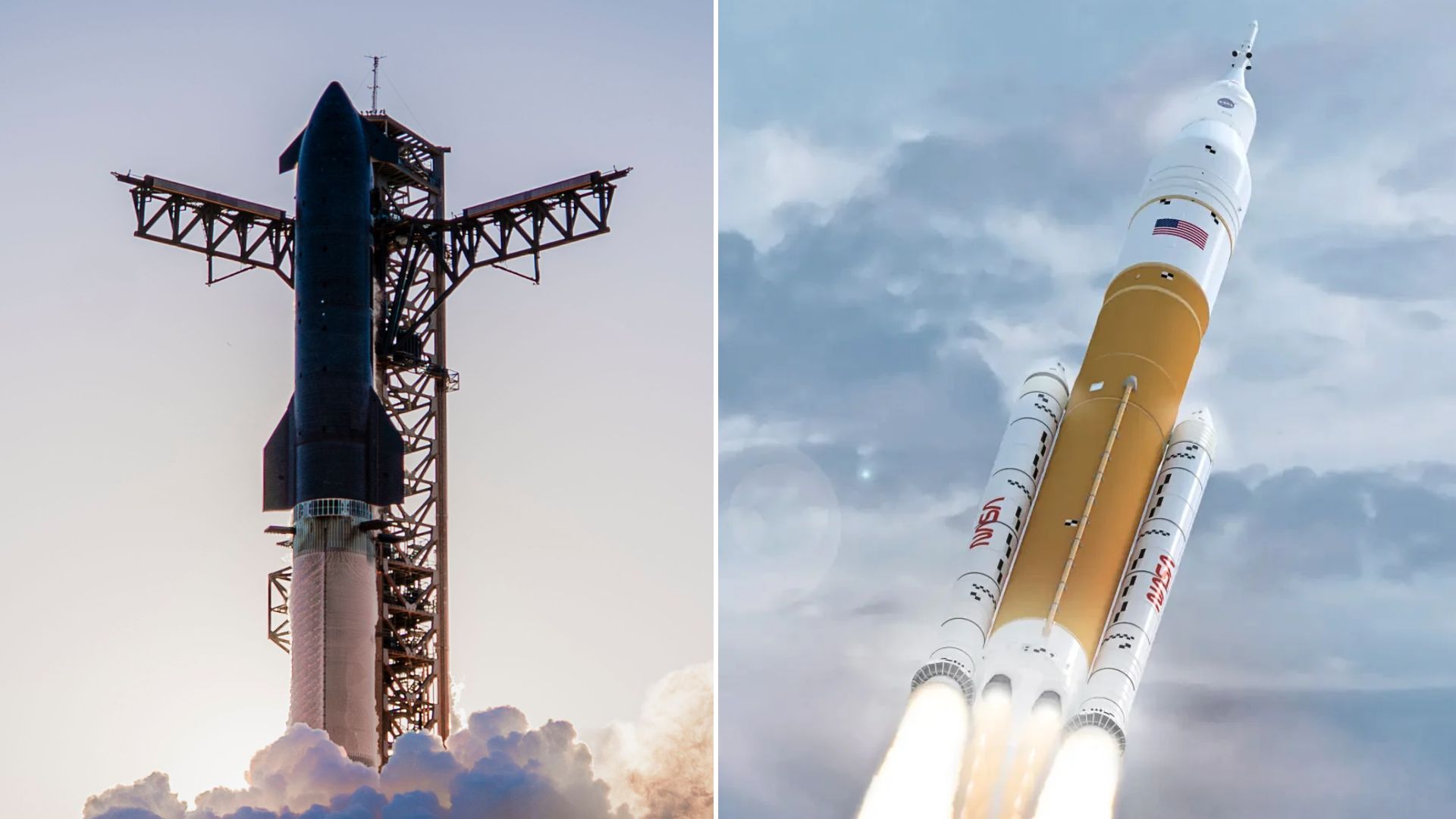
America’s return to the Moon relies on two radically different super heavy-lift launch vehicles: NASA’s Space Launch System (SLS) and SpaceX’s Starship. Though often framed as rivals, the two rockets are built on opposite engineering principles and play complementary roles in NASA’s Artemis program. SLS will carry astronauts aboard the Orion capsule toward lunar space, and a modified Starship will serve as a commercial Human Landing System (HLS) to ferry crews down to the lunar surface. Architecture, thrust, and propellant choices In its Block 1 configuration, NASA’s Space Launch System stands 322 feet (98 meters) tall and produces 8.8 million pounds (39.1 meganewtons) of maximum thrust at liftoff. This is roughly 15 percent more thrust than the Apollo-era Saturn V. Its orange core stage burns super-cold liquid hydrogen and liquid oxygen through four Aerojet Rocketdyne RS-25 engines, which are upgraded variants of the Space Shuttle Main Engine. Two flanking five-segment solid rocket boosters built by Northrop Grumman provide more than 75 percent of initial liftoff thrust during the first two minutes of flight before separating. SpaceX’s Starship, by contrast, is a 407-foot-tall (124-meter) stainless-steel stack measuring 29.5 feet (9 meters) in diameter. It is wider than the 27.6-foot (8.4-meter) SLS core. Powered by 33 Raptor engines burning sub-cooled liquid methane and liquid oxygen, the Super Heavy first stage generates up to 18.1 million pounds (8,240 metric tons-force) of thrust, more than double the liftoff power of SLS. Those propellant choices emphasize distinct engineering trade-offs. Liquid hydrogen offers high specific impulse, which means exceptional fuel efficiency per pound of propellant, making SLS well suited for injecting payloads directly onto a trans-lunar trajectory in a single launch. However, hydrogen’s ultra-low boiling point (−423°F / −253°C) and tiny molecular size make it prone to boil-off and seal leaks, as seen during pre-launch fueling tests. Methane is denser, easier to store cryogenically, and leaves minimal soot compared with kerosene, making it far more practical for rapid engine reuse and orbital refueling. Reusability, payload capacity, and launch economics The sharpest divide between the two vehicles lies in hardware recovery and cost. SLS is entirely expendable. After every flight, its solid booster casings, core stage, and four RS-25 engines fall into the ocean, driving per-launch costs to roughly $2 billion to $2.5 billion, excluding the Orion spacecraft. Starship is engineered for full and rapid reusability, with both the Super Heavy booster and the upper-stage spacecraft designed to return to the launch site for mid-air tower catches and turnaround flights. In low Earth orbit (LEO), SLS Block 1 can lift roughly 209,400 pounds (95 metric tons), while SpaceX targets 100 to 150 metric tons (roughly 220,000 to 330,000 pounds) for a fully reusable Starship. Beyond Earth orbit, however, their mission profiles diverge sharply. Because Starship’s upper stage carries heavy thermal protection tiles, landing hardware, and propellant tanks to orbit, it consumes nearly all its fuel just to reach LEO. To send a Starship lander to the Moon, SpaceX must first launch multiple orbital tanker flights to refill its propellant depots in Earth orbit. SLS requires no orbital refueling, sending up to 59,500 pounds (27 metric tons) directly toward the Moon on a single flight. Flight heritage and roles in the Artemis roadmap In operational maturity, SLS holds the lead for human-rated deep-space flight. Following its uncrewed Artemis I test in November 2022, SLS successfully launched four astronauts aboard Orion on the Artemis II lunar flyby on April 1, 2026, becoming the first rocket since Saturn V to carry humans beyond low Earth orbit. NASA has also standardized around the Block 1 architecture rather than pursuing costly Block 1B and Block 2 upgrades. Starship has progressed through rapid hardware iteration across more than a dozen integrated flight tests, demonstrating orbital velocity, payload deployment, and mid-air booster catches, though full orbital propellant transfer and human-rating certification remain ahead. Under NASA’s revised Artemis III architecture targeted for 2027, an SLS rocket will launch astronauts in Orion to rendezvous and dock in Earth orbit with test versions of both SpaceX’s Starship HLS and Blue Origin’s Blue Moon lander, paving the way for the Artemis IV lunar surface landing in 2028.Rather than one rocket replacing the other, America’s lunar strategy depends on pairing NASA’s conservative, single-launch crew carrier with SpaceX’s high-cadence, refuelable heavy lifter.Get the latest in engineering, tech, space & science - delivered daily to your inbox.Kaif Shaikh is a journalist and writer passionate about turning complex information into clear, impactful stories. His writing covers technology, sustainability, geopolitics, and occasionally fiction. A graduate in Journalism and Mass Communication, his work has appeared in the Times of India and beyond. After a near-fatal experience, Kaif began seeing both stories and silences differently. Outside work, he juggles far too many projects and passions, but always makes time to read, reflect, and hold onto the thread of wonder.
SLS vs. Starship: A technical breakdown of America’s two Moon rockets
Full Article
Original Source
Read the full article at Interestingengineering →KhanList aggregates and links to publicly available news content. We do not host full articles from third-party sources. Always verify important information with original sources.