
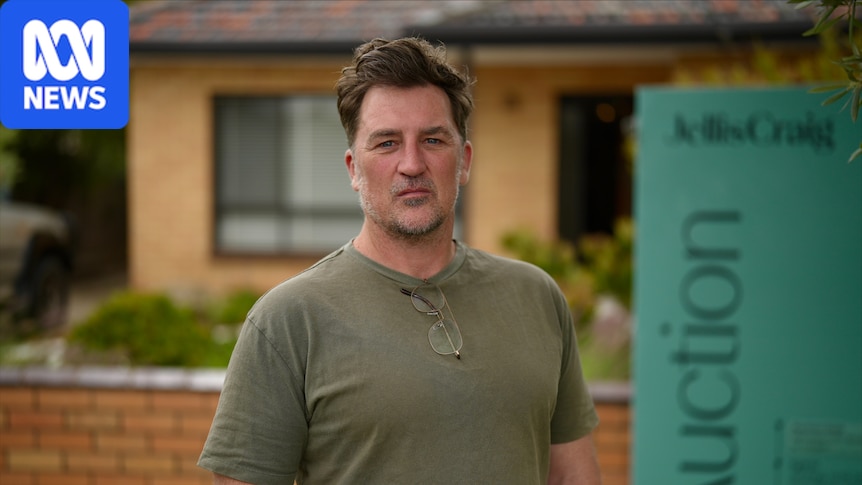
For Tom Kearney, the past two years have meant agonising uncertainty.He lost his job in advertising in February last year and hasn't been able to get full-time work since.He has been through four redundancies since 2019.After falling months behind on mortgage repayments, he put his home up for sale at the end of September, and signed the sale contract this week."It is bloody scary, it's really daunting, the idea of losing your home," he said."I've really held on as long as I can."Mr Kearney said his bank had allowed him to pause mortgage repayments for about five months, but he had not been able to make repayments since about June."It has been an absolute roller-coaster," he explained."I've been through the seven stages of grief and I've hit acceptance."But I have had rage. I have had sadness. I have had disbelief. I just can't believe what's happening."Mr Kearney had built up 17 years of experience in advertising, but like many other white-collar workers, he has been hit by a slowing economy and the rise of AI.Since the latest job loss in February, he said he had put in more than 100 job applications but only had three interviews.Mr Kearney fears things are going to get far worse as AI takes more jobs away."There are hundreds of me out there in the same boat really trying to get a crack back into the workforce," he said.'Collateral damage' the RBA expectedThe number of Australians losing their jobs is rapidly accelerating.The unemployment rate jumped to 4.9 per cent in October as the number of unemployed Australians grew by 17,800.Some also dropped out of the workforce, pushing the participation rate down. It is the highest unemployment rate in the post-COVID era, but the figure is tipped to rise further.The rise is also happening much faster than the Reserve Bank had been anticipating.Economists expect the central bank will keep interest rates on hold next month.Leonora Risse says Australians already feel like they are in a recession. (ABC News: Dean Caton)"It shows that the Reserve Bank's efforts to slow down the economy are working," Queensland University of Technology associate professor in economics Leonora Risse said."This is the collateral damage that it expected as it tries to contain inflation."Dr Risse said while Australia was not technically in a recession, for many Australians facing higher interest rates and cost-of-living pressures, it felt like they already were in one."The Reserve Bank is trying to tap the brakes on the economy to avoid the economy falling into a recession," she said."The problem is it can still very much feel like a recession when we see unemployment increase so quickly."Betashares chief economist David Bassanese said the latest jobs numbers showed the Australian economy "already has one foot in a recession" and that "could well mean we've seen the last interest rate hike" for a while. On Wednesday, retailer General Pants went into administration, placing 500 jobs in doubt.It follows the loss of about 1,500 roles at David Jones.From big retailers to banks to airlines and even tech companies, mass lay-offs are emerging.Corporate Australia is undergoing a restructure and investing in AI while some companies are sending jobs offshore.Experts speculate companies might be looking to ultimately replace those offshore jobs with AI."That could be a financial strategy for some companies," Dr Risse said."Businesses and employers [need] to be more transparent about the reasons why they're restructuring or they're relocating their workforce."What becomes of workers replaced by AI?Dr Risse said the country was now at a place where the unemployment rate could soon tip over the 5 per cent mark."There's still a lot more shifting in the economy to come in terms of that structural change where people are moving out of jobs that are being affected by AI," she said.Mr Kearney is still looking for a job.He said one of the issues not being properly debated, as AI took more jobs, was what happened to people like him.These were people who had built up years of experience in their field, and who now, in their 40s, 50s and beyond, might have to turn to a completely new profession."I don't think things are going to turn to pre-COVID times ever," Mr Kearney said."I think we're going to see mass unemployment within the next five to 10 years. I don't think there's enough time for people to pivot."You know, at my age, like 40s, what do I pivot into? I was thinking about the police force. Do I get into construction at 50 years of age? "What are all these white-collar people going to pivot into … if their jobs are getting superseded by AI and outsourcing to other countries? "How are they even going to pay their mortgages and their rents?"This is the question we need to be really looking at now."
Slowing economy and rising AI create new generation of unemployed
Full Article
Original Source
Read the full article at Abc →KhanList aggregates and links to publicly available news content. We do not host full articles from third-party sources. Always verify important information with original sources.